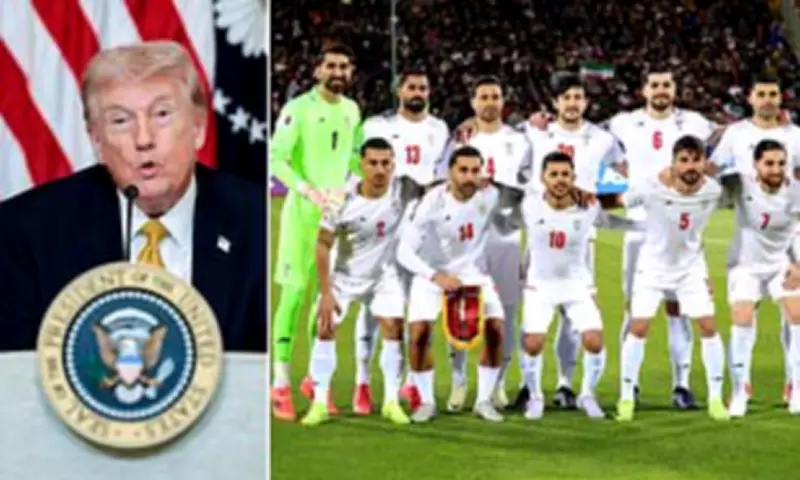
Iran has confirmed it is engaged in active discussions with FIFA regarding the potential relocation of its World Cup matches away from the United States. This development follows a public warning issued last week by former US President Donald Trump, who cautioned the Iranian national team against travelling to America for the tournament.
Safety Concerns Prompt Diplomatic Moves
The Iranian Football Federation, led by President Mehdi Taj, is formally requesting that its scheduled group stage fixtures be held in Mexico instead. The Iranian embassy in Mexico publicly stated this preference on Monday, although FIFA is reportedly hesitant to reschedule matches with less than one hundred days remaining until the competition begins.
'When Trump has explicitly stated that he cannot ensure the security of the Iranian national team, we will certainly not travel to America,' Mehdi Taj declared in a widely circulated statement. 'We are currently negotiating with FIFA to hold Iran's matches in the World Cup in Mexico.'

Political Tensions Escalate Uncertainty
Doubts over Iran's participation have intensified significantly since the outbreak of conflict involving the United States and Israel. Last Thursday, Donald Trump addressed the situation directly on his Truth Social platform.
'The Iran National Soccer Team is welcome to The World Cup, but I really don't believe it is appropriate that they be there, for their own life and safety,' Trump wrote, concluding his post with, 'Thank you for your attention to this matter! President DONALD J. TRUMP.'
These remarks came just one day after President Taj appeared to confirm a total boycott of the tournament. This stance followed US and Israeli military strikes that resulted in the death of Iran's supreme leader and triggered a series of retaliatory attacks.
Official Statements Signal Withdrawal Threat
Iran's Sports Minister, Ahmad Donyamal, reinforced this position during a televised interview, stating unequivocally that 'no conditions exist under which we can participate' and there is 'no possibility' of Iranian involvement in the World Cup.
'Since this corrupt government assassinated our leader, we have no conditions under which we can participate in the World Cup,' Donyamal explained via RTE. 'In view of the malicious measures taken against Iran, two wars were forced upon us within eight or nine months, and several thousand of our people were killed. Therefore, we definitely have no possibility of participating in this way.'
When questioned by Politico the previous week about Iran's potential participation, US President Trump responded dismissively, saying, 'I really don't care.'
Logistical Challenges and Tournament Impact
Iran is slated to compete in Group F against New Zealand, Belgium, and Egypt during June. Their initial two matches are scheduled for SoFi Stadium in Los Angeles, with the third fixture set for Seattle, Washington.
Although the 2026 World Cup is officially co-hosted by Mexico, Canada, and the United States, the overwhelming majority of games are planned for American venues. Should Iran progress from the group stage into the knockout rounds, it is highly probable they would subsequently be required to play matches within the United States.
Potential Historic Withdrawal
An official withdrawal by Iran would represent the first such occurrence in the modern era of the FIFA World Cup. This scenario would force FIFA into the urgent and complex task of identifying a suitable replacement team at short notice.
The Asian Football Confederation (AFC) addressed the situation on Monday, confirming it had received no formal notification of Iran's intention to withdraw from the event.
'At the end of the day, it's the federation who should decide if they're playing, and as of today, the federation has told us that they are going to the World Cup,' AFC General Secretary Windsor John told Reuters.
The ongoing negotiations between Iranian officials and FIFA, coupled with the escalating geopolitical tensions, create a precarious situation for tournament organisers as the start date rapidly approaches.