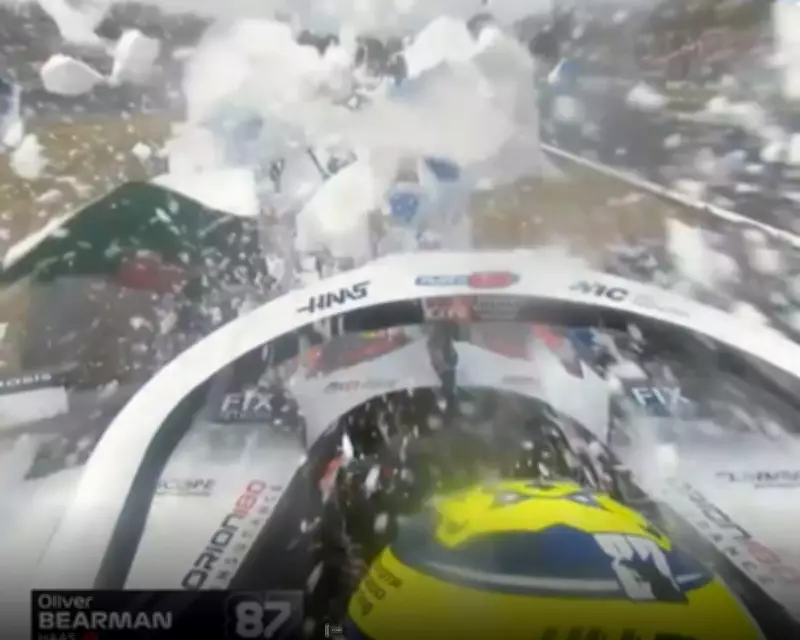
F1 Grapples with Safety Crisis Following Bearman's Dramatic Suzuka Escape
Oliver Bearman's emergence unharmed from a massive accident at the Japanese Grand Prix is being hailed as a fortunate escape. Formula One now finds itself with a critical five-week window before the next race in Miami to tackle a deeply complex safety issue. The sport will require every minute of this time to devise effective solutions.
The Incident That Sparked Concerns
Bearman's Haas car was travelling at an astonishing 307 kilometres per hour when he was forced to veer off the track. This sudden manoeuvre was necessary to avoid the slower-moving Alpine of Franco Colapinto. The closing speed between the two vehicles was a terrifying 50 kilometres per hour, a scenario that had been predicted by many experts even before the season commenced.
The root cause lies in the deployment and recovery of electrical energy, which has become integral to modern Formula One. Bearman was utilising his boost mode, while Colapinto was in the process of recovering energy, resulting in a significant speed differential. There was no malicious intent involved; Colapinto maintained a defensive line through the right-hand curve approaching Spoon corner without cutting across. Bearman simply approached at such a high velocity that swerving off the track was his only option to avoid a collision.

After leaving the track, Bearman impacted the barriers with a force of 50G. Remarkably, he sustained only minor bruising, although his car was utterly destroyed. Haas team principal Ayao Komatsu described the outcome as a lucky escape, a sentiment echoed throughout the paddock. Had Bearman collided with the rear of Colapinto's car, the potential for a far more violent crash, possibly involving a catastrophic launch into the air, was very real.
Circuit Safety Under Scrutiny
Williams driver Carlos Sainz pointed out that the location of the crash at Suzuka was fortuitous. The circuit features wide spaces and ample run-off areas, which allowed Bearman some room before hitting the barriers. Sainz raised a pertinent question: what would have been the outcome on high-speed circuits like Baku, Singapore, or Las Vegas, where walls are positioned mere feet from the track instead of grass and gravel?
This criticism is not new and has been voiced repeatedly throughout the current season. The governing body, the FIA, has acknowledged these concerns. They have been diligently monitoring and assessing all aspects of the new regulations, with a particular focus on safety implications. The cancellation of the Bahrain and Saudi Arabian Grands Prix, coupled with the five-week gap until Miami, provides a crucial window for comprehensive analysis and discussion.
The Complexity of Finding Solutions
McLaren team principal Andrea Stella offered a sobering assessment, stating that a simple solution does not exist. Komatsu echoed this view, emphasising the need for calm, collective discussion within the Formula One community. The complexity stems from the interconnected nature of the new engine regulations. Alterations in one area inevitably affect others, and each engine manufacturer has its own vested interests, though these are likely to be set aside when safety is at stake.
At the core of the issue is the management of electrical energy, a topic that has divided opinion within the sport. Proposals have been made to adjust how much energy can be recovered during super-clipping, but such changes could result in slower cars. The current settings were initially established to minimise speed differentials. Conversely, some argue that allowing a higher recovery rate might reduce the need for drivers to lift and coast, a practice that can create even greater disparities in speed between cars.

The cause-and-effect relationships are labyrinthine, compounded by the fact that teams employ diverse strategies for energy management. Simply increasing the power output of the internal combustion engine while reducing the role of hybrid energy is not a straightforward fix. Shifting the power distribution from the current near 50-50 split to, for example, 70-30 would necessitate increased fuel flow, larger fuel tanks, and a complete redesign of the cars. Furthermore, such a change might not gain consensus, as the existing formula was designed to attract engine manufacturers like Audi and Honda. Any major regulatory shift is unlikely to be implemented before the next season at the earliest.
A Unified Effort Amidst Pressure
There is, however, a genuine consensus and determination to address these safety concerns, especially in the wake of Bearman's crash. The competitive atmosphere of Formula One is now being channelled into a collaborative focus on this critical issue. The challenge is that the sport must adapt in real-time as the season progresses, with each race presenting new tests. The pressure to implement correct solutions is immense, as the community cannot afford to rely on further lucky escapes.