AI Study Reveals UK's Most Confusing Accents: Essex Tops List
From the friendly Geordie twang to the distinctive Edinburgh lilt, the United Kingdom boasts some of the world's most recognizable regional accents. Now, groundbreaking research has identified which of these accents prove most challenging for automated systems to comprehend.
Methodology: Testing AI Against Famous Voices
Language learning specialists at Preply conducted an innovative study, analyzing short television and radio clips featuring celebrities with strong regional accents. These audio samples were processed through advanced speech-to-text systems, with researchers meticulously counting transcription errors and misheard words.
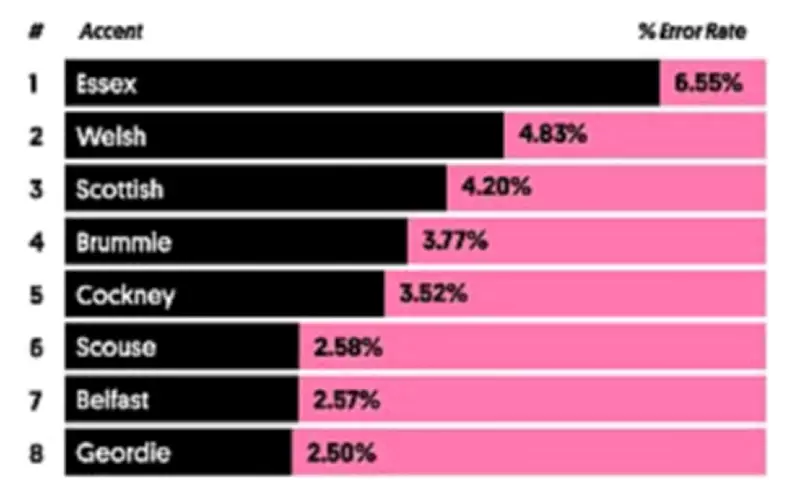
The results delivered surprising news for reality television stars from The Only Way Is Essex, including Gemma Collins and Joey Essex. Their distinctive Essex accents generated the highest error rates, confusing artificial intelligence systems more than any other British dialect.

Why Essex Accents Challenge Technology
"TOWIE became famous for its dramatic delivery and unique catchphrases like 'reem,' 'well jel,' and 'muggy,'" explained Yolanda Del Peso Ramos, Preply's spokesperson. "While instantly recognizable to fans, these expressions aren't widely used across Britain, creating confusion for unfamiliar listeners and AI alike."
Beyond vocabulary, the Essex accent's distinctive pronunciation patterns contribute significantly to comprehension difficulties. Speakers frequently employ strong vowel shifts that make words like 'face' and 'price' sound remarkably similar. Additionally, consonant dropping eliminates 't' and 'h' sounds from certain words, while the glottal stop—common in words like 'bottle' and 'water'—further complicates automated interpretation.
"These linguistic characteristics help explain why both human listeners and artificial intelligence tools struggle to accurately interpret the Essex accent," Ms. Ramos elaborated.
Regional Accent Rankings: From Confusing to Clear
Following Essex as Britain's most challenging accents are Welsh and Scottish dialects, with error rates of 4.83 percent and 3.2 percent respectively. Both accents feature pronunciation patterns shaped by strong cultural identities that differ markedly from standard international English.
Scottish speakers like Lewis Capaldi and Ewan McGregor utilize strongly rolled R's, shortened vowels, and rapid delivery that non-UK listeners find particularly difficult. Similarly, the Welsh accent employs distinctive rhythms and vowel sounds unfamiliar to many British residents.
"These differences don't always align with standard British pronunciation," noted Ms. Ramos. "That explains why both listeners and AI systems struggle with accuracy when encountering these accents."
Northern Accents Prove Surprisingly Clear
In a surprising discovery, the research revealed that AI transcription systems comprehend Northern regional accents remarkably well. The Mancunian accent—exemplified by musicians Liam and Noel Gallagher—proved easiest to understand despite recently being voted Britain's "least sexy accent" in a separate poll.
This was closely followed by the Yorkshire accent, with speakers like actor Sean Bean generating minimal error rates of just 2.11 percent. Geordie accents, represented by reality star Charlotte Crosby, produced only 2.5 percent errors, while the famously thick Liverpudlian Scouse accent resulted in just 2.58 percent transcription mistakes.
Individual Variations Within Accents
The study also uncovered significant variation among speakers sharing the same regional accent. UFC fighter Paddy "The Baddy" Pimblett proved more comprehensible than most Scousers, with his clips generating merely two percent errors. Conversely, Liverpool legend Cilla Black proved particularly challenging for AI systems, which misheard 5.16 percent of her words.
Broader Implications for AI Development
These findings emerge as researchers from the University of Sheffield attempt to teach artificial intelligence local slang terms. With councils across Britain increasingly deploying AI for telephone services, systems often struggle to understand Midlands and Northern English speakers.

Experts hope that incorporating regional vocabulary like "chuck," "canny," and "nowt" into AI training will prevent automated services from unfairly disadvantaging citizens with strong regional accents, ensuring equitable access to digital public services nationwide.