ChatGPT Users in US Confused by Unexpected Arabic Text in AI Replies
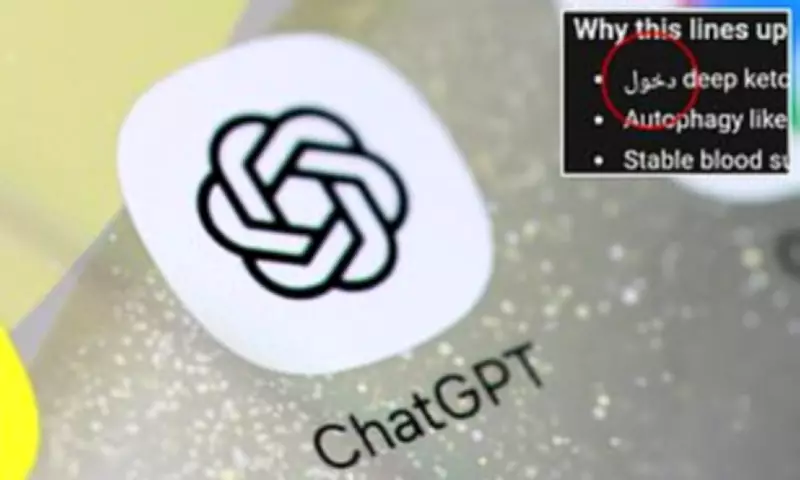
American users of ChatGPT have been left perplexed by a recent and unexplained surge in AI-generated responses containing Arabic text. Over the past month, numerous English-speaking individuals across the United States have encountered this bizarre phenomenon, sharing screenshots on social media platforms that show their conversations with the popular chatbot suddenly incorporating Arabic characters.
Social Media Flooded with Reports of Multilingual Mix-Ups
One Reddit user expressed their confusion, stating, 'It did it twice on my phone, and once on my work laptop, I'm not even in an Arabic-speaking country.' This individual shared an image demonstrating how ChatGPT began listing recipe ingredients in Arabic approximately two weeks ago. Other users have reported similar issues, noting that numbers were converted to Arabic numerals and that the AI occasionally responded in Armenian, Hebrew, Spanish, Chinese, and Russian to English prompts.
While some initially attributed these strange outputs to AI hallucinations—instances where chatbots produce factually incorrect or nonsensical information—the root cause appears to be more technical. The problem stems from how ChatGPT processes language through a system of tokens rather than reading complete words like humans do.

Understanding the Token-Based System Behind ChatGPT
ChatGPT, developed by artificial intelligence company OpenAI in 2022, operates as a large language model (LLM) that breaks text into small pieces called tokens. These tokens can represent:
- Complete words such as 'hello'
- Parts of words like 'un-' or '-ing'
- Punctuation marks
- Short words or phrases from foreign languages
For example, the word 'understanding' might be divided into three separate tokens: 'under,' 'stand,' and 'ing.' The AI model selects the most probable next token based on its training data, which includes billions of words from multiple languages. Because some foreign words are shorter and require fewer tokens to process, ChatGPT may occasionally choose them if they fit the context efficiently.
Historical Context and Company Response
OpenAI has previously addressed language-related issues with ChatGPT. In 2024, users reported widespread incidents of 'gibberish' generation caused by an internal token-mapping error during a model update. However, the company has not made recent announcements specifically addressing the current language mixing errors and unexpected Arabic responses to English prompts.
Social media users have noted that the inserted foreign words are not random gibberish. In most cases, the Arabic text carries the same meaning as the English word it replaces. One Reddit user explained regarding the recipe incident, 'The word means low. So it looks like it's missing a word. Possibly low-fat yogurt.'
User Reactions and Speculation
Some affected users have expressed skepticism about the randomness of these errors. One longtime AI user stated, 'This is the first time it did this, and I [have been using] AI for years now. It cannot be a random mistake.' Another individual shared a conversation where ChatGPT claimed an Arabic word 'slipped in' by mistake, to which the user responded incredulously, 'Brother, I am speaking English. Why are you responding in Arabic?... SLIPPED IN??? It's a whole different alphabet.'
Despite these user concerns, the technical explanation remains centered on token efficiency. ChatGPT, which reportedly serves nearly 900 million users monthly, continues to dominate the AI chatbot market with approximately two-thirds industry share, competing with alternatives like Google's Gemini, xAI's Grok, and Anthropic's Claude.
The AI's ability to generate human-like text for essays, explanations, stories, translations, and problem-solving has made it immensely popular. Yet this recent language mixing phenomenon highlights the complexities of large language models and their occasional unpredictable outputs when processing multilingual training data through token-based systems.