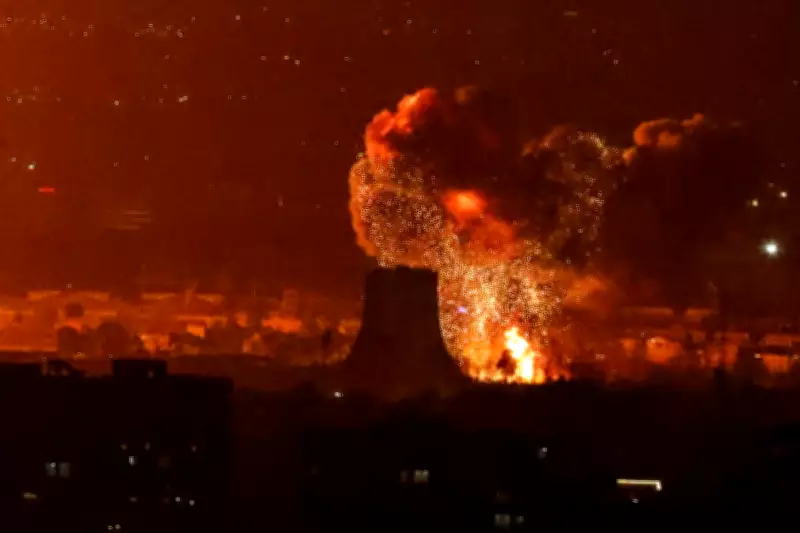
Smartphone Era Transforms Iran Conflict into Digital Game Show
As the military confrontation between Iran, the United States, and Israel enters its second week, a disturbing digital phenomenon has emerged. The internet has become flooded with misinformation and doctored content while cryptocurrency platforms enable punters to wager millions on the conflict's outcome. Experts warn that this represents a frightening new paradigm for experiencing warfare—one that appears here to stay.
White House Blurs Reality with Call of Duty Montage
In a striking example of this new reality, the White House itself posted a video that mixed authentic footage of US fighter jets launching strikes in Iran with animation from the popular video game Call of Duty: Modern Warfare III. The clip featured an animated character ordering a nuclear airstrike via tablet before transitioning to real military operations set to a Childish Gambino instrumental. Viewed over 50 million times on X, this official content stood in stark contrast to the tragic human cost unfolding across the region.
That same week, military investigators indicated US forces might be responsible for a strike on an Iranian girls' school that killed scores of young children. According to the Red Crescent, more than 1,300 people have died in Iran since hostilities began, while the US has lost six soldiers to retaliatory attacks. Yet these grim realities compete for attention with memes, entertainment, and speculative betting in the modern social media ecosystem.

Prediction Markets Monetize Geopolitical Violence
As war engulfs the Middle East, online platforms like Polymarket have enabled users to bet hundreds of millions of dollars on the conflict's progression. What began as markets for sports and stocks has expanded into precarious geopolitical wagering, with people trading on everything from Iran's next supreme leader to the timing of specific military strikes.
Polymarket issued a statement defending its role, claiming prediction markets "harness the wisdom of the crowd to create accurate, unbiased forecasts" during "gut-wrenching times." However, this expansion has raised serious concerns about insider trading and ethical boundaries. A user known as Magamyman reportedly made over $553,000 betting on Polymarket about Ayatollah Ali Khamenei's fate more than an hour before news of his death became public.
Neil Shearing of Chatham House's Global Economics & Finance Programme warns: "They are not regulated in the same way that financial markets are regulated, and that brings with it some risks. It does leave them open to potential insider trading." Democratic representative Mike Levin has called for Congressional investigation into these allegations.
AI-Generated Content and Verification Failures
Meanwhile, AI-generated videos depicting the conflict spread rapidly across social platforms, while established verification tools struggle to keep pace. NewsGuard Reality Check recently warned that Google's reverse-image tool—widely used to verify visual content—was "producing inaccurate AI-generated summaries of fabricated and misleading visuals tied to the US-Iran conflict."
In one documented instance, Google's AI Overview repeated disinformation about a purported CIA building strike in Dubai, despite the video actually showing a residential fire in Sharjah from 2015. This erosion of reliable verification mechanisms occurs alongside official channels adopting meme culture. The White House recently released a video splicing drone strike footage with a Spongebob meme asking "want to see me do it again?" on repeat.
Historical Context and Human Cost
Iain Overton, director of Action on Armed Violence, contextualizes this development: "We're witnessing drone feeds that show the last moment of a person's face up close as they're killed in a trench in Ukraine or very graphic scenes coming out of Gaza. We have an intimacy of war that we've never witnessed before."

Overton traces this evolution back to the 1990 Gulf War, when "grainy feeds of death" first appeared on evening news via military press releases. Today, unfiltered battlefield footage circulates freely on smartphones, creating what he describes as unprecedented granular visibility into violence. "People are able to watch war close up on the phone in their living room," he notes, while warning about the ethical implications of profiting from conflict.
As misinformation and AI-generated content continue spreading, experts fear they will distort public understanding of the war while blinding a generation to suffering beyond their screens. The convergence of entertainment, speculation, and violence creates what Overton calls a fundamental challenge to "our relationship between profit and human dignity."