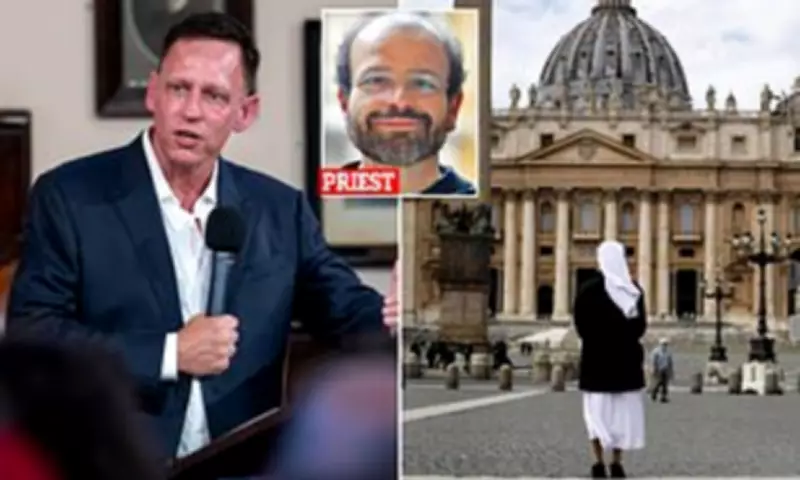
Peter Thiel's Controversial Rome Lectures on Biblical Antichrist Draw Vatican Condemnation
MAGA billionaire and tech mogul Peter Thiel has ignited a firestorm of controversy in Rome by hosting a clandestine four-part lecture series warning that the Antichrist is imminent and will usher in a tyrannical 'one-world' government. The 58-year-old PayPal co-founder's secretive conference, titled 'The Biblical Antichrist', began on Sunday and is scheduled to conclude on Wednesday, attracting approximately one hundred guests including Italian businessmen, politicians, and American priests.
Vatican Backlash and Accusations of Heresy
Thiel's lectures have provoked significant pushback from Italian Catholic authorities and Vatican circles. Prominent Italian Catholic priest Paolo Benanti, who previously advised Pope Francis on artificial intelligence matters, penned a scathing essay titled 'American heresy: Should we burn Peter Thiel?' in which he described Thiel's theological framework as both disturbing and structured.
Benanti argued that Thiel's interpretation of the Antichrist constitutes outright heresy, writing: 'In other words: either a global technocratic regime imposing salvation by falsehood, or total annihilation.' The criticism extended to Avvenire, a newspaper owned by the Italian bishops' conference, which branded Thiel 'the heart of darkness of the digital world' and accused him of advocating for 'absolute power managed by technocrats supported by artificial intelligence.'

Thiel's Apocalyptic Vision and Global Governance Fears
According to reports from The New York Times, Thiel has expressed concerns for months about what he perceives as an imminent threat from 'occult forces [that] are ceaselessly at work, intent on destroying what remains of the West.' The Palantir chairman has articulated a vision where the Antichrist manipulates humanity by promising solutions to contemporary existential threats while gradually eroding individual rights and freedoms.
Thiel specifically identified artificial intelligence, environmental crises, and bioweapons as potential pathways through which this apocalyptic scenario could unfold. Rather than envisioning the Antichrist as a single individual, Thiel suggested it might manifest as a centralized global government that systematically strips away personal liberties under the guise of addressing existential risks.
'I would say the default political solution people have for all these existential risks is one-world governance,' Thiel told The New York Times in June, adding that his specific fear revolves around a 'one-world totalitarian state.' He predicted that the Antichrist would 'talk about existential risk' incessantly while pushing for widespread regulations that effectively create centralized control.
Venue Controversy and Previous Lectures
The lecture series was originally scheduled to take place at the Pontifical St. Thomas Aquinas University, known as the Angelicum, where Pope Leo XIV (then Robert Prevost) wrote his canon law doctoral thesis. However, the university publicly distanced itself from Thiel's event following the mounting criticism in Italy, issuing a statement clarifying: 'We would like to clarify that this event is not organized by the University, will not take place at the Angelicum, and is not part of any of our institutional initiatives.'
This marks Thiel's third major lecture on the Antichrist theme, following similar talks in Paris this January and in San Francisco last year, though those earlier events drew considerably less pushback. During his approximately two-hour opening lecture in Rome, Thiel addressed artificial intelligence specifically, stating: 'It's not the solution to all evils. But it shouldn't be demonized.'
Thiel's Characterization of the Antichrist
In a surprising comparison, Thiel suggested that the Antichrist was 'far more likely' to resemble climate activist Greta Thunberg than a stereotypical 'evil tech genius' like Dr. Strangelove from the 1964 black comedy film. He argued that contemporary political resonance comes from calls to halt scientific progress rather than from revolutionary inventions.

'People are way too scared for that,' Thiel explained. 'In our world, the thing that has political resonance is the opposite. The thing that has political resonance is: We need to stop science. We need to just say "stop" to this.' When questioned whether he or his company Palantir might represent the very concerns he warns against, Thiel dismissed the notion, stating: 'I obviously don't think that that's what I'm doing.'
Organizational Background and Political Connections
The controversial lecture series was jointly organized by the Vincenzo Gioberti Cultural Association in Italy and the Cluny Institute at the Catholic University of America in Washington DC. The Italian organization described hosting Thiel as a 'special honor and a gift of providence,' praising him as 'one of the most original thinkers of our time' while acknowledging his nickname as the 'heart of darkness of Silicon Valley.'
Thiel, whose net worth is estimated at $23.7 billion, maintains significant political influence through his close relationship with US Vice President JD Vance, having donated millions to Vance's successful primary race for the US Senate. His company Palantir recently signed an agreement with US Immigration and Customs Enforcement to streamline identification and deportation processes, further cementing his controversial profile in both technological and political spheres.