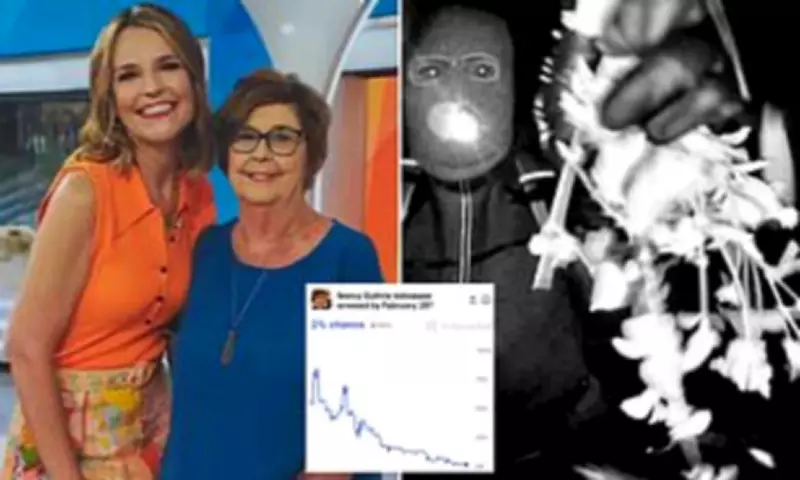
Lawmakers are under mounting pressure to intervene after revelations that a prominent betting platform is enabling users to place wagers on the disappearance of 84-year-old Nancy Guthrie. Polymarket, a prediction market, has created a live gambling contract tied to the active missing-person case, allowing bets on whether her alleged kidnapper will be arrested by Saturday, February 28.
Ethical Outrage and Financial Stakes
Over $188,000 has been staked on the outcome so far, nearly double the $100,000 FBI reward offered for information in the search for the elderly mother of Today show host Savannah Guthrie. Evan Nierman, founder and CEO of global crisis PR firm Red Banyan, expressed disgust, telling the Daily Mail, "Betting about the outcome of an elderly woman's kidnapping is stomach turning and insensitive. Even if you think prediction markets are useful in other contexts, for most people this instantly crosses a bright red line."
Nierman called for updated laws around prediction markets, warning, "There is also real danger that deranged people may be incentivized to commit crimes with the hope of profiting from prediction markets." As of Thursday, Polymarket traders were pricing the chance of an arrest by February 28 at just 2 percent, down sharply from a 57 percent peak earlier this month.

How Polymarket Operates
Polymarket differs from traditional sportsbooks by allowing users to bet against each other rather than against the company. Users buy and sell shares tied to specific outcomes, with prices ranging from $0 to $1. The price reflects the crowd's perceived chance of that outcome; for instance, a 60-cent price implies roughly a 60 percent likelihood. If the outcome occurs, holders are paid $1 per share; if not, shares expire worthless. Market prices fluctuate based on supply and demand as traders take positions.
Regulatory Gaps and Insider Trading Concerns
Prediction markets like Polymarket and rival Kalshi have surged in popularity, enabling bets on everything from elections to military actions, but they frequently court controversy. This week, Kalshi suspended and fined Artem Kaptur, an editor for YouTube star MrBeast, for insider trading after he placed unusually accurate bets tied to MrBeast video outcomes using non-public information. Kalshi banned him for two years, fined him $20,000, and reported the case to federal regulators.
In a separate incident, Kalshi suspended and fined Kyle Langford, a former candidate for California governor, for insider trading violations, referring the matter to regulators. Legal and industry analysts highlight that these cases, combined with bets on Guthrie's disappearance, expose the light regulation of such platforms.
Expert Warnings on Perverse Incentives
Daniel O’Boyle, senior analyst at InGame Intel, told the Daily Mail, "There is nothing stopping platforms offering bets on crimes and kidnappings, as Polymarket is, because they’re unregulated. They don’t have a responsible trading page, they don’t ban insiders, they don't have know-your-customer checks, so they’re not even sure when someone is an insider, they just have a house rule against market manipulation."
O’Boyle added, "Aside from the general ethical question of whether it is right to be able to bet money on a subject like this, it also risks creating perverse incentives, where people interfere in the case. Law enforcement could make decisions that compromise an investigation because of the existence of a market like this."
Braden Perry, a litigation, regulatory and government investigations attorney, echoed these concerns, stating, "Prediction markets don’t just reflect reality - they can influence it. If traders stand to profit from escalation or delay, that raises real moral hazard concerns. Even the perception of that risk is corrosive when public safety and interests are involved."
Public Backlash and Historical Precedents
The public has reacted with horror to the bets on Guthrie's case. One user on X declared, "Anyone making wagers on a woman's life is a demon," while another wrote, "This seems so very morally wrong and unethical." A third commented, "This is crazy. We're going to have people kidnapping people to rig their bets."

Historical incidents underscore the risks. In January, an anonymous user turned a $32,000 bet into over $400,000 by correctly predicting Venezuelan president Nicolás Maduro would be captured, with most trades occurring hours before a surprise US operation. Earlier this month, an anonymous account created just before the Super Bowl placed nearly $70,000 in wagers on halftime-show markets, earning roughly $17,000 in profit with near-perfect accuracy.
Platform Responses and Enforcement Efforts
Kalshi addressed the insider trading cases in a statement. Bobby DeNault, who leads Kalshi's enforcement efforts, said in a post, "No financial exchange is immune from bad actors. Not stock exchanges, not banks, not prediction markets. We're committed to deterring and finding the bad actors, manipulators, and those who willingly cheat." Kalshi reported launching over 200 investigations into potential rule violations in the past year, with at least a dozen becoming active cases.
The Daily Mail has reached out to the Pima County Sheriff's Department and representatives for the Guthrie family for comment. The controversy highlights urgent calls for regulatory updates to prevent exploitation of sensitive cases through prediction markets.