Sole Survivor Files Lawsuit Against Tesla Following Fatal Cybertruck Crash
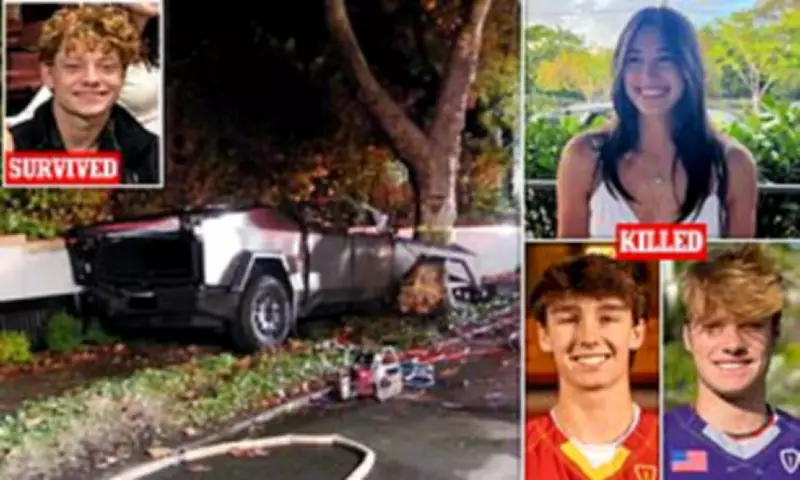
The only survivor of a devastating Tesla Cybertruck crash that claimed the lives of three wealthy college students has initiated legal action against the electric vehicle manufacturer. Jordan Miller, aged 21, alleges that a critical design flaw in the truck prevented his escape from the burning wreckage following a high-speed collision in Piedmont, California, during Thanksgiving 2024.
Details of the Tragic Incident
Miller was seated in the passenger seat alongside three friends when the Cybertruck, driven by 19-year-old Soren Dixon, struck a tree at excessive speed and erupted into flames. The crash resulted in the deaths of Dixon and two other passengers: Krysta Tsukahara, 19, and Jack Nelson, 20. All four individuals were Piedmont High School graduates who had returned home from college for the holiday break.
Miller's rescue was only possible due to the swift actions of a friend who witnessed the accident. This individual, who had been driving behind the group, immediately intervened by breaking the front passenger window with a tree branch and extracting Miller from the inferno. Despite this heroic effort, the other occupants could not be saved as the fire rapidly consumed the vehicle.

Severe Injuries and Allegations Against Tesla
The survivor endured catastrophic injuries, including a five-day medically induced coma, severe burns to his airways and lungs, major abdominal surgery, four fractured vertebrae requiring spinal fusion, third-degree burns on his left leg and hand, extensive skin grafts, and significant burn debridement procedures.
Miller's legal team from The Veen Firm announced the lawsuit on Tuesday, asserting that the Cybertruck's design trapped occupants inside during the fire and obstructed rescue attempts. The complaint specifically targets the vehicle's door handles, which rely on electronic buttons powered by a low-voltage electrical system. According to the filing, these mechanisms failed to function after the impact.
'A friend was right there within seconds. He couldn't open the doors,' stated attorney Annie Wu. 'No handles. The buttons weren't working. Jordan was trapped in a burning vehicle when he didn't have to be. That is a design problem.'
Legal Claims and Broader Context
The lawsuit accuses Tesla of negligence, design defect, failure to warn consumers, and failure to issue recalls. It further alleges that the company has been aware of the risk of occupants becoming trapped in its vehicles for over a decade.
Attorney Anthony Label emphasized the gravity of the design choice: 'When you design a vehicle with no mechanical way to open the doors from the outside, you are betting the electronics will work in every scenario, including a high-speed crash followed by a fire. Someone was there to help immediately. He couldn't get in. This lawsuit is about what Tesla knew and what Tesla designed.'
Separate lawsuits have also been filed by the families of Tsukahara and Nelson. Tesla has not responded to requests for comment from Daily Mail, KRON4, or other media outlets regarding the allegations.
Investigation Findings and Contributing Factors
The California Highway Patrol's preliminary investigation determined that the crash resulted from a combination of alcohol intoxication, drug impairment, and unsafe speeds. Autopsy reports revealed that Dixon had a blood alcohol concentration of 0.195—more than twice the legal limit—along with cocaine in his system. Tsukahara and Nelson also tested positive for cocaine, with blood alcohol levels of 0.028 percent and 0.168 percent, respectively.
According to witness statements, the group had been attending a small party before the accident. The witness who rescued Miller described the harrowing scene: 'I saw a car on fire wedged between a wall and a tree. I instantly knew by the tail it was the Cybertruck. [Miller] was barely conscious.' After freeing Miller, the witness attempted to save Tsukahara but was thwarted by the spreading flames.
This case highlights ongoing concerns about electric vehicle safety and design, particularly in high-impact scenarios where electronic systems may fail.