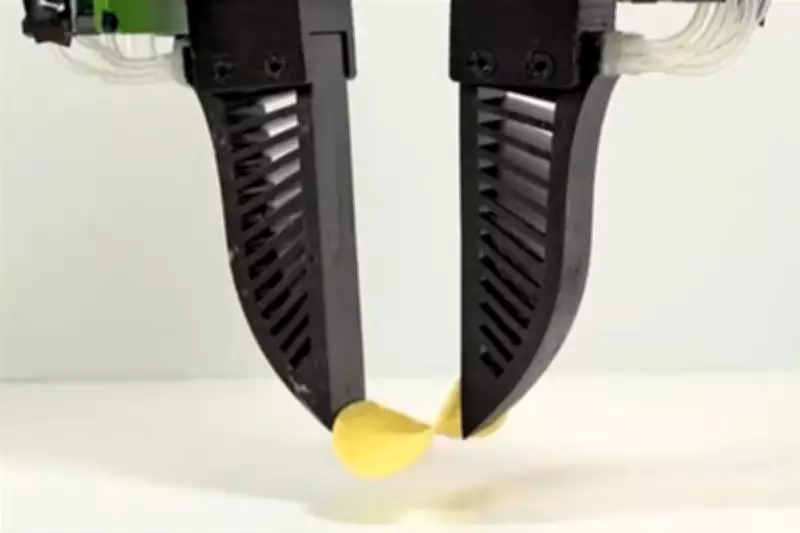
Engineers have revealed a groundbreaking robotic hand with the sensitivity to handle fragile items such as crisps and raspberries without causing any damage. This significant advancement represents a major step toward creating robots with dexterity comparable to humans, potentially heralding a new era for household robots and industrial applications.
FORTE Technology: A Leap in Robotic Touch
Developed by a team at the University of Texas at Austin, the Fragile Object Grasping with Tactile Sensing (FORTE) system could revolutionise industries including health care and manufacturing. The technology addresses a key limitation in current robotics: the ability to perform fine, delicate movements.
Siqi Shang, a doctoral student who led the project, explained, "Robotics is now capable of large motions in domestic settings, but it often falters with precise and gentle tasks. For instance, robots might fold a shirt yet struggle to pick up glasses or unpack fruit from groceries. We believe that integrating sensing signals will equip robots with a sense of touch to handle these objects carefully."

Inspired by Nature: The Fin-Ray Effect
The robotic hand's fingers are inspired by the fin-ray effect, featuring internal air channels that function as tactile sensors. As the fingers grasp an object, the empty air channels undergo pressure changes, which are detected by sensors. These sensors then inform the robot about the exact amount of pressure required, enabling delicate manipulation.
Impressive Testing Results
In rigorous testing, the system was evaluated on 31 diverse objects, ranging from fragile items to sturdier everyday objects like jam jars and apples. During a single-trial grasping experiment, the robotic fingers achieved a remarkable 91.9% success rate. Additionally, the system demonstrated an unparalleled ability to detect slip events, achieving a 100% success rate in identifying slips.
According to the UT engineers, this slip-sensing capability is unmatched by other robotic gripping technologies, with reaction times that also surpass existing systems.
Human-Like Precision
Lillian Chin, assistant professor of electrical and computer engineering at UT, highlighted the importance of this development: "Humans pick up objects with just the right amount of force; too much pressure crushes the item, while too little causes it to slip. Most current force sensors lack the speed and accuracy to provide that Goldilocks level of detail. Our sensors, however, operate closer to the timescales of human hand sensors."
Publication and Future Implications
The details of this innovative robot hand were published in a paper titled 'FORTE: Tactile Force and Slip Sensing on Compliant Fingers for Delicate Manipulation' in the IEEE Robotics and Automation Letters journal. This research not only showcases a technical milestone but also opens up possibilities for more versatile and sensitive robots in various sectors, from domestic assistance to precision manufacturing and medical procedures.