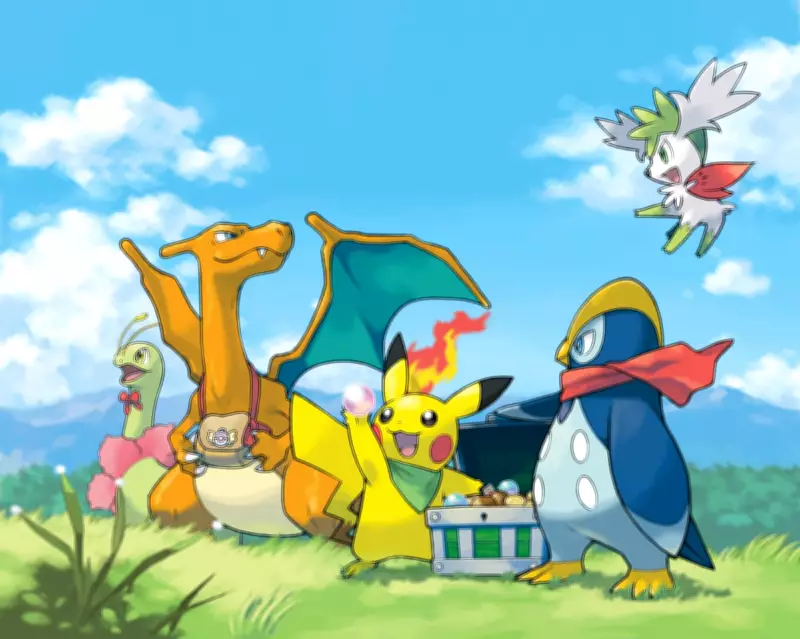
From Moral Panic to Global Phenomenon: Pokémon's 30-Year Journey
When I was eleven years old, my greatest aspiration was to compete in the Pokémon World Championships held in Sydney during the year 2000. Discovering this event in a magazine, I devoted countless hours to training teams of creatures, meticulously transferring them between my Pokémon Red Game Boy cartridge and the three-dimensional arenas of Pokémon Stadium on the Nintendo 64. Although I never achieved my goal as a player, I ultimately realized this dream on my twenty-sixth birthday, traveling to Washington DC to cover the world championships as a journalist. The experience proved profoundly moving. Under the watchful gaze of a giant inflatable Pikachu suspended from the ceiling, competitors and spectators alike were united by an unselfconscious love for these games, with their vibrant menageries and heartfelt messages about trust, friendship, and perseverance.
The Emotional Core of Competition
Witnessing the victors hoist their trophies after intense final battles is undeniably emotional, their overwhelming joy mirroring that of any elite athlete. However, it is the palpable pride displayed by parents of the younger competitors that truly resonates. During the initial wave of Pokémania in the late 1990s, most adults regarded Pokémon with deep suspicion. Now, as the first generation of Pokémaniacs have matured, many becoming parents themselves, we recognize the series for what it truly represents: an imaginative, challenging, and remarkably wholesome collection of games that genuinely rewards the dedication children invest in them.
A Legacy Among Children's Fiction Greats
Over the three decades since the original Red and Blue versions—Green in Asia—were launched in Japan in 1996, Pokémon has secured its place alongside the titans of children's fiction. Much like Harry Potter, the Famous Five, and the Chronicles of Narnia, it presents a powerful fantasy of self-determination, unfolding in a world largely devoid of adult oversight. In each installment, your mother sends you into the world with a rucksack and a farewell kiss; from that moment forward, your journey is entirely your own.

For the millennial generation, Pokémon functions as a cultural shorthand, akin to The Simpsons. More than Mario, Zelda, or any other Nintendo creation, Pokémon possesses a unique ability to bring people together. It was conceived from the outset as a social experience, encouraging—and indeed necessitating—that players trade and battle with one another to complete their collections of virtual creatures and develop their teams into formidable squads. While the internet has now normalized the concept of video games as social activities, this was a novel idea in the late 1990s. Playing Pokémon inherently requires other people: in 1999, this meant huddling in playgrounds, linking Game Boys with cables; by 2016, at the peak of the Pokémon Go phenomenon, it meant hundreds of people converging unexpectedly in parks, smartphones in hand, to capture a Gengar.
Financial Dominance and Cultural Roots
Often perceived as a turn-of-the-century fad, it may surprise many to learn that Pokémon generates more revenue today than at the height of its initial popularity. It has ascended to become the highest-grossing entertainment franchise in history. Between the television series, merchandise, trading cards, video games, and countless other products adorned with the endearing faces of Pikachu and friends, the franchise has amassed over $100 billion, surpassing giants like Star Wars and the Marvel Cinematic Universe.
This global phenomenon traces its origins to Machida, a city on the outskirts of Tokyo, where Pokémon creator Satoshi Tajiri was born in 1965. Like many Japanese children in the 1960s and 1970s, young Satoshi was an avid bug collector, earning such expertise that his elementary school classmates dubbed him "Dr. Bug." As a teenager, a new obsession emerged: video games, which were just beginning to appear in Japanese arcades. His passion was so profound that he, along with friend Ken Sugimori, began publishing a monthly fanzine called Game Freak—a name that would later become their video game development company, still featured on the title screens of modern Pokémon games.

The Genesis of an Idea
The concept for Pokémon began to crystallize for Tajiri around 1990. Observing people connect their Game Boys with cables to play Tetris, he envisioned the bugs he had collected crawling between the consoles. However, transforming this vision into a monochrome world populated by 151 collectible creatures, rendered in chunky black Game Boy pixels, required six arduous years. During this period, the developer faced near-bankruptcy multiple times, undertaking projects for Nintendo and other companies to stay afloat, with Tajiri frequently forgoing his own salary.
A Slow-Burning Success Story
Pokémon's astronomical success was not instantaneous but the result of steadily growing sales over time. Upon its eventual release in 1996, Pocket Monsters Red and Green—as they were known in Japan—were indie underdogs, developed by a small team with limited technology for the aging Game Boy handheld. No one anticipated a major hit, yet the world of Pokémon Blue possessed an unexpected sense of place that transcended its technical constraints. The symbiotic relationship between humans, nature, and Pokémon permeates every facet of life, often delivering touching moments—particularly at in-game locations like Lavender Town, where grieving owners honor their departed Pokémon at a grand commemorative tower.
The true marketable genius of Pokémon lay in its release strategy: the game was available in different versions, each containing unique monsters. To complete your Pokédex field guide and "catch 'em all," you needed to trade with friends who owned the alternate version. While the Game Boy link cable facilitated competition in Tetris, here it fostered genuine connection.
Overcoming Moral Panic and Xenophobia
Pokémon's popularity spread organically through playground word-of-mouth. By the time it reached the United States in 1998 and Europe in 1999, it had already blossomed into a full-fledged franchise, with Pikachu-adorned games, TV shows, toys, films, and lunchboxes meticulously rolled out by marketers following a proven strategy.
Today, Tajiri is a reclusive figure, with almost everything known about him stemming from a single 1999 interview with Time magazine. The tone of that article was shockingly dismissive, labeling the series "a pestilential Ponzi scheme" and describing the "delinquent" and "criminal" behavior of young fans, while reassuring readers that the craze would likely fade quickly, much like the Power Rangers.
Now that Pokémon stands as one of the most enduring and successful entertainment properties ever, this alarmist perspective appears absurd. Yet the scaremongering was very real. Some of this stemmed simply from older generations struggling to comprehend the new fascination captivating youth. However, there was also a disturbingly xenophobic undercurrent to the moral panic, with this "scary Japanese thing" and its "sinister monsters" crossing oceans to enchant children. In the United States, Christian pastors declared Pikachu a demon, and movements arose to ban the television show from airing.
The Enduring Legacy and Modern Evolution
Perhaps understandably, given the disrespectful and presumably hurtful tone of that Time interview and the unwitting moral panic ignited by Pokémania, Satoshi Tajiri has largely avoided the spotlight since. Now sixty years old, he remains with Game Freak and continues to contribute to each new Pokémon game—thirty-eight in total as of 2025—though he reportedly stepped back from day-to-day development in 2012.
July 2016 witnessed the launch of Pokémon Go, a mobile game that rapidly became the most popular in U.S. history, attracting 232 million players worldwide. Pokémon Go operates like a form of modern magic. With the app open, you explore your neighborhood; on your phone screen, a map of your real surroundings displays icons indicating where Pokémon might be found. Upon encountering a creature, it is superimposed onto your actual environment—a Gengar casually posing in your local park. Capturing them involves simply flicking a Pokéball in their direction.
A Unique Vector for Connection
Pokémon Go possesses a distinctive quality that sets it apart from every other video game phenomenon I have observed. Typically, when discussing how games can aid people through difficult times, we emphasize escapism: how virtual worlds offer respite from real-world problems. However, Pokémon Go was less about escape and more about connection, continuing the lineage established by those original games decades prior.
At its peak, the game connected players with their local areas and the people around them. For several months, we all viewed our surroundings through a different lens, believing that a little magic might exist in the world—like a bug hiding beneath a rock.
While "Dr. Bug" may be less involved than before, the pastoral essence he instilled in Pokémon has endured throughout the past thirty years. The interrelationships between people and Pokémon form the emotional core of the games, movies, and television shows, with even a quasi-environmentalist slant to its narratives. After all, this is a game about evolution and living in harmony with the natural world. A profound resonance with nature prevents this $100 billion franchise from feeling overtly cynical or exploitative. Pokémon's story underscores a vital truth about video games: they serve as powerful vectors for human connection. Millions are united by these imaginary creatures, born from one boy's profound love for the natural world.