Artemis 2 Mission Concludes with Historic Splashdown Tonight
The crew of NASA's Artemis 2 mission is poised for a dramatic return to Earth tonight, marking the end of a record-breaking journey that saw them travel farther from our planet than any humans in history. After their groundbreaking Moon mission, the four astronauts are scheduled to splash down in the Pacific Ocean, bringing humanity's first voyage to the Moon in over fifty years to a thrilling close.
A Record-Breaking Journey Beyond Apollo
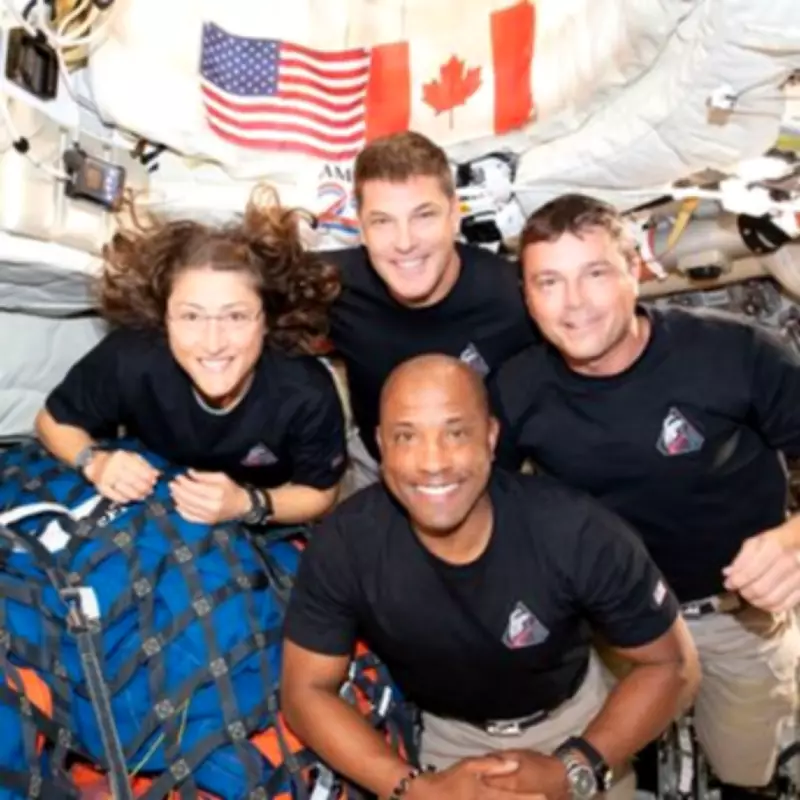
While Artemis 2 did not land on or orbit the Moon, it achieved a significant milestone by surpassing the distance record set by Apollo 13. Commander Reid Wiseman, pilot Victor Glover, Christina Koch, and Canada's Jeremy Hansen reached an astounding 252,756 miles from Earth, pushing the boundaries of human space exploration. This mission has reignited global interest in lunar travel and set the stage for future deep-space endeavors.
The Final Descent: Speed and Precision
The tension in Mission Control is palpable as the miles rapidly diminish between the returning astronauts and Earth. The Orion capsule is on track to hit the atmosphere at a blistering Mach 32, equivalent to thirty-two times the speed of sound. This re-entry velocity, not witnessed since the Apollo missions of the 1960s and 1970s, presents a critical challenge for the spacecraft's heat shield.

Scientists are closely monitoring the shield, which must withstand temperatures reaching thousands of degrees during re-entry. In the only previous uncrewed test flight in 2022, the shield returned charred and pockmarked, resembling the lunar surface itself, underscoring the extreme conditions faced during this phase of the mission.
Splashdown Details and UK Visibility
The Artemis 2 mission launched from Cape Canaveral, Florida, on April 1, and the Orion capsule is scheduled to splash down off the coast of San Diego, California, at approximately 8:07 PM local time. For viewers in the United Kingdom, this translates to 1:07 AM on Saturday morning.
Unfortunately, the splashdown will not be visible to British space enthusiasts with the naked eye due to the location and timing. However, NASA is providing live coverage, allowing fans worldwide to witness this historic event remotely. The agency has detailed that after slowing to about 20 mph, Orion will complete its 694,481-mile journey with a precise splashdown in the Pacific.
Recovery Operations and Post-Mission Procedures
Following splashdown, a coordinated recovery effort will swing into action. Teams from NASA and the U.S. military will extract the crew from the Orion capsule using inflatable rafts. Helicopters will then transport the astronauts to the USS John P. Murtha, a recovery ship stationed nearby.
The entire extraction process is expected to take within two hours after splashdown. Once aboard the USS Murtha, the crew will undergo comprehensive post-mission medical evaluations to assess their health after the long-duration spaceflight. Subsequently, awaiting aircraft will fly them to NASA's Johnson Space Center in Houston for further debriefing and reunions with their families.
This meticulous recovery plan ensures the safety and well-being of the astronauts as they transition back to Earth's environment, capping off a mission that has expanded the horizons of human exploration and inspired a new generation of space enthusiasts.