Artemis II Crew Returns Safely After Historic Lunar Flyby Mission
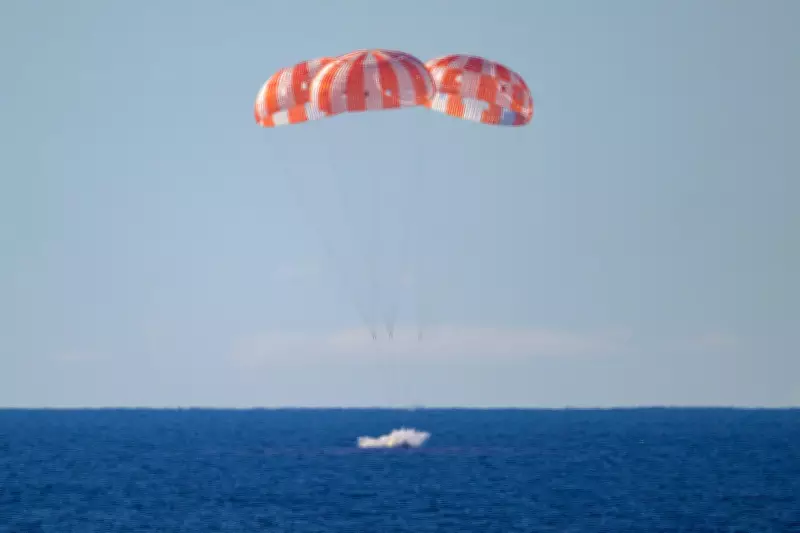
NASA astronauts have made a triumphant return to Earth following their record-breaking lunar flyby, a pivotal milestone in humanity's renewed quest to explore deep space. The Artemis II crew, comprising Commander Reid Wiseman, pilot Victor Glover, Christina Koch, and Canadian astronaut Jeremy Hansen, splashed down safely in the Pacific Ocean off the coast of San Diego, California, at 1:07 AM UK time on April 10, 2026.
Mission Control's Rob Navias hailed the landing as "a perfect bullseye splashdown", with all four crew members reported to be in good health. This mission represents the first crewed journey to the Moon in more than five decades, blasting off from Cape Canaveral on April 1 and venturing deeper into space than any previous human expedition.
A High-Stakes Re-Entry and Recovery
During re-entry, the Orion capsule endured extreme conditions, hitting the Earth's atmosphere at approximately 24,000 miles per hour, or 32 times the speed of sound. Temperatures outside the spacecraft soared to a staggering 2,760 degrees Celsius, putting its heat shield to a rigorous test. Engineers had previously adjusted the descent trajectory based on lessons from an earlier test flight to mitigate risks of the module burning up.

The intensity of the return caused a communication blackout for several minutes, with contact restored only after parachutes deployed, slowing the capsule's descent to a mere 17 miles per hour before it gently touched the water. Cheers erupted from the crew's families at Mission Control in Houston as the capsule emerged from the blackout and splashed down successfully.
A naval ship, the USS John P Murtha, along with a fleet of military aircraft, stood ready to recover the crew members one by one. Speaking from the ship, NASA administrator Jared Isaacman emphasized, "This is just the beginning. We are back in the business of sending astronauts to the moon, bringing them back safely and to set up for a series."
Record-Breaking Journey and Future Ambitions
The Artemis II mission shattered a long-standing distance record, traveling 252,756 miles from Earth and surpassing the previous milestone of 248,655 miles set by the Apollo 13 crew 56 years ago. The epic voyage took the astronauts around the far side of the Moon, an area normally hidden from view, where they experienced a 40-minute communication blackout, completely cut off from Earth.
During their journey, the crew captured breathtaking images of the Moon and Earth, including a total solar eclipse, while the Goonhilly Earth Station in Cornwall assisted in tracking the flight. This mission follows NASA's last crewed Moon landing with Apollo 17 in 1972 and sets the stage for ambitious future goals.
NASA aims to return astronauts to the lunar surface by 2028, ahead of China's planned mission around 2030. US President Donald Trump praised the "entire trip was spectacular" on Truth Social, while the Canadian Prime Minister congratulated the crew on "an historic feat", underscoring the global significance of this achievement in space exploration.