Artemis II Crew Safely Returns to Earth After Record-Breaking Lunar Voyage
In a monumental achievement for space exploration, NASA astronauts have completed the first manned Moon mission in over five decades, splashing down safely in the Pacific Ocean. The Artemis II crew's return marks a critical step toward future lunar landings and eventual Mars expeditions, rekindling humanity's presence in deep space after a 53-year hiatus.
Perfect Splashdown Caps Epic Journey
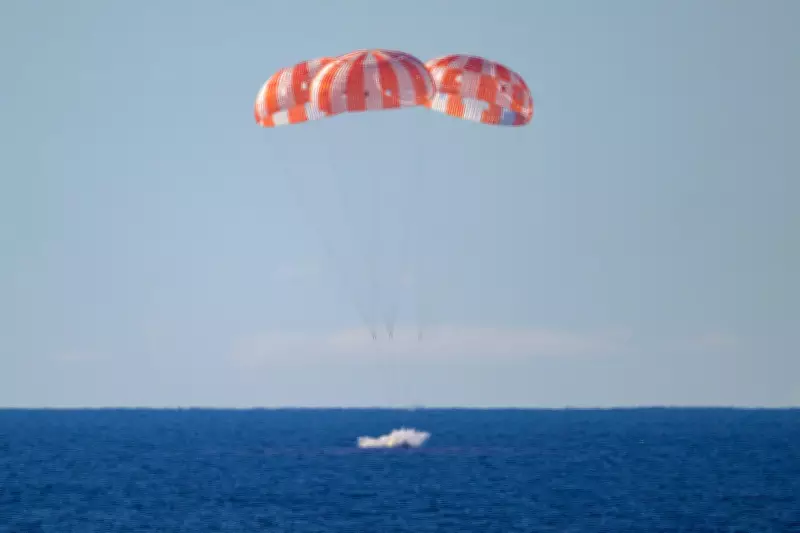
The Orion spacecraft, carrying Commander Reid Wiseman, pilot Victor Glover, Christina Koch, and Canadian astronaut Jeremy Hansen, touched down off the coast of San Diego at 1:07 AM UK time on Friday, April 10, 2026. Mission Control's Rob Navias hailed the landing as "a perfect bullseye splashdown," with all four crew members reported healthy upon recovery.
Their return involved a harrowing re-entry, with the capsule hitting Earth's atmosphere at approximately 24,000 mph—about 32 times the speed of sound. During this phase, external temperatures soared to an astonishing 2,760°C (5,000°F), putting the spacecraft's heat shield to a rigorous test. Engineers had previously adjusted the descent trajectory following earlier test flights to mitigate burn-up risks.

Communication Blackout and Recovery Operations
The intensity of re-entry caused a several-minute communication blackout, during which contact with the crew was lost. Cheers erupted from families in Houston's Mission Control when the capsule re-established contact and parachutes deployed, slowing its descent to a mere 17 mph before impact with the water.
More than an hour after splashdown, the astronauts emerged from the capsule, declining wheelchairs as they walked across the deck of the recovery ship USS John P Murtha. Following initial medical checks, they were scheduled to return to Johnson Space Center in Houston on Saturday.
Historic Milestones and International Collaboration
The mission shattered multiple records, traveling 252,756 miles from Earth—surpassing the 56-year-old distance milestone set by Apollo 13 by over 4,000 miles. Their journey took them around the far side of the Moon, providing unique photographic opportunities, including images of a total solar eclipse.
NASA associate administrator Amit Kshatriya emphasized the mission's success, stating, "This moment belongs to the thousands of people across 14 countries who built, tested, and trusted this vehicle." He added that Artemis II validated the international partnerships essential for sustained lunar exploration.
Political Reactions and Future Ambitions
US President Donald Trump praised the mission on Truth Social, calling the entire trip "spectacular," while Canadian Prime Minister Mark Carney congratulated the crew on their historic achievement. NASA administrator Jared Isaacman declared from the recovery ship, "This is just the beginning. We are back in the business of sending astronauts to the moon."
The mission's total distance covered an impressive 694,481 miles, with tracking support from facilities like the Goonhilly Earth Station in Cornwall. NASA aims to return astronauts to the lunar surface by 2028, ahead of China's projected 2030 timeline, positioning this mission as a cornerstone for future deep-space endeavors.