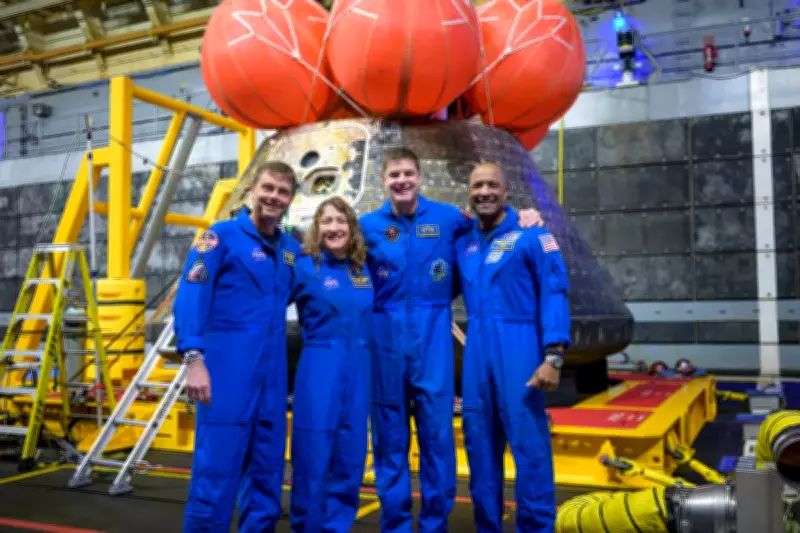
Artemis II Astronauts Return to Hero's Welcome After Historic Moon Mission
The Artemis II astronauts, fresh from their groundbreaking lunar journey, were greeted with a thunderous welcome home on Saturday as they returned to Houston. The crew of four arrived at Ellington Field near NASA's Johnson Space Center, flying in from San Diego where they had splashed down offshore the previous evening.
A Poignant Homecoming on Apollo 13 Anniversary
Commander Reid Wiseman and his U.S.-Canadian crew's return carried special significance, occurring on the 56th anniversary of the Apollo 13 launch. That mission's famous "Houston, we've had a problem" transmission transformed a near-disaster into one of NASA's greatest triumphs.
After emotional reunions with their spouses and children, the astronauts took the stage in a hangar surrounded by space center workers and invited guests. The crowd included NASA Administrator Jared Isaacman, flight directors, the launch director, Orion capsule managers, exploration system leaders, high-ranking military officers, and both current and retired members of NASA's astronaut corps.

"Welcome home Artemis II," Isaacman announced to the assembled gathering.
Record-Breaking Deep Space Achievement
During their nearly 10-day mission, the Artemis II crew voyaged deeper into space than any previous moon explorers, capturing unprecedented views of the lunar far side that had never before been witnessed by human eyes. A total solar eclipse added to the cosmic spectacle during their journey.
The astronauts achieved a maximum distance of 252,756 miles (406,771 kilometers) from Earth before executing a U-turn behind the moon, eclipsing the distance record previously held by Apollo 13. Their mission also produced a remarkable new perspective of our planet with an Earthset photograph, showing the Blue Marble setting behind the gray, pockmarked lunar surface.
This image powerfully echoed the famous Earthrise photograph taken by Apollo 8 astronauts in 1968, creating a visual bridge between NASA's historic and contemporary lunar exploration programs.
Overcoming Challenges for Future Missions
Despite their extraordinary accomplishments, the Artemis II astronauts faced more mundane challenges during their mission, including a malfunctioning space toilet. NASA has promised design improvements before longer moon-landing missions commence.
The crew—consisting of Commander Reid Wiseman, pilot Victor Glover, mission specialist Christina Koch, and Canadian astronaut Jeremy Hansen—represented the first humans to travel to the moon since Apollo 17 concluded NASA's initial exploration era in 1972. During the Apollo program, twenty-four astronauts journeyed to the moon, including twelve who walked on its surface.
Historical Connections and Future Preparations
Apollo 13 commander Jim Lovell, who also flew on the pioneering Apollo 8 mission, cheered the Artemis II crew through a pre-recorded wake-up message before his passing last summer. His support symbolized the continuity between NASA's past achievements and current ambitions.
The successful Artemis II mission was crucial for NASA's broader lunar exploration plans. The space agency is already preparing for next year's Artemis III mission, which will see a new crew practice docking their capsule with a lunar lander in Earth orbit. This will establish the foundation for the pivotal Artemis IV moon landing in 2028, when two astronauts will attempt a touchdown near the lunar south pole.
The Artemis program represents NASA's determined return to lunar exploration, building upon the legacy of Apollo while incorporating new technologies and international partnerships for sustainable exploration of our celestial neighbor.