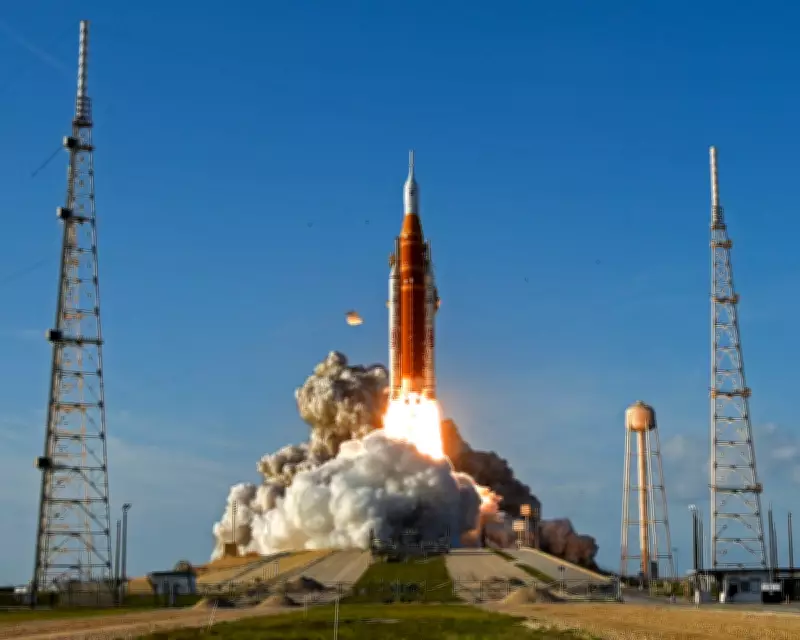
Artemis II Mission Ignites Controversy Over Space Exploration's Value
The upcoming launch of NASA's Artemis II mission from Cape Canaveral on 1 April has reignited a fierce debate about the purpose and priority of human spaceflight. While the mission represents a significant milestone in returning astronauts to the moon, critics argue it exemplifies a misguided allocation of resources amidst pressing planetary crises.
The Core Argument Against Space Exploration
In a provocative stance, columnist Zoe Williams contends that space exploration has become an increasingly pointless pursuit. "It is absolutely self-evident to me that space exploration is pointless, and the more urgent the crises besetting this planet we live on, the more pointless it becomes," she asserts. Williams acknowledges the historical excitement surrounding space during the 1960s, when the possibility of extraterrestrial life captured public imagination. However, she points to the Fermi paradox—first articulated by physicist Enrico Fermi in 1950—as a compelling reason to reconsider modern efforts.
The paradox questions why, if intelligent life exists elsewhere, it has not made contact. Williams interprets this as evidence that there is simply nothing out there worth discovering, describing other planets as "infinitely less beautiful than this one we live on." She maintains that this view should be uncontroversial, yet it consistently provokes strong reactions whenever high-profile missions like Artemis II are announced.

Public Backlash and Misinterpretations
Williams notes that her criticism of space exploration elicits disproportionate ire compared to her other opinions. "I have loads of opinions way more vexatious than that one, yet none of them attract the same ire," she observes. The backlash manifests in various forms:
- Some accuse her of ruining celebratory events centred on space achievements.
- Others misinterpret her stance as opposition to innovation and modernity, which she denies.
- Defenders of space travel highlight technological spin-offs, though Williams sceptically notes many involve military applications.
- Critics suggest she dislikes astronauts personally or lacks poetic appreciation for the endeavour.
Williams clarifies that she holds no animosity toward astronauts, whom she describes as "great" and "wholesome," nor does she oppose scientific progress. Instead, she frames the issue as a matter of prioritisation, questioning whether the United States, with its domestic challenges, should continue funding such missions.
The Irony of Engaging in the Debate
Acknowledging the paradox of her position, Williams admits that "moaning about the waste of energy that is space travel has turned into quite a significant waste of my own energy." This self-awareness underscores the emotional and rhetorical investment the topic commands. She directly appeals to NASA to "just knock it off," emphasising that terrestrial issues demand greater attention and resources.
The Artemis II mission, intended to pave the way for lunar exploration and eventual Mars journeys, thus serves as a flashpoint for broader discussions about humanity's future. While proponents see it as a symbol of ambition and discovery, critics like Williams view it as a distraction from solving immediate problems on Earth. The debate highlights enduring tensions between exploration and conservation, innovation and pragmatism, in an era of global uncertainty.