NASA's Artemis II Mission to Culminate in Dramatic Ocean Splashdown
The crew of NASA's groundbreaking Artemis II lunar flyby mission will make their triumphant return to Earth on April 10, 2026, concluding their journey with a carefully orchestrated splashdown in the Orion spacecraft. While this final descent presents extraordinary challenges—the capsule will hurtle through Earth's atmosphere at supersonic speeds while enduring temperatures reaching thousands of degrees—NASA has refined this recovery method through decades of experience and technological advancement.
Historical Lessons: The Dramatic Legacy of Gus Grissom
One of NASA's most significant learning experiences occurred during the early days of space exploration. On July 21, 1961, astronaut Gus Grissom completed the Liberty Bell 7 mission, a ballistic test flight that launched him over 100 miles above Earth before splashing down in the Atlantic Ocean. Initially, the mission appeared flawless, with the USS Randolph monitoring from a safe distance and mission controllers celebrating at Cape Canaveral.
However, the situation turned perilous when an incorrect command triggered the capsule's explosives system, causing the hatch to detach unexpectedly. As water flooded the tiny spacecraft, Grissom faced additional complications—he had neglected to close a valve in his spacesuit, allowing water to seep into his protective gear as he struggled to stay afloat.

After a dramatic escape from the sinking capsule, Grissom fought to keep his head above water while signaling to a rescue helicopter pilot. The helicopter managed to retrieve him at the last possible moment, making this one of the most harrowing splashdowns in spaceflight history. Despite this near-tragedy, water landings have remained a primary method for returning astronauts to Earth, with modern engineering making them significantly safer.
The Artemis II Splashdown: Engineering a Safe Return
The upcoming Artemis II splashdown will subject the Orion spacecraft's heat shield to its most rigorous test yet. This critical component bears the brunt of reentry heat to protect the four-person crew inside. Following the uncrewed Artemis I mission, where the shield sustained more damage than anticipated, engineers dedicated years to investigation and redesign.
Their work resulted in a completely new atmospheric reentry trajectory for Artemis II, optimizing the spacecraft's path to minimize thermal stress while ensuring precise targeting of the splashdown zone.
The Science Behind Splashdown: From Reentry to Recovery
Before any spacecraft can achieve a safe landing, it must dramatically reduce its velocity. As the vehicle careens toward Earth, it possesses tremendous kinetic energy that friction with the atmosphere converts into thermal energy—creating intense heat through atmospheric compression.
During reentry, velocities can reach several times the speed of sound, generating surrounding air temperatures approaching 2,700 degrees Fahrenheit (1,500 degrees Celsius). For massive vehicles like SpaceX's Starship rocket, these temperatures can exceed 3,000 degrees Fahrenheit (nearly 1,700 degrees Celsius).
Despite this heat dissipation, atmospheric drag alone cannot sufficiently slow the spacecraft. Engineers therefore employ multiple deceleration systems:

- Parachute Systems: NASA utilizes brightly colored parachutes exceeding 100 feet in diameter for visibility and stability. Initial drag parachutes deploy when velocity drops below approximately 2,300 feet per second (700 meters per second).
- Water as Shock Absorber: Researchers determined early that water provides ideal landing characteristics due to its low viscosity, relatively low density compared to solid surfaces, and covering 70% of Earth's surface.
- Final Impact Velocity: Splashdown occurs at about 80 feet per second (24 meters per second)—sufficiently slow to prevent structural damage while cushioning astronauts from excessive impact forces.
Evolution of Splashdown Technology
The first crewed splashdowns utilized Mercury program capsules with conical designs that fell base-first toward the water. These early vehicles featured ablative heat shields that gradually boiled away during atmospheric passage, dissipating thermal energy.
Following the 1986 Challenger disaster, engineering focus shifted toward crashworthiness phenomena—the study of how spacecraft structures withstand impact forces. Modern vehicles must now demonstrate survival capability in water landings through complex modeling and laboratory testing.
Contemporary Successes and Future Applications
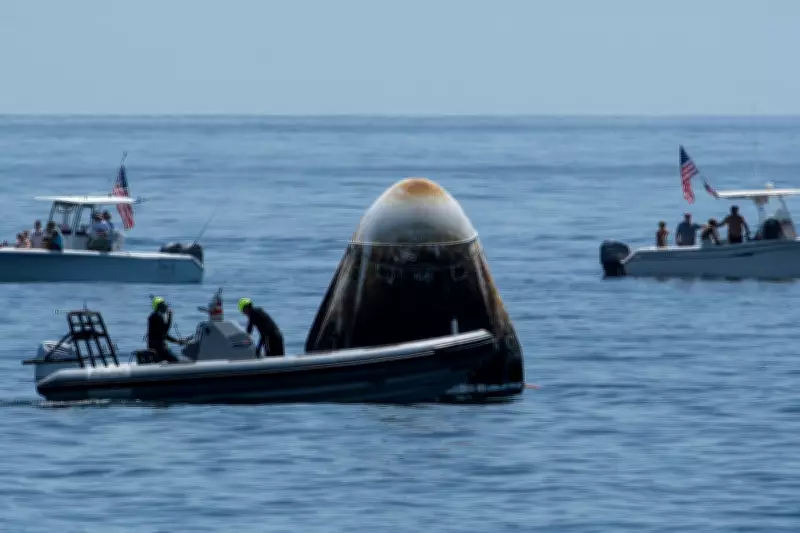
Between 2021 and June 2024, SpaceX successfully executed seven flawless Dragon capsule splashdowns returning from the International Space Station. On June 6, 2024, SpaceX's Starship—currently the most powerful rocket ever developed—achieved a remarkable vertical splashdown in the Indian Ocean, with its rocket boosters creating dramatic steam clouds during descent.
SpaceX has demonstrated that splashdown recovery enables capsule reusability, saving millions in infrastructure costs and reducing mission expenses—a critical advancement for commercial spaceflight. As more space agencies and private companies pursue orbital and beyond-Earth missions, splashdown technology continues evolving as the primary method for safe spacecraft recovery.
The Artemis II mission represents the culmination of six decades of splashdown refinement, combining historical lessons with cutting-edge engineering to ensure the safe return of humanity's next lunar explorers.