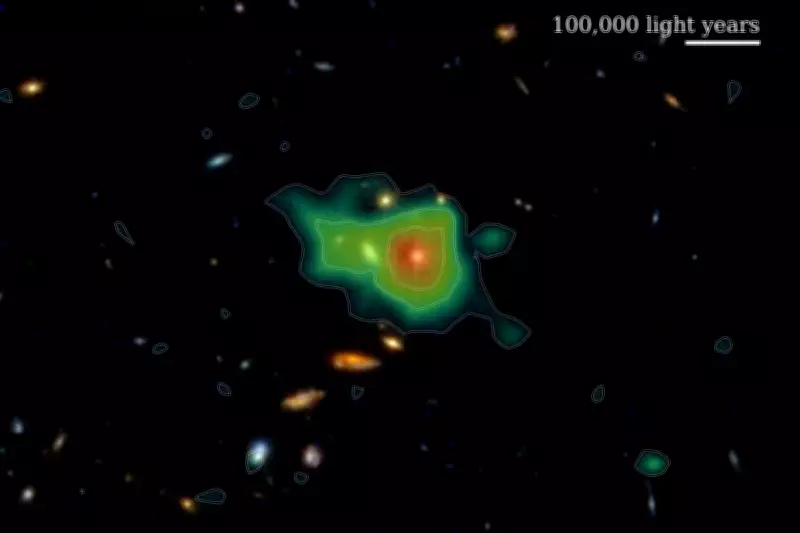
A new astronomical study has uncovered that hydrogen gas clouds surrounding galaxies are significantly more abundant than scientists previously believed. This revelation provides essential clues about the "cosmic noon" period, which occurred approximately 10 to 12 billion years ago, when star formation in galaxies reached its maximum intensity.
Unprecedented Discovery of Hydrogen Halos
Utilising the Hobby-Eberly Telescope Dark Energy Experiment, researchers have detected more than 33,000 gas halos, a dramatic increase from the roughly 3,000 that were known before. This finding suggests that hydrogen halos are far more prevalent in the universe than earlier estimates indicated.
Diverse Structures and Sizes
The newly identified hydrogen halos exhibit a wide range of sizes and structural complexities. Some appear as simple, football-shaped clouds, while others form large, irregular configurations that envelop multiple galaxies. This diversity highlights the varied nature of gas distribution in the cosmos.

Implications for Understanding Cosmic Evolution
Scientists are now focused on studying these halos in greater detail to address key questions about the universe's 'missing' hydrogen. By analysing these structures, they aim to pinpoint the sources of this elusive gas and refine existing models of early galaxy evolution.
The discovery not only enhances our comprehension of the cosmic noon era but also opens new avenues for research into how galaxies formed and developed over billions of years. This could lead to more accurate simulations of the universe's history and its chemical composition.
Overall, this study marks a significant advancement in astrophysics, offering a clearer picture of the hydrogen that has long puzzled astronomers and bringing us closer to solving one of the universe's enduring mysteries.