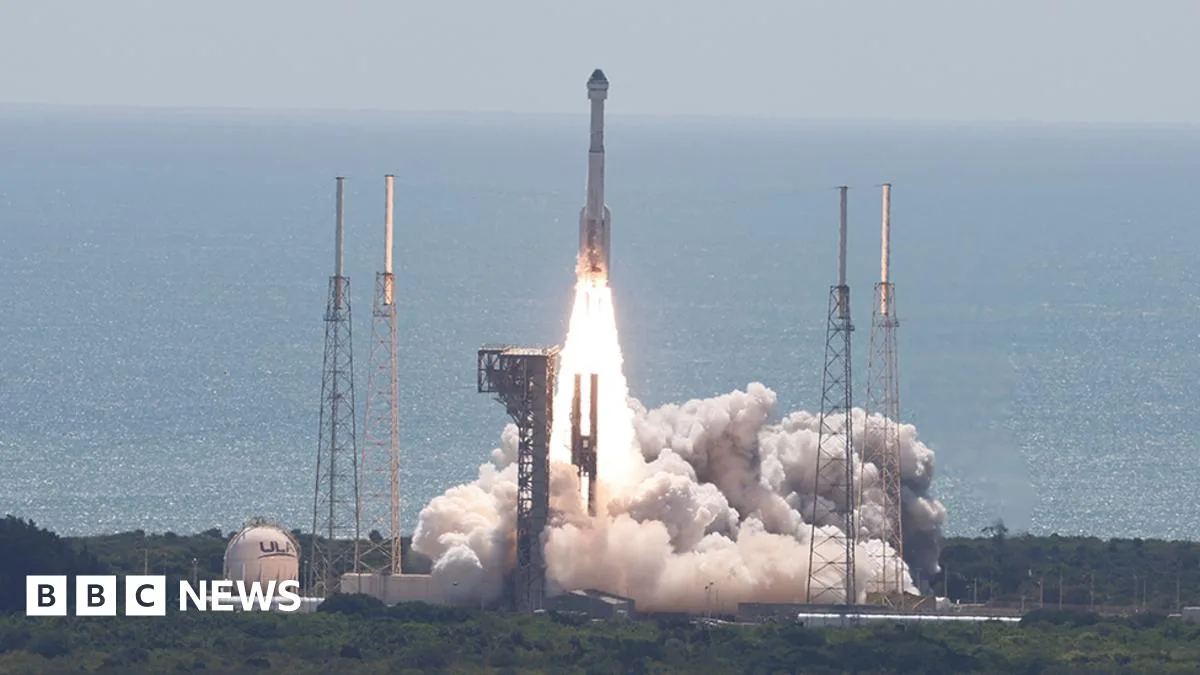
Boeing's Starliner spacecraft has successfully launched from the Kennedy Space Center in Cape Canaveral, Florida, carrying NASA astronauts Barry "Butch" Wilmore and Sunita "Suni" Williams to the International Space Station (ISS). This marks the first time the Starliner has flown with humans on board, after two previous launch attempts were aborted due to technical issues.
The spacecraft is now orbiting and heading towards the ISS, with docking expected at approximately 12:15 ET (17:15 BST) on 6 June. The astronauts will spend about a week on the station. The mission is a critical step towards NASA certifying the Starliner for regular crewed flights.
Before lift-off, Commander Wilmore thanked all those involved, saying, "When the going gets tough - and it often does - the tough get going, and you have." Pilot Suni Williams added, "Go 'Calypso'! Take us to space and back." NASA Administrator Bill Nelson called it "a historic first test flight of a brand-new spacecraft."

The Starliner, officially named CST-100 (Crew Space Transportation-100), is 4.6 metres wide and 5 metres tall with its service module. It can accommodate up to seven astronauts, though routine missions will likely carry four. The capsule is designed to be reusable with refurbishment.
The launch also marks a milestone for United Launch Alliance (ULA), which operated the Atlas-V rocket. Established in 2006, ULA is known for launching military satellites and NASA science missions, but this is its first crewed launch. The Atlas-V's booster fired for about four and a half minutes to lift Starliner off the ground.