Honolulu Officials Criticised for Delayed Evacuations During North Shore Flooding
Honolulu officials have faced sharp questions about why North Shore residents did not receive evacuation alerts last week until floodwaters already filled streets and homes. In the days since a destructive flood swept through Oʻahu’s North Shore, residents have been asking why they weren’t told to evacuate until their cars were floating and they had to wade or swim away from their homes.
Initially, officials provided unsatisfying answers: evacuating was a difficult call, they didn’t want people driving through flooded roads in the dark, they had prepared people well, and the storm caught them by surprise. However, a closer examination reveals other issues, including broken equipment and overlooked warning signs. Notably, a stream gauge near Otake Camp showed water rising rapidly before the rest of Waialua flooded, combining to put thousands at risk.
For many critical hours, city officials were effectively flying blind. The city’s emergency operations centre had been operational since 10 p.m. and was fully staffed that night, according to spokesperson Molly Pierce, with heads of police and fire departments present alongside agencies dealing with infrastructure, transportation, and emergency medical care.

But Randal Collins, director of the city’s emergency management department, told Civil Beat they were operating with limited information, vague weather forecasts, and low visibility due to darkness and downpour, making ground assessment difficult. As leader of the emergency operations centre that night, Collins said he accepts full responsibility for how the city managed the flood. "I’ll take ownership of the decisions we made that night," he stated.
Forecast Failures and Radar Outages
Emergency management officials in Hawaiʻi and nationally rely on National Weather Service forecasts to inform decisions about resource deployment, evacuation timing, and public communication regarding natural disasters. However, those forecasts failed to adequately predict the weather system approaching Oʻahu, triggering a chain reaction.
Lacking a clear understanding of rainfall amounts and locations, emergency officials were left flat-footed in formulating a response. They dismissed rising water levels at a key stream gauge, their best indicator that flooding would be worse than expected, putting them hours behind in warning the public even as streets filled with feet of water.
Weather patterns over the Hawaiian Islands seemed unpredictable on the night of March 19. In the afternoon and early evening, experts estimated just a few inches of rain on Oʻahu. A National Weather Service report that afternoon predicted about a quarter of an inch. Honolulu Mayor Rick Blangiardi said he was told that evening to expect 2 to 3 inches over eight to 10 hours.
But experts lacked confidence. "For tonight into Friday, there is atypically high uncertainty for such a short lead time," a National Weather Service report noted. Meteorologists struggled to determine where rain would fall overnight. A doppler radar on Molokaʻi had been out of commission due to motor issues since March 12 and wouldn’t be repaired for days. This radar would have allowed meteorologists to estimate rainfall location and intensity on Oʻahu hours in advance.
In a historically rainy winter that broke state records and triggered repeated evacuations, service logs show the radar faced extended outages since late November. Collins said the radar outage contributed to the "vagueness of information" officials received and hampered decision-making.
Rising Waters and Missed Alerts
Throughout the evening, water rose at streams and reservoirs across the island. The gauge in Kaukonahua Stream near Otake Camp serves as a critical indicator of possible storm flows in Waialua. By 8:25 p.m., the water level there had surged 2 feet in two hours. The National Weather Service modified its prediction: heavy showers would move toward Oʻahu throughout the night. Mayor Blangiardi later said 10 inches of rain fell in two hours, "a phenomenon known as a rain bomb."

The first flash flood advisory went out at 8:52 p.m. via HNL Alerts, the city’s emergency notification system. However, HNL Alerts has two significant problems: people must sign up to receive text messages, and only 11% of Oʻahu’s population, about 110,000 people, have done so.
Residents' Experiences and Official Inaction
Residents in low-lying Waialua and Haleʻiwa are familiar with flood warnings. Many trusted officials and experts that this storm would be less severe than recent ones, particularly the previous weekend’s Kona low. But they sensed something different.
Otake Camp resident Wendell Toki was on the phone with his mother around 9 p.m. as rain poured down. He stuck his head out the window and smelled the Kaukonahua Stream rushing behind his home. The stream was rising about a quarter inch every minute. Toki noticed other worrying signs: a bucket left out to measure rainfall was already full, his dog kept barking at the river, and his birds fell silent.
"My grandpa always said 'You listen to the animals. If you don’t hear no birds chirping, something wrong. Something’s coming,'" Toki recalled. "And that’s the truth. Animals know faster than us."
By nightfall, the only flood advisory issued by the city was for all of Oʻahu. When North Shore residents went to sleep, they had no idea they were about to be inundated with an unfathomable amount of rain rapidly.
John Sivigny checked outside and saw about an inch of water in his yard on Waialua Beach Road. The alert he’d received was only advisory, indicating vigilance but no immediate danger. He went to bed around 10 p.m. without concern.
In Downtown Honolulu, officials stood up their emergency operations centre to coordinate responses as the storm developed. Collins monitored rainfall levels, stream gauges, National Weather Service reports, and calls from first responders. Things looked more serious but not yet alarming.
The first flash flood warning for the entire northern half of Oʻahu went out at 10:57 p.m. Cellphones blared warnings that flash flooding was expected or had started. Rain was falling at 1 to 3 inches per hour. Streams and drainage ditches around Waialua rapidly filled with water.
A couple minutes later, at 11 p.m., the gauge near Otake Camp measured the stream at about 24 feet deep. Half an hour later, it had risen nearly 3 feet, quickly approaching 28 feet, the level at which flooding begins. Collins said officials monitored those stream levels but noted Otake Camp is prone to flooding. The rising waters weren’t alarming enough to issue an evacuation notice yet.
Just a week before, on March 13, that same water level triggered more concern, and Otake Camp was evacuated when the stream hit 29 feet. Not so on March 19. By 11:40 p.m., the stream hit 28 feet. Ten minutes later, it was at 29.3 feet. By midnight, it exceeded 30 feet. Still no evacuation order.
"It didn’t raise as many alarm bells as maybe we wish it had," Collins admitted.
Rapidly Worsening Conditions
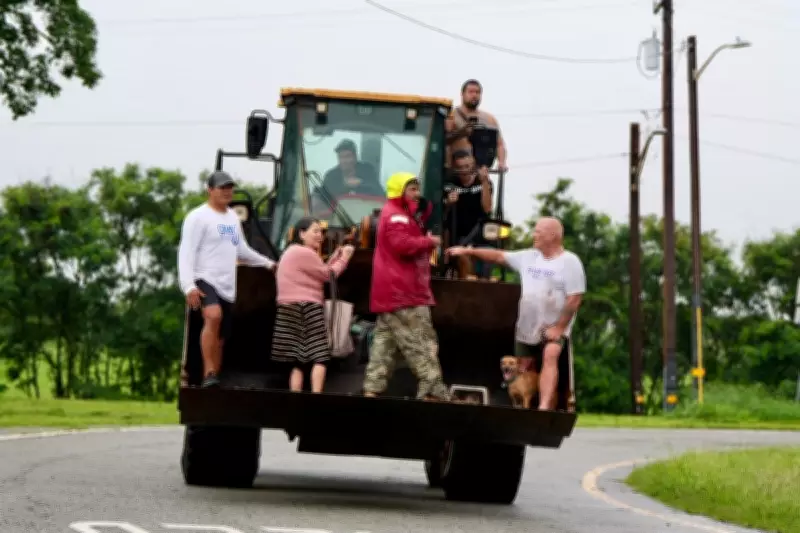
Floodwaters reached several feet deep by the time Levi Rita left his house at Dillingham Ranch at 11:30 p.m. "Hard to even think about how much water there was. Ungaugeable kind of water," Rita said. "Put it this way: it buried a Dodge truck." He added, "The river was flowing through my house." He and friends rescued horses using a backhoe with high tires, later using it to rescue neighbours from rooftops across Waialua.
Shortly after, at 11:39 p.m., the National Weather Service pushed out a notice warning of a "dangerous and life-threatening situation." "Flash flooding is ongoing potentially making roadways impassable," it stated. "Flooding conditions will rapidly worsen as additional heavy rain continues to fall over the next hour."
At Otake Camp, Wendell Toki left but swam back to rescue a stranded girl. They escaped, but he lost his house and birds. The severity of the flooding still wasn’t sinking in at the Emergency Operations Centre. For several hours, the city’s response lacked urgency.
Around midnight, Collins said officials remained focused on water levels in reservoirs, particularly Wahiawā and Nuʻuanu. If dams failed, they could kill thousands. "Other than that," Collins said, "we heard it’s raining. It’s raining hard. But we certainly didn’t have any level of awareness of the severity, at least at that point, that would have caused an evacuation order."
Between 12:30 and 1 a.m., John Sivigny’s neighbours on Waialua Beach Road called each other sharing what they witnessed. One neighbour already had water in her first-floor house. At Sivigny’s, water had risen about 2.5 feet in three hours, now just three inches below his steps at the base of his red front door. "I had 15 minutes and the water was in my house," he said.
Sivigny and his wife Maureen Clarke kept phones by their bed but hadn’t received any alarms specific to the North Shore. They checked levels at Wahiawā Dam above them; it was just peaking over the crest of the dam’s spillway at 80 feet. "All of us who live here," Sivigny said, "we’re already dam savvy."
Levels at the stream near Otake Camp climbed to 32 feet by 12:15 a.m. Forty-five minutes later, they reached 34.93 feet, the last transmission before the gauge stopped sending data. About a mile upstream, Sivigny and his wife struggled to walk through the river in their yard as they tried to get trucks up a slight slope. Water was up to the seats. In just a few hours, water deepened fast across the North Shore.
At Jesse Lovert’s house on Olohio Street near Farrington Highway, the neighbourhood went from no flooding at 11:30 p.m. to knee-high waters by 1 a.m. Near Otake, people later recounted stories of a friend carrying her toddler on her shoulders in water deeper than her chest.
On Waialua Beach Road, Heather Nakahara called 911 around 1:30 a.m. for help as water quickly rose waist-deep in her bedroom. Emergency responders, the dispatcher told her, couldn’t reach her; the road was already impassable. They advised not going outside. Nakahara ended up trapped in her closet for seven hours, hoping loved ones and pets wouldn’t die.
For almost three hours after the 11 p.m. flash flood warning, city officials didn’t send another alert, leaving residents in the dark as many started escaping in rapidly rising waters. By the time officials issued their next flash flood warning at 1:52 a.m., people had already been swimming for their lives.
Warnings for People Already Swimming
Eighteen-year-old Nuutea Van Bastolaer decided to flee his house in Long Bridge with his girlfriend and younger sister at 1:14 a.m. on March 20. The neighbourhood between Haleʻiwa Road and Waialua Beach Road had no standing water less than two hours before; now it was 3 or 4 feet deep.
They avoided the front door where cars floated down swift currents, instead going around back and jumping a neighbour’s fence to reach the street. Water on the other side went up to Van Bastolaer’s chest. "You guys are gonna follow me, you hear me?" he told his sister and girlfriend. "Hold onto each other. Come, come."
The teenager led the group, all in yellow fluorescent raincoats, down stairs into the street-turned-river. His girlfriend recorded on her cellphone. Brown water was up to their waists, moving fast, with water heaters and washing machines floating alongside. "Hold on, the current is really strong," one girl called out as they picked their way through the neighbourhood. Van Bastolaer called out to neighbours, trying to wake as many as possible.
At points, his 12-year-old sister’s feet couldn’t touch ground. The boy wrapped his arms around the two girls and grabbed a coconut palm, water rushing around them. They stayed like that for 15 or 20 minutes. When they could move again, they dropped bags and Van Bastolaer carried his sister on his back. The flood was unlike anything he’d seen before; the area usually floods three or four times a year with ankle or knee-high water. When alerts come, he simply carries bags out with rainboots and heads to work. But March 19 was different.
In the emergency operations centre, officials discussed sending an evacuation order just before another alert went to cellphones at 2:22 a.m., telling residents emergency vehicles could be delayed due to flooding. Collins told Civil Beat officials opted to hold off, fearing an evacuation notice would send people into floodwater. Instead, they continued monitoring.
The weather service did not hold back, sending an alert at 3:16 a.m. to all cellphones: "SEEK HIGHER GROUND NOW!" As Collins watched Wahiawā reservoir levels rise, he heard from the weather service that heavy rain would continue and learned from field units that roads were inaccessible. He finally decided to advise residents to evacuate if possible at 3:42 a.m.
That alert included advice to escape to rooftops if water filled a home. Neighbors rescued people using surfboards, backhoes, and Jet Skis. Shelters opened as drenched residents filed in. The first civil defence sirens sounded at 4:23 a.m. But one siren in Waialua at a district park wasn’t working, and a resident near another siren at Farrington Highway said the alarm was barely audible over the storm noise.
Sirens are typically used for tsunamis, but state and county officials can trigger them for other hazards including wildfires and floods. Fifteen of Oʻahu’s 176 sirens awaited repairs or replacement during the storms of the last two weeks.
Honolulu officials issued an evacuation order around 5:30 a.m. as more residents emerged to find streets flowing like rapids. Rescue efforts continued, and shelter crowds swelled until just before 8:30 a.m. Water levels in Wahiawā reservoir peaked at just over 85 feet, less than 3 feet from the dam crest. Sirens went off again, and emergency notifications appeared on cellphones warning the 120-year-old Wahiawā Dam, which does not comply with modern safety standards, had failed.
It had not actually failed, emergency officials clarified 30 minutes later, but by then the National Guard had already begun evacuating the shelter at Waialua High School in case it did.
The Confrontation
The crowd in Waialua Elementary School’s auditorium grumbled as Mayor Blangiardi told residents on Tuesday night what his administration had been doing during and after the flood. The fact there were no fatalities, Blangiardi said, was a credit to first responders. "I’m talking about people who are in dangerous situations, who could have died," he stated. "We talk about a rescue, it’s at that level."
In back rows, men in mud-stained clothes with work boots caked in red clay shifted, muttering about locals in backhoes rescuing people long before first responders arrived. Someone interrupted to ask why the city didn’t have a plan for clearing storm debris. "What would you do?" Blangiardi shot back. "I’ll tell you what we did do."
The room erupted. "Don’t point fingers at us, what we did. We did everything. So don’t ask us what we did," Waialua resident Mana Merrill called from the back, his voice echoing. "You guys only came in today. We’ve been here four days, five days. If it wasn’t for the Ritas, the Souzas, the Brandon Rice’s – people would have died." The crowd applauded neighbours who stepped into the void to help.
"If they never come in with their loaders, people would have died," Merrill said. "I’m telling you right now." Similar frustrations flared over the more than two-hour meeting. The community, still reeling from frantic escapes and destruction, had little patience. Several asked why there hadn’t been more warnings.
Levi Rita stepped up to the mayor and summarized many thoughts. "Can we have an apology?" he asked, gesturing to officials from various city departments. "Levi, what do you want us to apologize for?" Blangiardi asked. "I just want everybody to apologize to the community for failing," Rita said. But Rita wouldn’t get what he sought.
"I know you’ve done incredible work," Blangiardi said. "But I’m not asking anyone on my team to apologize because you don’t know the work that’s been going on for the last four days."
Civil Beat reporter Ben Angarone contributed to this report. This story was originally published by Honolulu Civil Beat and distributed through a partnership with The Associated Press.