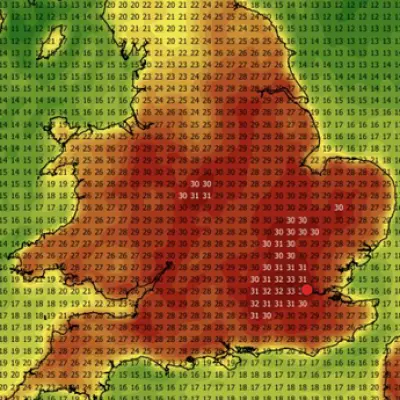
The United Kingdom is bracing for potentially more temperature records on Tuesday after experiencing its hottest May day on record during the bank holiday weekend. The Met Office confirmed that the country also recorded its provisional all-time hottest meteorological spring temperature, with Kew Gardens in south-west London reaching 34.8 degrees Celsius.
Record-Breaking Heat Across the UK
On Monday, the Met Office listed 12 locations where the previous May record was surpassed, spanning from Suffolk to Berkshire and Warwickshire. Additionally, 97 of its monitoring sites reached or exceeded 30 degrees Celsius. The previous all-time May peak stood at 32.8 degrees Celsius, set in 1922 and 1944. Temperature records are typically broken by just tenths of a degree, making this surge particularly notable.
Senior Met Office meteorologist Becky Mitchell stated that the expected high for large swathes of southern England and Wales on Tuesday is 35 degrees Celsius, with the potential to creep up to 36 degrees Celsius. These forecasts cover the Midlands, south-east and south-west England, East Anglia, and South Wales. However, thunderstorms may develop in the afternoon, which could affect how hot it gets. "So it's a trickier one to predict the temperatures for tomorrow, definitely potential for it to be hotter," Ms Mitchell said.

Warm Nights and Heatwave Conditions
Records may also be broken overnight, with forecasters warning that some places may not drop below 20 degrees Celsius. This follows the UK's warmest May night on Sunday, when temperatures did not fall below 19.4 degrees Celsius at Kenley Airfield in Surrey. Many areas across England and Wales will reach the heatwave threshold on Tuesday, and some will have experienced five days of heatwave conditions by Wednesday, according to Ms Mitchell.
Heatwave conditions were already met in eight parts of England by Sunday night: Heathrow, Kew Gardens, Northolt London, Benson in Oxfordshire, Brooms Barn and Santon Downham in Suffolk, and High Beech and Writtle in Essex. That number is expected to rise after the bank holiday weather, though data is yet to be released. The fact that nearly a hundred sites reached 30 degrees Celsius on Monday "goes to show just how many places would have succeeded their heatwave threshold," Ms Mitchell added.
To qualify as a heatwave, temperatures must meet or surpass a specific threshold for three consecutive days. The highest heatwave threshold in the UK at this time of year is 28 degrees Celsius, which applies to London and north of the capital towards Cambridgeshire.
Gradual Decline Expected Midweek
Temperatures will start to gradually decline from the middle of the week, but it will remain largely dry with sunny spells. Many will still experience temperatures in the high 20s Celsius. However, eastern areas may see temperatures drop by around 10 degrees Celsius as a brisk easterly wind develops.
If validated, the latest May record means seven of the 12 monthly highs have been set since 2003, the Met Office said. A previous study by the forecasters found that breaking this record "is around three times more likely now in our current climate than it would have been in a natural climate not impacted by greenhouse gas emissions." This means that the once one-in-a-hundred year event is now a one-in-33 event.
Climate Change and Rapid Heat Build-Up
The dramatic temperature swing comes after last week saw lows of minus 5 degrees Celsius in Scotland and daytime temperatures peaking at about 14 to 15 degrees Celsius. "We see these changes happening so much more dramatically," Met Office senior forecaster Greg Dewhurst said on Monday morning, adding that climate change is boosting the heat. "In the past, heatwaves built and built and built and built over days and days and days – these now just develop so quickly."
Impacts on Infrastructure and Health
Amid the bank holiday weekend heat, South East Water apologised and handed out bottled water after about 502 of its customers experienced issues including outages and low pressure. Meanwhile, fire and smoke spread across a large patch of Holyrood Park in Edinburgh, above St Anthony's Chapel on Monday.

On Sunday, Lincolnshire Police reported that the body of 15-year-old Declan Sawyer was recovered from the water at Swanholme Lakes in Lincoln after he had been reported to be in trouble that afternoon.
The UK Health Security Agency issued its first amber health alert of 2026 on Friday, warning that there is a risk of a significant impact across health and social care services. The alert will remain in place until Wednesday. The AA also warned that the interior of vehicles can reach 60 degrees Celsius on a day when the outside temperature is 27 degrees Celsius.
The heat is considered dangerous for some vulnerable groups, including older adults, as their bodies struggle to regulate temperature. Age UK recommended staying inside during the hottest hours of the day, between 11am and 3pm, and having regular cold baths or showers.
Locations That Surpassed the May Record
The May high record was surpassed in: Heathrow, Greater London (34.4C); Northolt, Greater London (34.2C); Teddington Bushy Park, Middlesex (34C); Benson, Oxfordshire (33.6C); Wisley, Surrey (33.3C); Reading University, Berkshire (33.2C); Wellesbourne, Warwickshire (33.2C); Cippenham, Berkshire (33.0C); Brize Norton, Oxfordshire (32.9C); Charlwood, Surrey (32.9C); Houghton Hall, Norfolk (32.9C) and Santon Downham, Suffolk (32.9C). It was matched at Marham, Norfolk and Woburn, Bedfordshire. Wales also provisionally beat its May record as Hawarden Airport reached 32.2C, with the previous peak measured at 30.6C in 1944.