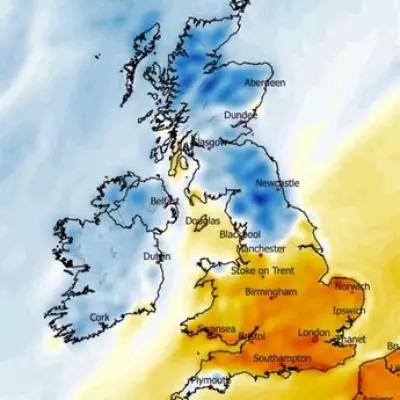
Britain is poised to enjoy a burst of scorching temperatures, with fresh weather maps suggesting a 26C "mini-heatwave" could be on its way. The latest forecasting data from WXCharts indicates the sweltering conditions are set to arrive on May 20. Maps for this day and the following few have turned orange across several regions, pointing to the prospect of significantly hotter conditions. A "mini-heatwave" is defined as temperatures exceeding 20C, particularly when such warmth wouldn't ordinarily be expected at that time of year.
Hottest Areas
According to the data, areas surrounding London will experience the hottest weather, with temperatures soaring to highs of 26C. This will only be marginally warmer than the south coast, which could reach highs of 23C and 24C, while the Midlands, Southwest of England, and the East of England will enjoy 20C heat, the maps indicate.
Elsewhere, temperatures could climb to 18C across the North West and Wales, with the North East only slightly cooler at 17C. Scotland looks set to remain a touch chillier, with the maps displaying temperature peaks of between 13C and 16C.

Nine Hottest Places
- London - 26C
- Cambridge - 26C
- Southampton - 23C
- Brighton - 23C
- Ipswich - 23C
- Luton - 22C
- Swindon - 22C
- Gloucester - 21C
- Northampton - 21C
The highs next week are a climb from temperatures recorded on Friday. Just 14.8C was recorded in County Down, Northern Ireland, while the mercury struggled at 15C in Renfrewshire. However, forecasters at Metdesk understand the warm spell looms, and the weather maps reflect this. Yellow and orange hues are seen across the UK on the graphics.
But, according to the Express, the Met Office's long-range forecast covering May 13-22 suggests many Britons may not be fortunate enough to enjoy the warmer spell. It says: "Changeable and at times rather unsettled conditions look to dominate through the middle part of May, with low pressure often close by. This means periods of rain or showers, some of which could be heavy, for many places, though some drier interludes are also expected. For the most part, temperatures are likely to be close to or perhaps a little below normal, with winds often blowing from a northwesterly quadrant. By the end of this period, pressure may increase towards the southwest, which could bring more in the way of dry weather here."