America's Top Restaurant Sparks Controversy with Mandatory Service Fee
Burdell, an acclaimed Oakland restaurant recently crowned the best in America, is facing significant backlash from diners over its mandatory 20 percent service charge and the accompanying explanation about tipping's "ugly past." The establishment, celebrated by Food & Wine magazine for its innovative California soul food, has drawn criticism for what some customers describe as a "woke" approach to service fees.
The Controversial Receipt Message
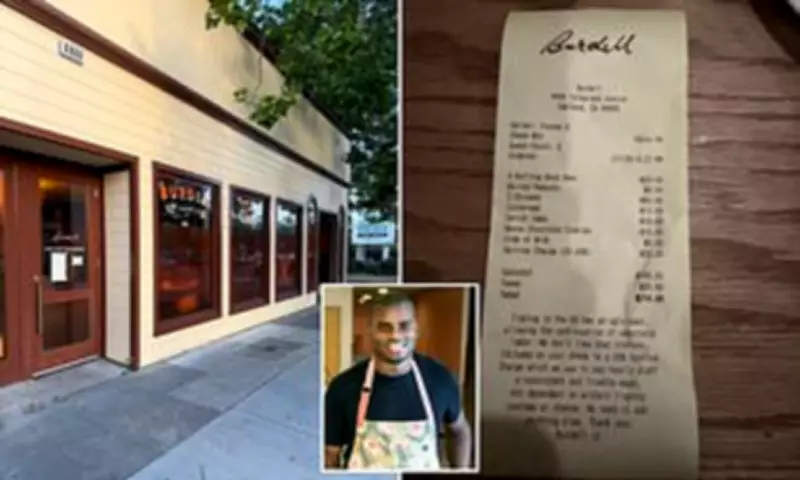
At the heart of the controversy is a message printed at the bottom of every customer's receipt. The statement reads: 'Tipping in the US has an ugly past, allowing the continuation of underpaid labor. We don't like that history. Included on your check is a 20 percent service charge, which we use to pay hourly staff a consistent and livable wage - not dependent on archaic tipping customs or chance. No need to add anything else.'
This automatic charge and its historical justification have ignited fury across social media platforms. A viral Reddit post, since deleted, featured a photo of a Burdell receipt highlighting the controversial policy. Similarly, Facebook users Andrian and Mirela shared their February 1 bill, expressing frustration about the unexpected additional cost.

Customer Outrage and Financial Impact
The financial implications of the policy became clear when Andrian and Mirela posted their dining experience. Their meal totaled $161 before the automatic 20 percent service charge was applied, increasing the subtotal to $193. After taxes, the final bill reached $214 for two people.
The couple expressed their anger bluntly: 'Two people eat dinner and somehow the bill hits two hundred dollars because they sneak a twenty percent service charge on there like it's cute.' They added: 'Don't touch my money first and then write a whole damn essay on the receipt telling me why tipping culture is bad. You already took the tip - shut up.'
Chef's Defense and Industry Context
Despite the criticism, Burdell owner and chef Geoff Davis stands firmly behind the policy. He told the Daily Mail that the service charge is clearly communicated to diners, and the restaurant does not request additional tips. Davis emphasized: 'We clearly state our service charge, just like the hundreds of other restaurants that use a service charge.'
Davis explained his rationale: 'For too long, restaurant workers have been vulnerable. In many states, people are paid a sub-minimum wage starting at $2.13 an hour. In this country, the origins of tipping are divisive, and tipping doesn't work. It places the risk of financial harm on the employee.'
The chef, who opened Burdell in 2023 after a successful pop-up phase, highlighted the benefits of his approach: 'We pay our employees as professionals - they earn their rate of pay from the moment they clock in. There's no luck of the draw with generous tables, no convoluted point system for sharing tips with the rest of the team, no bias toward busy days. Just consistency.' Davis confirmed he has no plans to change the policy despite mounting criticism.
Broader Restaurant Industry Trend
Burdell is not alone in adopting this approach. Across the United States, a growing number of restaurants have implemented automatic 20 percent service charges. Many establishments argue this model allows them to guarantee higher, more stable wages for staff while moving away from traditional tipping practices.
While some diners view these mandatory charges as excessive, they are becoming an increasingly common feature of the dining landscape. The debate reflects broader conversations about fair wages, restaurant economics, and customer expectations in the modern hospitality industry.
The controversy surrounding Burdell highlights the tension between innovative business practices and customer preferences, particularly when those practices come with social commentary about historical labor practices.