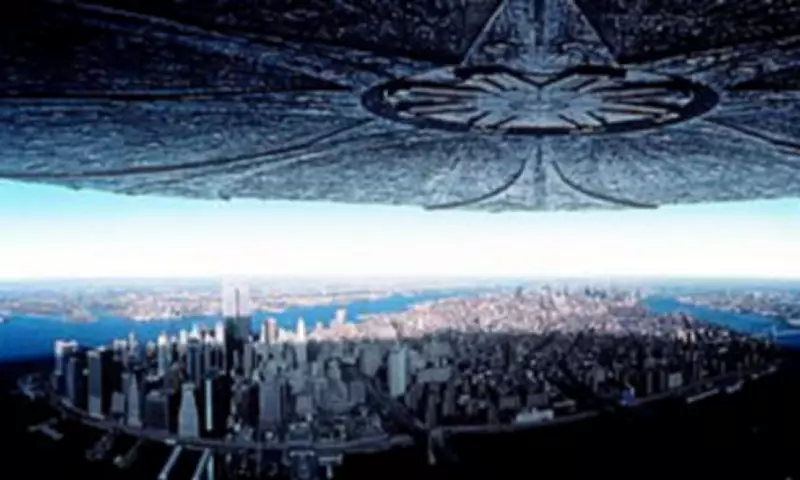
An alien invasion might sound like science fiction, but a scientist has now revealed what the terrifying consequences of an encounter could be. Professor Avi Loeb, head of Harvard University's Galileo Project, claims our first encounter with an extraterrestrial invader will not resemble sci-fi movies like E.T. or War of the Worlds. Rather than a biological, flesh-and-blood alien, Professor Loeb explains that we are more likely to be met by a technological device guided by artificial intelligence.
The arrival of such a device would pose a 'potential threat to all earthlings', he claims – sparking political, economic, and spiritual chaos around the world. Professor Loeb told the Daily Mail that 'the stock market may crash due to the uncertainty about the impact of the encounter on the future of humanity.' Likewise, the fact that the aliens' technology would likely outclass our own would not only be humbling for human intelligence – but would also make their technology a grave threat to humanity.
Technological Probes Over Biological Invaders
Professor Loeb suggests that aliens will not invade Earth in biological form, partly due to the vast distances between our planet and the nearest habitable worlds. Even the very closest habitable world, Proxima Centauri b, is located a staggering 4.2 light-years from Earth. The preference for technology over living organisms also reflects trends in our own space exploration efforts, which tend to use robotic probes instead of human crews.

If one of these artificial emissaries arrived on Earth, Professor Loeb suggests that its very presence would send shockwaves through human society. Just as astronomers rattled the world by showing that Earth was not at the centre of the cosmos, an encounter with aliens would shift humanity's sense of importance. 'I would not regard it as a crisis but rather as a realization that we are not at the top of the food chain, cosmologically speaking,' Professor Loeb told the Daily Mail.
Psychological and Geopolitical Repercussions
It would not just be religious believers who would be psychologically shaken by this revelation. Secular individuals will also be shaken by the realisation that alien technology is far more advanced than our own. Professor Loeb says this will come from an understanding that 'there is a more accomplished sibling in our family of intelligent civilizations.' Similarly, meeting our technologically advanced cosmic siblings would have a 'profound effect' on international geopolitics.
'It would pose a potential threat to all earthlings because we are all in the same boat,' says Professor Loeb. However, this common threat could actually help bring Earth's divided nations together in collective self-defence. 'An encounter with alien technology could bring together all humans on Earth in the same way that a knock on the door by a stranger quiets down arguments among family members within the room. It will definitely bring us to a better place by delivering a much needed sense of humility and a change of priorities towards space exploration and cooperation among humans, since we are all in the boat.'
Motives of Alien Civilisations
Exactly what aliens would want with us or how they would treat our civilisation depends on the nature of the aliens involved. Professor Loeb has previously suggested that alien civilisations might send technological probes to our solar system as a 'reconnaissance mission'. Since Earth has a stable atmosphere, liquid water, and sits in its star's habitable zone, it is natural that civilisations would want to investigate. In exactly the same way that human astronomers study exoplanets from Earth, alien scientists might simply examine Earth out of curiosity or in the search for a new home.
But it is also possible that an alien civilisation might have more malicious plans for our planet. For example, Professor Loeb has put forward the idea that ancient visitors might have polluted the atmosphere enough to trigger the Permian Extinction, the largest extinction event in Earth's history. About 252 million years ago, 96 per cent of marine species were killed by a global warming event that left ocean creatures unable to breathe. While the majority of scientists agree that this was caused by greenhouse gases from volcanic eruptions, Professor Loeb suggests there could be a technological explanation instead.

The Fermi Paradox and the Great Filter
The Fermi Paradox questions why, given the estimated 200-400 billion stars and at least 100 billion planets in our galaxy, there have been no signs of alien life. The contradiction is named after its creator, Italian physicist Enrico Fermi, who first posed the question back in 1950. Fermi believed it was too extraordinary that a single extraterrestrial signal or engineering project has yet to be detected in the universe — despite its immense vastness. Fermi concluded there must be a barrier that limits the rise of intelligent, self-aware, technologically advanced space-colonising civilisations, sometimes referred to as the 'Great Filter'.
Professor Brian Cox believes the advances in science and engineering required by a civilisation to start conquering the stars will ultimately lead to its destruction. He said: 'One solution to the Fermi Paradox is that it is not possible to run a world that has the power to destroy itself. It may be that the growth of science and engineering inevitably outstrips the development of political expertise, leading to disaster.' Other possible explanations include that intelligent alien species lack the necessary technology to communicate, or that distances are too great for two-way communication. The so-called Zoo hypothesis claims intelligent alien life deliberately avoids contact to allow natural evolution on Earth.
While these ideas might seem far-fetched, Professor Loeb insists that these theories should be treated like any other scientific hypothesis and put to the test with rigorous investigation.