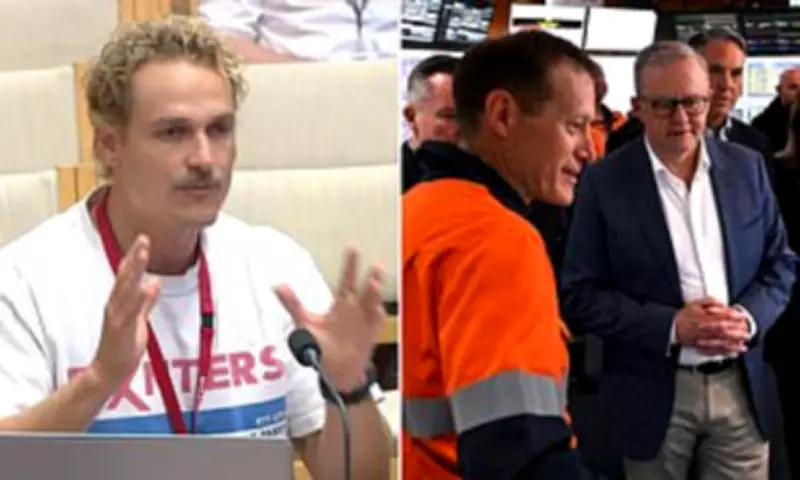
A former economics teacher turned political commentator has launched a scathing attack on Australia's government and gas industry, accusing them of 'selling out' everyday citizens by effectively giving away the nation's valuable liquefied natural gas (LNG) resources for free to foreign-owned corporations.
Senate Committee Hearing Highlights Tax System Failures
Konrad Benjamin, who runs the website Punters Politics, appeared before a Senate committee hearing on Tuesday to detail how Australia's current taxation system for LNG exports primarily benefits massive corporations while confusing ordinary Australians. Mr Benjamin has been leading calls for Australia to implement a royalties system on its LNG exports, which would operate alongside the existing Petroleum Resource Rent Tax (PRRT).
The Current Taxation Framework
To simplify a complex arrangement, companies extracting gas from Australian reserves typically pay a 40 percent tax on their profits through the PRRT. However, these profits can be substantially reduced through offsets for capital expenditure losses and various other accounting mechanisms. In 2025, the government collected approximately $1.5 billion in revenue from this tax.

Mr Benjamin argues this represents an incredibly low amount charged to companies, most of which are foreign-owned, that profit from one of Australia's most valuable natural resources. He contends the minimal taxation effectively makes the resource 'free' for businesses to extract and export.
Comparative Tax Revenue Revelations
The $1.5 billion collected from the PRRT is less than the $2.7 billion collected from beer excise taxes and is lower than what some foreign governments collect simply for importing Australian gas. For instance, Japan's government collects about $1.8 billion annually in taxes on Australian gas imports, according to The Australia Institute.
Richard Denniss, an economist at The Australia Institute, previously claimed the Albanese Government could have collected an additional $63 billion in revenue if it had introduced a proposed tax when it came to power in 2022. Broken down, he estimated this would have raised $17 billion each year, or roughly $350 million weekly – funds he described as 'money we will never get back.'
'We've Been Sold Out'
Mr Benjamin told the Select Committee on the Taxation of Gas Resources that the existing LNG export taxation fails what Australians call 'the pub test,' particularly following years of significant national debt accumulation.
'We're told every day, 'Oh we can't afford to invest in schools, our medical system is under strain,'' he testified. 'We're about to hear in the upcoming federal budget that the global economy is under shock and we can't afford anything. Except when we look at what we are as a nation, with lots of resources that we all collectively own, we know this not to be true. We've been sold out.'
Expert Criticism of Current System
Former Treasury secretary Ken Henry, who authored a prominent tax review, told the committee that Australia's existing gas revenue regime is fundamentally insufficient. 'People will say, in respect of the taxation of gas, that the Petroleum Resource Rent Tax does a bit, and it's true. But that's the point. It does such a tiny bit that anybody should be embarrassed to use that as an argument for not changing arrangements,' he stated.
Mr Henry added that Australians have 'put up with this crap for decades' in reference to not seeing adequate benefits from gas exports.
The Norwegian Model: A Better Alternative
Mr Benjamin pointed to Norway as a contrasting example of how Australians should be benefiting from their natural gas reserves. Despite producing and exporting less gas than Australia, Norway is globally recognized for its exceptional living standards supported by comprehensive social programs.
The Nordic country imposes a 56 percent 'special tax' on oil and gas companies alongside a 22 percent corporate tax rate, and the government maintains majority ownership stakes in gas production. Revenue from these taxes funds Norway's sovereign wealth fund – the world's largest – which bankrolls free higher education and extensive welfare systems.

Industry Pushback and Counterarguments
Gas companies have resisted calls for increased taxation on Australian resources, arguing it would drive domestic prices higher. However, Mr Denniss dismissed these claims by referencing Norway's experience. 'There's no Norway premium for Norwegian gas, which is heavily taxed. All of the gas is selling at the same world price,' he explained.
He further argued that implementing a tax would actually increase gas supply to Australians 'by taxing the gas exporter to increase the supply of gas. And, we will push the price of that gas down.'
Growing Public Demand for Change
Mr Benjamin is part of a substantial coalition of Australians advocating for a new tax on gas exports, with some proposing an additional 25 percent royalty. He told the committee the government can no longer claim gas taxes are 'too technical, too complicated' for public understanding.
'The question we punters have is – how are we holding all of the cards, yet still be losing?' he questioned. 'We understand that Australia's gas is incredibly valuable. We understand that we're giving most of it away, for free, to foreign corporations. We understand that those same corporations pay bugger all tax.'
Mr Denniss added that giving away Australia's resources to foreign companies had unfortunately become 'the Australian way,' while global gas companies were 'taking the p***' from the current arrangement.
The Senate committee will continue investigating arguments for and against implementing a new gas tax ahead of the Federal Budget scheduled for release in May.