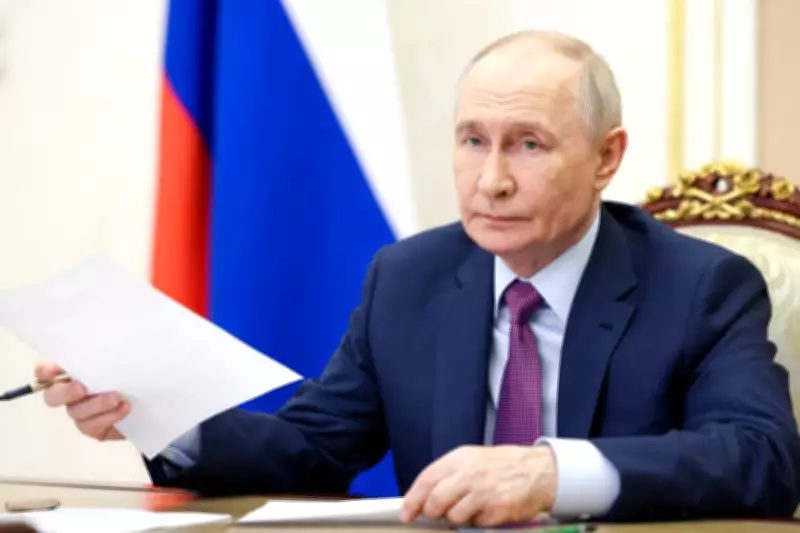
Vladimir Putin has been warned by his own finance officials that the mounting cost of the war in Ukraine is unsustainable, as Kyiv continues to rack up frontline gains and devastate energy infrastructure deep inside Russia.
Finance Officials Urge Restraint
Top finance officials and Russia's central bank have reportedly urged the Kremlin to rein in spiralling defence spending, as both sides ramp up costly aerial attacks on vital infrastructure. Ukrainian Foreign Minister Andrii Sybiha stated on Tuesday that Moscow is losing on the battlefield and has no cards left except terror, despite a major overnight blitz on Ukrainian cities that killed at least 22 people.
As Kyiv piles on pressure with strikes on Russian energy infrastructure, defence officials in Moscow reportedly told Putin they need billions of extra dollars this year to fund the conflict, according to Bloomberg News. Putin is said to have instructed the finance ministry to find savings elsewhere after the ministry suggested spending cuts were necessary to avoid a widening budget deficit becoming unmanageable.

Budget Overshoot and Projections
It emerged last week that Finance Minister Anton Siluanov had anticipated Russia would run at least $28 billion over budget on war spending this year, according to documents reviewed by the Financial Times. A letter from Siluanov in February reportedly urged the cabinet to freeze around $40.8 billion in planned non-war-related spending this year. He also projected that Russia would overspend on the conflict by a further $54.8 billion in 2027 and 2028.
Siluanov told Russian newspaper Kommersant that the finance ministry is revising the budget to account for changes in macroeconomic conditions and the need to concentrate additional resources on priority areas. He emphasised that absolute priority spending items include fulfilling social obligations and ensuring the country's defence and security. However, he warned that reserves are not infinite and that no financial slack can be afforded in the face of large-scale global transformations.
Defence Spending and Economic Impact
Around two-fifths of the budget has been set aside for defence and security this year as the conflict rages on. Major investment into industry and procurement has buoyed Russia's economy in recent years, but analysts warn the apparent economic growth is illusory and that disentangling from a war economy will incur further challenges. Sources told Bloomberg that the Russian defence ministry and the Kremlin have urged against defence cuts that would damage businesses reliant on lucrative defence contracts.
Dr Nigel Gould-Davies, senior fellow for Russia and Eurasia at the International Institute for Strategic Studies, warned last month that on its present course, the war is likely to prove economically unsustainable. He stated that the Kremlin will soon face a fundamental choice between radically escalating demands on Russia's economy and society or scaling back its war aims, as civilian sectors suffer from inflated costs of capital, labour, and goods, as well as rising taxes.
Russia's $3 trillion, commodity-dependent economy slowed sharply to about 1% growth last year from 4.9% in 2024, and shrank by 0.2% in the first quarter of 2026, which officials blamed on high interest rates, Western sanctions, and a strong rouble. Growth is now forecast at a modest 0.4% this year.
Ukrainian President Volodymyr Zelensky has said that Russian forces' advance on the ground has slowed, while Ukraine has intensified medium and long-range strikes inside Russia, targeting mainly its oil industry. Drone attacks deep inside Russia on refineries, fertiliser plants, and ports have knocked out a significant part of the economy, affecting one quarter of refining capacity and creating the risk of fuel shortages during the driving season.