Trump's Tariffs Impose $1,300 Annual Burden on Average US Household
President Donald Trump has consistently maintained that American citizens do not bear the financial burden of his extensive tariff policies. However, groundbreaking new research from the Tax Foundation, a non-partisan think tank based in Washington, D.C., reveals a starkly different reality. The study, published this month, indicates that Trump's sweeping levies are poised to significantly increase household expenses throughout 2026, representing the most substantial tax hike witnessed in over three decades.
Substantial Financial Impact on American Families
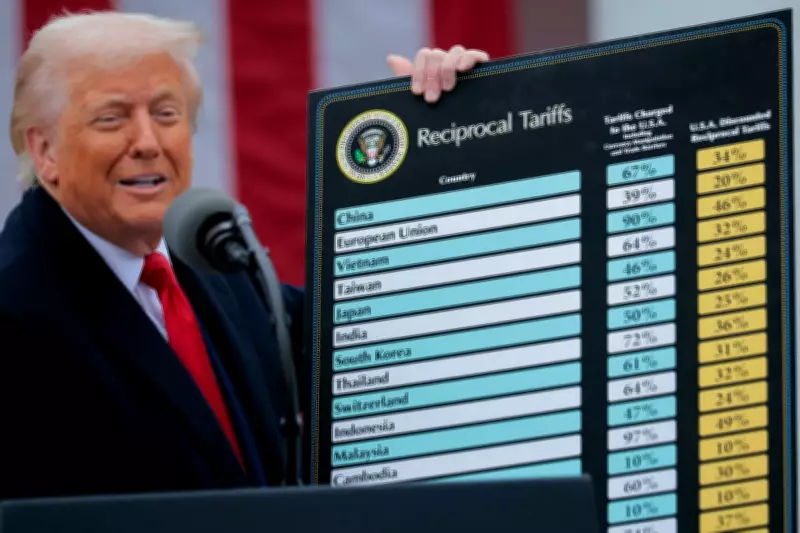
According to the comprehensive analysis, the average American household will be required to pay an additional $1,300 in 2026 directly attributable to Trump's tariffs. This figure marks a notable increase from the $1,000 extra paid by households in the previous year, 2025. The president initiated his unprecedented tariff regime in April of last year, imposing so-called reciprocal levies on dozens of nations, including major trading partners such as China and the European Union. This was accompanied by a universal 10 percent rate applied to all imports entering the United States.
Since their implementation, the administration has repeatedly delayed, canceled, and reinstated these measures, while simultaneously threatening further actions, creating persistent uncertainty within global markets. The Tax Foundation's calculations demonstrate that the average effective tariff rate on all U.S. imports has now reached 9.9 percent, establishing it as the highest average rate recorded since 1946.

Largest Tax Increase in a Generation
The study further elaborates that "The Trump tariffs are the largest US tax increase as a percent of GDP (0.54 percent for 2026) since 1993." These levies generated an impressive $132 billion in tax revenue during the previous year and are projected to accumulate approximately $2 trillion over the coming decade, assuming foreign retaliation is not factored into the equation. When negative effects are accounted for, the estimated revenue decreases to a still substantial $1.6 trillion.
Concurrently, the president's tariffs are forecast to reduce the nation's Gross Domestic Product by 0.5 percent. They also pose a significant risk of undermining the economic gains achieved through Trump's earlier tax cuts, encapsulated in his "Big, Beautiful Bill," without generating sufficient revenue to counterbalance their overall cost.
Broad Political Opposition and Public Disapproval
Nearly all Democratic lawmakers, alongside a contingent of Republicans, have voiced strong opposition to the sweeping tariffs unilaterally imposed by President Trump. Senator Chris Coons, a Democrat from Delaware, articulated this sentiment in a recent statement, declaring, "American families will soon pay higher prices for avocados and appliances, diesel fuel and dog toys, car parts and Christmas lights, tomatoes and tequila, beer and gas. It's the largest tax increase on working Americans in a long time, and it will cost them thousands of dollars every year. President Trump is making America expensive again."
Public opinion appears to align with this critical perspective, as evidenced by recent polling data. A February survey conducted by the Pew Research Center found that 60 percent of Americans disapprove of the president's increased tariffs, while only 37 percent expressed approval.
White House Response and Legal Challenges
The White House has largely dismissed concerns regarding Trump's levies. A Trump spokesperson stated in November, "The hard data of robust consumer spending and retail sales data have been clear: real wages are rising under President Trump, and Americans' hard-earned money is going further than it did under Joe Biden." When contacted for comment by The Independent, a White House spokesperson did not provide an immediate response.
This latest study from the Tax Foundation emerges as the U.S. Supreme Court prepares to deliberate on whether the president possesses the authority to unilaterally impose tariffs. President Trump has issued a stark warning, asserting that should the high court rule against him, the nation will be "SCREWED!"

The research concludes with a sobering assessment, noting that "Historical evidence and recent studies show that tariffs are taxes that raise prices and reduce available quantities of goods and services for U.S. businesses and consumers, resulting in lower income, reduced employment, and lower economic output." This comprehensive analysis underscores the profound and far-reaching economic implications of the current tariff policies on everyday American households and the broader national economy.