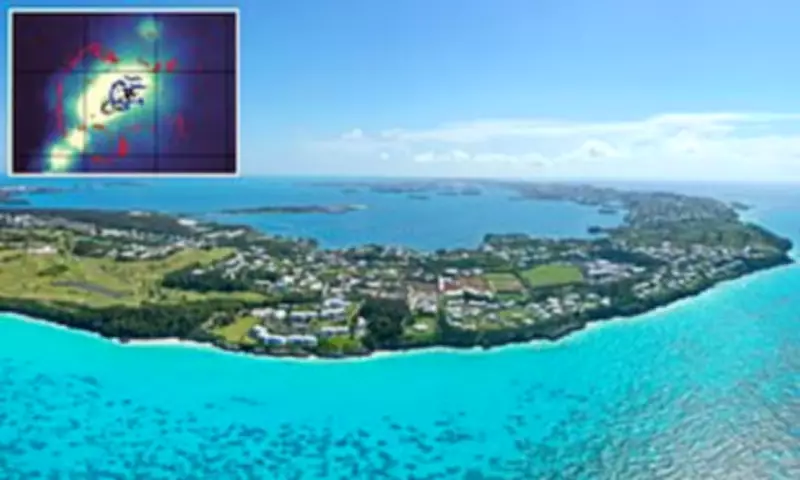
Scientists have uncovered the mystery of why Bermuda, a small volcanic island in the North Atlantic Ocean, remains high above the ocean floor despite its volcanoes ceasing activity over 30 million years ago. A team from the Carnegie Institution of Washington and Yale University revealed that a hidden structure beneath the island formed after the last volcanic eruption, keeping it afloat through prehistoric times.
Bermuda's Geological Puzzle
Bermuda, located about 650 miles east of North Carolina and home to roughly 64,000 people, has puzzled researchers for decades. Typically, islands require regular volcanic heat to stay elevated, but Bermuda has remained above the surrounding deep ocean floor without active volcanism. The team discovered an extra slab of rock directly beneath the island's normal ocean crust, measuring about 12 miles thick. This slab is lighter than the surrounding rock, acting like a giant raft that keeps the entire area lifted.
Formation of the Hidden Slab
Researchers believe this lighter layer formed 30 to 35 million years ago when hot, melted rock from deep inside Earth rose, spread out beneath the crust, and then cooled and hardened. Unlike most raised ocean areas that depend on active volcanoes, Bermuda's elevation results from this ancient geological event, proving that volcanic leftovers can sustain islands over millions of years.

Scientists William Frazer and Jeffrey Park used over 20 years of natural earthquake vibrations recorded by a single seismic station on Bermuda. They tracked how fast-moving earthquake pressure waves converted into slower shear waves at boundaries between rock layers. By processing hundreds of signals with specialized tools, they mapped rock layers down to more than 25 miles below the island. The slab is composed of lightweight volcanic magma about 1.5 percent less dense than the surrounding mantle, providing the buoyancy needed to keep Bermuda 1,300 to 2,000 feet higher than the normal ocean floor.
Bermuda Rise and Anomalies
The Bermuda Rise, a giant underwater plateau spanning hundreds of miles, keeps the ocean bottom around Bermuda 1,600 to 3,300 feet higher than typical seafloor of the same age. This rise has remained elevated for millions of years without active volcanoes. It is associated with several anomalies, including a gravitational anomaly where gravity is slightly weaker, making the area more buoyant. This causes the ocean surface to sit slightly higher over the rise, known as a geoid anomaly. Additionally, high-amplitude magnetic anomalies affect compasses and navigation equipment due to iron and titanium-rich rocks from ancient volcanic activity, though these are natural and harmless.
Frazer stated, 'Bermuda is an exciting place to study because a variety of its geologic features do not fit the model of a mantle plume... This suggests that there are other convective processes within Earth’s mantle that have yet to be well understood.'