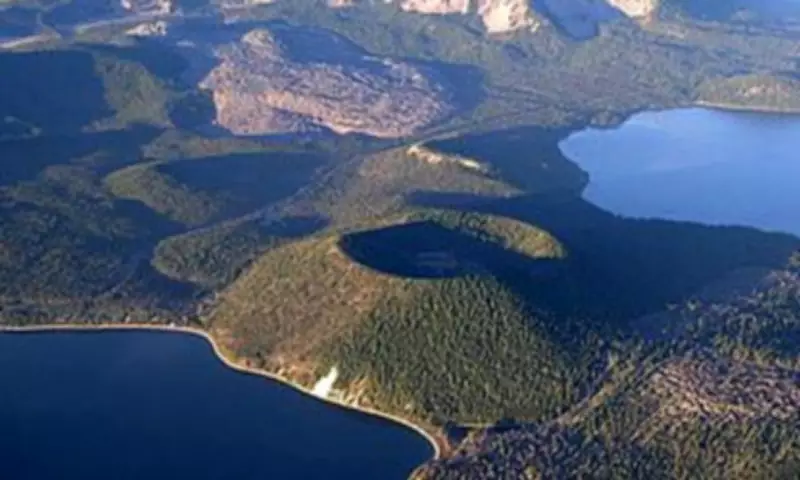
A new study challenges the assumption that only massive volcanic eruptions have global consequences. Researchers have discovered that the last eruption of Oregon's Newberry Volcano in 686 AD spread ash more than 3,100 miles (5,000 km) across the globe, far exceeding previous estimates for a volcano of its size.
Ash in Greenland Ice Cores
Scientists from the University of St Andrews identified microscopic ash particles (about 0.02 mm) in Greenland ice cores. By matching the chemical composition with deposits from Newberry's most recent eruption, they confirmed the ash originated from this event. The Greenland ice sheet acts as a frozen time capsule, preserving evidence of past eruptions.
Lead author Dr. Helen Innes stated, 'Finding so many microscopic ash particles in Greenland shows us that the eruption and conditions were able to transport the ash across the North American continent, and possibly even further across the North Atlantic.'

Volcanic Explosivity Index
The Newberry Pumice Eruption is rated VEI-4 on the Volcanic Explosivity Index, ten times less powerful than the 1980 Mount St. Helens eruption (VEI-5) but ten times more powerful than the 2010 Eyjafjallajökull eruption (VEI-3) that grounded flights worldwide. This demonstrates that relatively small but ash-rich eruptions can have outsized impacts.
Volcanic ash melts at high temperatures inside jet engines, clogging them with molten lava. Small rock and glass particles can also sandblast aircraft, stripping paint and damaging landing lights.
Implications for Air Travel
The discovery that ash from an American volcano reached Greenland suggests that future eruptions could block critical North Atlantic flight routes. While volcanoes in Iceland and the US are well-monitored, many others around the world lack adequate surveillance.
Dr. Innes warned, 'Future ash-rich eruptions like Newberry are going to require a coordinated international response. We need to do more to stress test our supply chain and transport networks for these sudden volcanic shocks.'
Pinpointing the Date
Previous studies could only narrow the eruption to a 140-year window around the 7th century. Using precise dating models for Greenland ice cores, researchers have now dated it to within two years of 686 AD.
Co-author Dr. William Hutchinson added, 'Iceland usually grabs the headlines as our restless volcanic neighbour. But this study is an important reminder that there are huge numbers of volcanoes across North America, Russia and Japan that can spread vast quantities of ash across the Northern hemisphere.'
Predicting Volcanic Eruptions
While predicting eruptions remains challenging, researchers monitor indicators such as volcanic infrasound, seismic activity, gas emissions, and ground deformation. The Newberry Volcano is still classified as a 'very high threat potential' by the US Geological Survey.