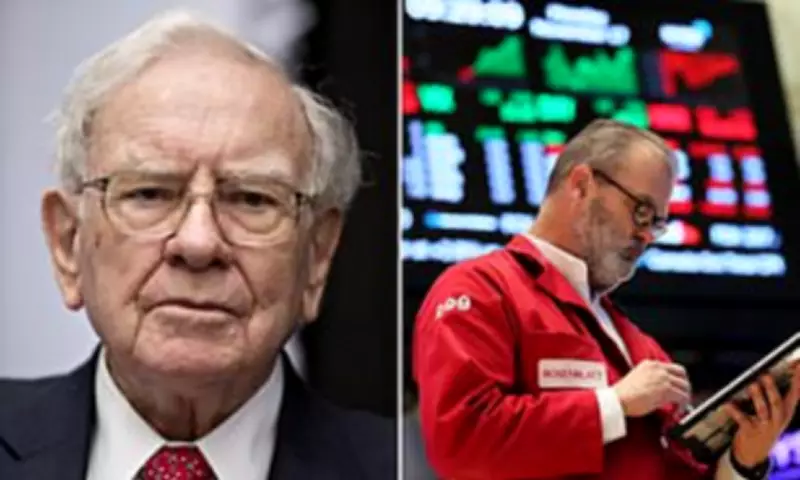
Finance experts are sounding the alarm that the final strategic moves of legendary investor Warren Buffett as chief executive of Berkshire Hathaway could be sending a stark warning about the state of the US economy. In recent quarters, Buffett and his investment deputies, Ted Weschler and Todd Combs, have consistently sold more stocks than they purchased, a trend analysts interpret as a struggle to find attractively priced opportunities in today's overheated market.
Berkshire's Massive Cash Accumulation
This cautious approach has resulted in Berkshire Hathaway building up an enormous cash position of approximately $373 billion after thirteen consecutive quarters of net stock sales. Stock market analyst Trevor Jennewine, writing for The Motley Fool, highlights that this growing cash pile, revealed in Berkshire's latest annual report, serves as a potential red flag. He argues that when market valuations reach such elevated levels, historical data suggests the market could become highly vulnerable.
Historical Precedents and Market Vulnerabilities
In past periods characterised by similarly high valuations, the S&P 500 has experienced declines of up to 30 percent over the following three years. A drop of this magnitude would not merely impact Wall Street; it could send ripples throughout the wider economy. When stock prices fall sharply, retirement accounts and investment portfolios lose significant value, often leading households to reduce spending—a phenomenon known as the 'wealth effect.'

Given that consumer spending constitutes the bulk of US economic activity, such a pullback could substantially slow overall growth. Furthermore, falling markets can severely damage business confidence, causing companies to delay hiring or expansion plans if share prices drop and financial conditions tighten. If borrowing becomes more difficult and unemployment begins to rise, the risk of a recession increases, although a market decline alone does not directly cause one.
Buffett's Cautious Stance and Investor Advice
Jennewine emphasises that investors should pay close attention to Buffett's prudent stance. He advises individuals to sell any stocks they would be uncomfortable holding through a prolonged downturn and to focus instead on companies with reasonable valuations and strong long-term earnings potential. This guidance comes as Berkshire's latest earnings report showed a sharp decline in operating profits for the fourth quarter, largely due to weaknesses in its insurance business.
Berkshire's Financial Performance and Leadership Transition
Berkshire Hathaway reported operating earnings of $10.2 billion for the quarter, down more than 29 percent from $14.56 billion a year earlier. Insurance underwriting profits fell 54 percent to $1.56 billion, while income generated from investing insurance premiums dropped nearly 25 percent to $3.1 billion. Overall quarterly earnings, which include gains and losses from Berkshire's stock portfolio, slipped slightly to $19.2 billion, partly due to a $4.5 billion impairment tied to investments in Kraft Heinz and Occidental Petroleum.
Buffett, now 95 years old, announced last May that he would step aside as Berkshire's chief executive at the end of 2025. The conglomerate owns dozens of companies, including insurer Geico, battery maker Duracell, and restaurant chain Dairy Queen. In recent years, Buffett's trades have been closely monitored by Wall Street heavyweights and everyday investors alike, often triggering sharp market movements as capital rushes in behind him.
Market Reactions to Buffett's Trades
For instance, when Buffett increased his stake in five Japanese trading houses earlier in 2025, their stocks rocketed. Similarly, in late 2024, it emerged that Berkshire had scooped up $563 million of stock in Occidental Petroleum, Sirius XM, and VeriSign, leading to significant price surges. Conversely, his decision to sell shares has negatively impacted stocks; in February 2025, filings revealed he sold shares of DaVita, a healthcare company, causing the stock to immediately dip more than 11 percent.

Buffett released his final annual letter as CEO in November, where he wrote that he is 'going quiet' after nearly 60 years at the helm of Berkshire. Under his direction since 1965, Berkshire has dramatically outperformed the S&P 500, making his current cautious stance all the more noteworthy for market observers and economic analysts.