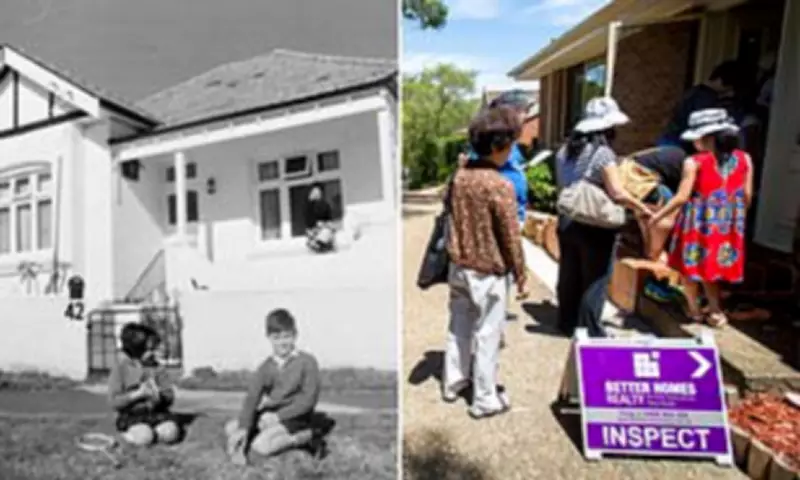
The Australian middle class is disappearing at an alarming rate, with families, workers, and retirees being systematically priced out of the lifestyle that was once considered standard. For 25-year-old university student and barista Saxon, the prospect of owning a home in a safe, comfortable suburb has transformed from a distant goal into an outright fantasy.
The Crumbling Foundations of the Australian Dream
Where previous generations planned lives built around mortgages, marriages, and children, Saxon's aspirations have become far more modest: paying rent without panic, taking one annual holiday, and not having to hesitate before purchasing a daily coffee. "Without parental assistance or government support, it's impossible to live, let alone study to secure better employment," he explained to the Daily Mail. "Most people I know would love to own a home, get married, and have children, but I don't believe that's realistic anymore unless you're financially comfortable."
Income Versus Reality
Despite Australia's middle-class income band officially ranging between approximately $60,000 and $150,000, the median full-time salary of $78,000 is no longer sufficient to sustain a middle-class lifestyle. This financial strain is exacerbated by skyrocketing rents, escalating mortgage costs, and surging expenses for childcare and healthcare.

Australia now hosts 48 billionaires who collectively possess more wealth than the bottom 40 percent of the population combined, according to a recent Oxfam report. Oxfam Australia chief executive Jennifer Tierney highlighted that the wealth divide has expanded dramatically since the pandemic, with over 3.7 million people currently living in poverty.
"While millions of Australians are cutting back on essentials, struggling with soaring rents and mortgages, and observing global crises, Australia's billionaires are accumulating extraordinary wealth at an extraordinary pace," Tierney stated. "The gap between those facing the toughest challenges and those benefiting the most is stark and well documented."
The Emergence of a U-Shaped Society
Demographer Simon Kuestenmacher has warned that the nation is sliding into a "U-shaped society," divided between asset-rich homeowners and a growing cohort permanently excluded from homeownership. He noted that the middle class has contracted significantly, with only 58 percent of Australians now classified as "middle-income," which is below the OECD average and substantially lower than in previous decades.
"Middle-class jobs have largely disappeared, leaving more people at the lower end and more at the upper end," Kuestenmacher explained.
Historical Contrast and Current Crisis
By the 1980s, most Australians identified as solidly "middle class," enjoying a modest home complete with a Hills Hoist clothesline and an annual holiday. Today, those foundations are fracturing, with the soaring cost of simply maintaining shelter delivering the most devastating blow to the middle-class dream.
The Great Australian Dream is fading as house prices—now more than triple what they were in the 2000s—outpace wages, forcing prospective buyers into record debt or completely out of the market. Domain data reveals that a typical couple purchasing their first home can no longer afford an entry-level house in any Australian city. Five years ago, only Sydney was unattainable; today, the Harbour City's entry-level median price stands at $1.15 million, a 64 percent increase since 2020.
Brisbane has doubled to $860,000, Perth has reached $780,000, and Adelaide has more than tripled to $720,000. For a Sydney couple aged 25–34 earning the median income, servicing even the most affordable house now consumes 62 percent of their pay—double the amount from five years ago.
Domain's chief of research and economics, Dr Nicola Powell, emphasized that buyers are assuming greater financial risk than at any time in the past decade. "This is no longer just a Sydney problem. Brisbane, Adelaide, and Perth, once viewed as more attainable, have experienced rapid growth in entry-level prices, pushing them much closer to the least affordable markets," she said. "Units have traditionally served as the stepping stone into homeownership, but even that pathway is narrowing. In several capitals, unit buyers are now stretching themselves into mortgage stress."

The Transformation into a Nation of Renters
Census data indicates that the national home ownership rate peaked at 71 percent in 1966, declining from 70 percent in 2006 to 66 percent in 2025. This decline is most pronounced among younger Australians, with ownership for those aged 25–34 plummeting from 61 percent to 43 percent.
The rate for individuals aged 55–64 has seen only a modest decrease, from 81 percent to 76 percent, although more Australians in this age bracket are carrying mortgages for longer periods. Renting, once a temporary phase in one's twenties, has become a long-term reality across more life stages. Since 1981, the proportion of Australians renting has increased from 27 percent to 31 percent.
Intensifying Financial Pressure
Meanwhile, the financial squeeze is worsening. Rising interest rates, soaring grocery bills, and relentless rent hikes are eliminating any opportunity to save. Cotality data shows that rents have risen three times faster than wages over the past five years—increasing by 44 percent compared to a 17 percent wage growth.
Affordability has also reached a new low: renters now spend one-third of their pre-tax income on housing, driven by tight vacancies, limited supply, and demand that consistently exceeds availability.
Essential Workers Priced Out of Housing
Alarming national heatmaps reveal that essential workers in schools, hospitals, and healthcare cannot afford to pay rent in large portions of the country. Anglicare Australia research found that holding a secure job in a critical sector no longer guarantees the ability to afford shelter.
Across Australia, only 1,117 rentals (2.3 percent) were affordable for an ambulance officer, 850 (1.7 percent) for an aged care worker, 754 (1.5 percent) for a nurse, and a mere 417 (0.8 percent) for both an early childhood educator and a hospitality worker.
International Comparisons and Policy Solutions
Economist Leith van Onselen suggested that Canada provides a template for addressing Australia's housing crisis, which he attributed to the country's largest immigration surge in history. "Canada is actively solving its rental crisis by curbing immigration. Why won't the Albanese government do the same for Australia?" he questioned.
He noted that the sharp deceleration of Canada's population growth has been most evident in the rental sector, with Canadian asking rents declining for 16 consecutive months to reach a 31-month low. "In 2024, Canada's centre-left Liberal government implemented major immigration restrictions intended to alleviate housing and infrastructure pressures," van Onselen explained.
The vanishing middle class represents not merely an economic shift but a fundamental transformation of Australian society, where the traditional pathways to stability and prosperity are becoming inaccessible to an increasing number of citizens.