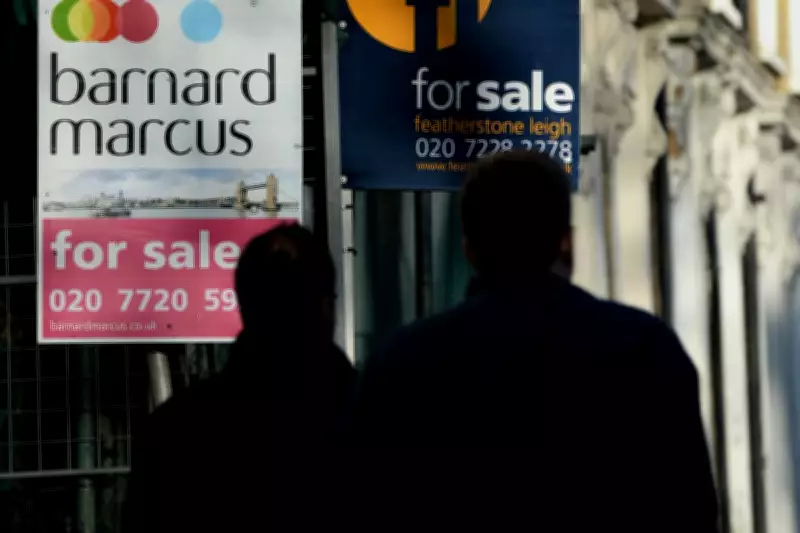
Mortgage Market Sees Unprecedented Rate Inversion
Homeowners across the United Kingdom are facing what financial experts describe as "pricing turmoil" within the mortgage sector. In a highly unusual development, average rates for five-year fixed residential mortgages have now become cheaper than their two-year counterparts, marking a significant inversion in traditional lending patterns.
Rate Movements and Market Volatility
According to the latest data from Moneyfacts, the average two-year fixed residential mortgage rate climbed to 5.56 percent on Wednesday morning, representing an increase from 5.51 percent recorded on Tuesday. This upward movement means it now exceeds the average five-year fixed residential mortgage rate, which also experienced an uptick to 5.54 percent on Wednesday from 5.52 percent the previous day.
Rachel Springall, a finance expert at Moneyfactscompare.co.uk, provided insight into this developing situation. "The turmoil in fixed mortgage rate pricing has worsened, as ongoing hikes have made the two and five-year fixed rates invert, where five-year is slightly cheaper on average," she explained.

Springall continued: "Swap rates, which lenders use to price mortgages, have been inverted for several days now, so it was only a matter of time before the market caught up. There is hope this will be a temporary blip until the markets settle down, but that depends on how long the current volatility persists."
Historical Context and Market Forces
This market abnormality represents a departure from traditional lending patterns, where shorter-term deals typically offer lower rates than longer-term commitments. Springall noted that a similar inversion occurred following the fallout from the mini-budget, taking approximately three years to resolve.
"This is unusual, however it's all down to how the markets foresee interest rate setting," Springall elaborated. "Many expect higher rates over the shorter-term. The unrest in the Middle East is causing concerns over the path of interest rate setting, with inflation expected to spike in the months ahead."
Shrinking Options and Rising Costs
The uncertainty surrounding future interest rates has had a damaging impact on mortgage availability. According to Moneyfacts data, over 1,500 options have disappeared from the residential mortgage market since the beginning of March, leaving fewer than 6,000 available products.
"If deals return within the coming days, they will likely be at inflated rates to catch up with the current state of play," Springall warned. "After all, a volatile mortgage market tends to be a more expensive one for borrowers."
House Price Trends Across the UK
These mortgage developments coincide with new housing market data from the Office for National Statistics (ONS). The average UK house price increased by 1.3 percent in the 12 months to January, showing a slight easing from the annual growth of 1.9 percent recorded in December.
Across the United Kingdom, the average house price in January stood at £268,000. Regional variations showed:
- England: £290,000 (1.1 percent annual growth)
- Wales: £210,000 (2.0 percent annual growth)
- Scotland: £188,000 (1.3 percent annual growth)
- Northern Ireland: £196,000 in Q4 2025 (7.5 percent annual increase)
Inflation Concerns and Economic Outlook
The ONS also reported that the Consumer Prices Index (CPI) inflation rate remained unchanged last month from the level reported in January. However, experts caution that these steady figures have not yet reflected the impact of the Middle East conflict on rising prices.
David Hollingworth, associate director at L&C Mortgages, commented: "The sharp change in outlook for inflation as a result of rising oil and gas prices has already sent mortgage rates substantially higher than at the beginning of March. Markets are anticipating that interest rates will remain higher for longer and are now factoring in interest rate rises."
Hollingworth highlighted the dramatic shift in market expectations: "That's a far cry from only a few weeks ago where an expectation of further cuts was the consensus. That swing is causing significant volatility and fixed-rate mortgages continue to be priced higher by lenders."

Regional Variations and Market Response
The North West of England emerged as the region with the highest annual house price inflation in January, recording growth of 3.1 percent. In contrast, London experienced a 1.7 percent annual decline in average house prices during January, marking the sixth consecutive month of annual falls.
Jason Tebb, president of OnTheMarket, explained: "Values in London continue to contract due to increased supply and stretched affordability in the capital where property prices tend to be considerably higher than other parts of the country."
Rental Market Developments
The ONS also provided data on the rental market, revealing that the average monthly private rent in the UK reached £1,374 per month in February. This represents a 3.5 percent increase, or £47 higher, compared to the same period one year earlier.
Industry experts continue to monitor these developments closely as homeowners navigate an increasingly complex and volatile property market landscape.