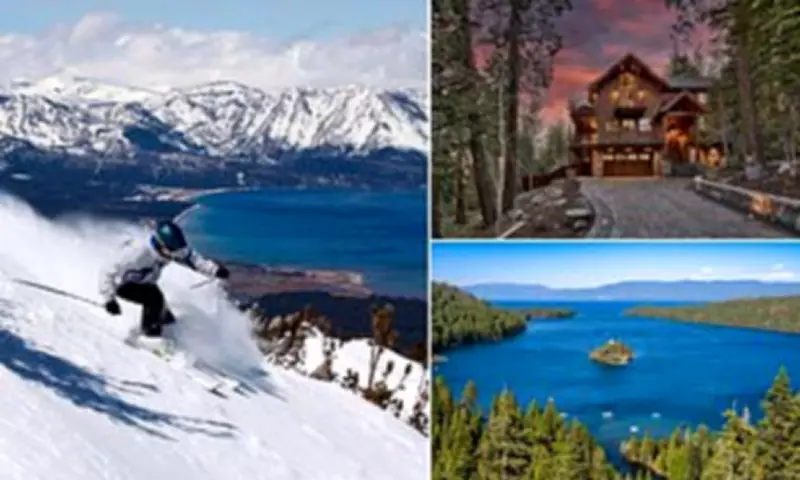
Lake Tahoe has solidified its status as one of America's most coveted yet financially inaccessible residential destinations, with inhabitants reporting that conditions are deteriorating rapidly. The proliferation of so-called 'mushroom homes'—compact, multi-level vacation properties that frequently remain vacant for extended periods—has exacerbated the shortage of long-term, affordable housing. These dwellings have multiplied throughout the region, and a recent ordinance passed by the South Lake Tahoe City Council is poised to accelerate their expansion further.
Council Approves Controversial Short-Term Rental Expansion
The South Lake Tahoe City Council has enacted significant modifications to local regulations governing short-term rentals. The total cap on permits for such properties has been elevated to 900, representing an increase from the previous limit. Concurrently, a longstanding mandate requiring a minimum separation of 150 feet between short-term rental properties has been abolished entirely.
This buffer rule had previously functioned to distribute short-term rentals more evenly across residential neighborhoods by prohibiting permit issuance to homes situated within 150 feet of another licensed property. Its elimination now permits these rentals to operate in much closer proximity, thereby facilitating a substantial influx of additional homes into the short-term rental marketplace.

Economic Benefits Versus Community Costs
Municipal authorities contend that these regulatory adjustments will bolster the local economy, potentially enabling approximately 300 properties that were previously denied permits to now submit applications. However, numerous residents argue that the move will amplify pressure on the housing market by diminishing the inventory of homes available for long-term occupants, rendering affordable housing even more elusive.
One long-term Tahoe resident expressed profound dismay on Reddit, stating: 'It is genuinely heartbreaking to observe the complete dismantling of communities driven by avarice. I previously encountered individuals from diverse socioeconomic backgrounds in local grocery stores—my child's educators, the postal service clerk, the plumber who serviced my home, even my primary care physician, who was compelled to relocate due to escalating housing expenses.'
Another commentator added: 'I concur. I returned to the mountains seeking the communal atmosphere I recalled from my childhood. Presently, neighborhoods are predominantly either vacant, function as short-term rentals, or house overcrowded groups of financially strained locals. This transformation has eradicated the sense of community entirely.'
Survey Reveals Severe Housing Cost Burdens
A comprehensive survey conducted last year within the Tahoe Basin disclosed that 66 percent of respondents are housing cost-burdened, allocating between 30 percent and 50 percent of their income toward rent. Critics caution that this alarming statistic may deteriorate further as additional properties transition to short-term rental operations.
Participants identified escalating rents, mounting insurance and utility expenditures, and substandard housing conditions as their most pressing challenges. Housing instability is emerging as a growing concern, with approximately 15 percent of respondents reporting experiences of homelessness while residing in the Tahoe Basin. Some individuals disclosed sleeping in vehicles or frequently shifting between friends' residences.
National Context and Local Resistance
Across the United States, numerous municipalities have implemented restrictions or outright prohibitions on short-term rental platforms like Airbnb to address housing shortages and surging rental costs, thereby returning thousands of properties to the long-term market. Stringent regulations—including mandatory registration, zoning limitations, and owner-occupancy requirements—are now commonplace in cities such as New York City, New Orleans, and Irvine.
Despite considerable resident advocacy, South Lake Tahoe is diverging from this trend by retreating from a comprehensive residential ban on short-term rentals. A proposal to cap the number of second homes within the city was rejected by the council in late March, representing a pivotal moment in the ongoing conflict surrounding 'mushroom homes.'

Council Member Voices Disappointment
Council member Scott Robbins, who advocated for the second-home cap, expressed his dissatisfaction with the outcome to the San Francisco Chronicle. He remarked: 'Families have evacuated Tahoe, supplanted by retirees and second-home proprietors who do not reside here permanently. The consequence is a diminished workforce, a reduction in businesses catering to local necessities rather than tourist demands, and a disastrous decline in educational funding.'
According to data from the San Francisco Chronicle, over 7,100 housing units in the city are classified as 'vacant,' with nearly 6,000 designated for seasonal, recreational, or occasional utilization. In certain northern shore areas, including the Sunnyside–Tahoe City vicinity, vacancy rates approach 70 percent based on the most recent census figures.
Property Prices Reflect Mounting Strain
Real estate valuations underscore the intensifying crisis. Information from Realtor.com indicates that the median listing price in South Lake Tahoe approximates $728,000—approximately 75 percent higher than the national median of about $415,000. Rental costs are similarly inflated, with average monthly expenditures around $2,000 compared to the national average of $1,895.
Robbins further commented: 'There is excessive deference to the interests of real estate agents who desire continuous property price escalation. As long as this dynamic governs local governance in resort communities, we will not witness substantive, rigorous resolutions to the housing emergency.'