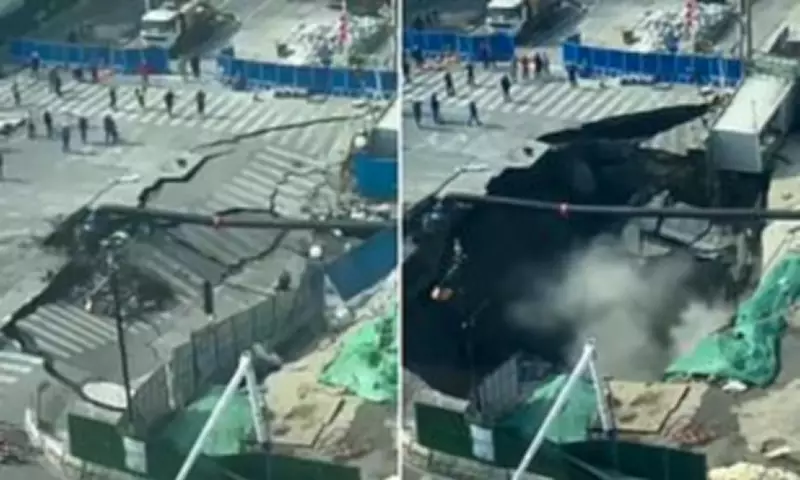
Dramatic Sinkhole Collapse at Shanghai Construction Site
This is the incredible moment a huge sinkhole swallowed a road at a construction site in China, sending workers fleeing for their lives. Dramatic CCTV footage shows cracks splitting the tarmac before the ground suddenly gives way, devouring nearby structures and leaving a gaping void.
Workers Escape Unharmed in Sudden Ground Collapse
Builders sprinted to safety as dust billowed into the air at the newly built intersection in Shanghai on Wednesday. Social media users suggested the collapse was triggered by a leak at a nearby subway construction site, according to local media. Local authorities confirmed that there were no fatalities or injuries.
The incident occurred at the junction of Qixin Road and Li'an Road, an area undergoing significant underground works for a new Metro Line. Shanghai municipal authorities later cordoned off a large perimeter around the affected area.

Geological Vulnerabilities and Human Factors
The city faces persistent subsidence risks due to soft alluvial soils, excessive groundwater extraction, thin sand layers, and voids created by urban construction. China is particularly vulnerable to sinkholes because large swathes of the country sit on so-called karst terrain, where soluble rocks such as limestone and dolomite are gradually eaten away by groundwater.
Over time, this natural erosion creates vast underground voids and caverns which can suddenly collapse without warning. Heavy rainfall can accelerate the process by seeping into cracks in the rock and widening them, especially in southern provinces such as Guangxi, Guizhou and parts of Sichuan, where dramatic karst landscapes dominate.
When the roof of an underground cavity becomes too thin to support the ground above, it can give way abruptly, swallowing roads, buildings or farmland.
Historical Context and Recent Incidents
In January 2024, a road in Minhang District collapsed around 10 metres after a sewage pipe failure, though no injuries were reported. Data from 2017-2023 shows that 72% of sinkholes in China were linked to human activity, including construction faults and ageing infrastructure.
Rapid urban development has also been blamed for worsening the risk. Construction, groundwater extraction and poorly regulated drilling can destabilise already fragile ground, increasing the likelihood of sudden collapses in densely populated areas.
In recent years, China has reported a string of dramatic sinkhole incidents, with cars and even entire sections of street disappearing into the earth, prompting renewed concerns about infrastructure safety in fast-growing cities.
Major 2020 Sinkhole Incident Recalled
In 2020, a massive sinkhole swallowed 21 cars in south-western China after the pavement of a street suddenly gave way. Authorities said no one was hurt in the incident, which occurred in Sichuan Province. Around 500 square metres (5,380 square feet) of the road collapsed, according to state media.
Footage released by the provincial TV station SCTV shows parked vehicles disappearing in the sinkhole after the road suddenly gave way. This incident highlights the ongoing challenges China faces with geological stability amid rapid urban expansion.