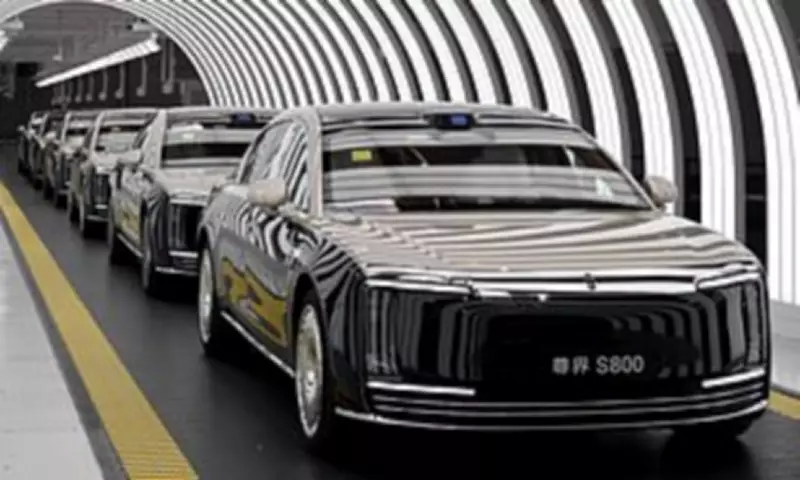
A futuristic 18-foot-long limousine that appears to have emerged directly from a European luxury design studio represents the latest achievement of China's rapidly advancing high-tech automotive industry. The Maextro S800 sedan, featuring sweeping two-tone paintwork and a lavishly trimmed leather interior, bears an unmistakable resemblance to a Rolls-Royce at first glance.
High-End Technology and Ambitious Push
Beneath its polished surface, the Maextro incorporates cutting-edge technology as Chinese manufacturers make an ambitious push into the ultra-luxury segment. Built in Hefei, China, the £130,000 gold-trimmed vehicle is assembled with the assistance of over 1,000 robots and powered by technology from Huawei, the Chinese tech giant globally renowned for its smartphone and electronics empire.
This car signifies a broader strategic shift among Chinese automakers, who have already established dominance in the affordable electric vehicle market and are now targeting the luxury end. They are acutely aware that they lack the century-old prestige of brands like Mercedes or Rolls-Royce. Instead, their approach is brutally modern: overwhelming customers with technology, screens, and gadgets.

Interior and Features
Inside the Maextro, rear passengers enjoy a 40-inch display and a sound system boasting around 40 speakers, transforming the back seat into something closer to a private cinema than a traditional limousine cabin. The car can also park itself, reinforcing its futuristic positioning. All of this comes at a striking price point for the segment. Fully equipped versions cost roughly £130,000, while a more stripped-down model can be purchased for about £77,000 — still dramatically below the cost of entry-level Mercedes-Maybach models and a fraction of what a Rolls-Royce commands in the United States.
Car expert Thomas Luk told the WSJ: 'This is a maxed-out car for a very affordable price,' adding that the Maextro 'is definitely challenging the Maybach and the 7-series BMW.' Such claims would once have sounded implausible, but Chinese manufacturers have been steadily reshaping the global car industry.
China's Export Surge and Global Ambitions
In 2020, China exported around one million vehicles worldwide. Last year, that figure surged past seven million, cementing the country's position as the world's leading car exporter. For now, the Maextro is sold exclusively within China, though Huawei has made clear it intends to expand internationally in the future. Geopolitical tensions complicate that ambition. Huawei products are effectively barred in the United States under sanctions introduced during the Trump administration, making an American launch highly unlikely even if broader EV restrictions ease.
Huawei itself — a sprawling conglomerate spanning semiconductors, consumer electronics, and more — is applying a distinctly smartphone-era philosophy to the automotive world. Its software powers Maextro's autonomous driving systems and in-car entertainment. Manufacturing is handled by Hefei-based JAC Motors, partly owned by Volkswagen and historically associated with budget vehicles. Yet its role is deliberately understated in marketing, with Huawei taking centre stage in the brand identity instead.
That positioning is reinforced in showrooms, where the Maextro is displayed alongside Huawei's high-end consumer products, including multi-thousand-dollar foldable phones and diamond-studded smartwatches — blurring the line between carmaker and tech brand.
Demand and Future Plans
Demand appears strong. According to Huawei, more than 17,000 Maextro vehicles have been delivered since the launch a year ago. Buyers include entrepreneurs and senior executives, while some companies are reportedly using the model as a chauffeur-driven executive limousine. Huawei executive Richard Yu also signalled even more ambitious plans ahead, stating in April that a new ultra-premium model could arrive as soon as June, with a price tag approaching £225,000.

Experiencing the Maextro firsthand reveals just how aggressively it leans into futuristic luxury. Entry into the vehicle begins with a clenched fist motion detected by an exterior camera, echoing smartphone-style controls, according to WSJ reporter Peter Landers, who took a ride in a Maextro. Inside, further gestures replace physical interaction. A wave closes the door, while a swipe darkens the window shades. The rear cabin reclines almost fully flat, resembling a business-class airline seat, complete with massage functions as standard.
Soft carpeting, ambient lighting, and a starry ceiling — a clear nod to Rolls-Royce design cues — aim to complete the sense of floating comfort expected in the ultra-luxury segment. On the road, however, the experience is more experimental than perfected. Huawei believes Level 3 autonomous driving, where drivers can disengage from active monitoring in certain conditions, could receive wider approval in China as early as next year. While the technology is undeniably advanced, the ride quality still appears to be evolving. The suspension and smoothness, at least for now, do not fully match the refinement expected in long-established European luxury cars.