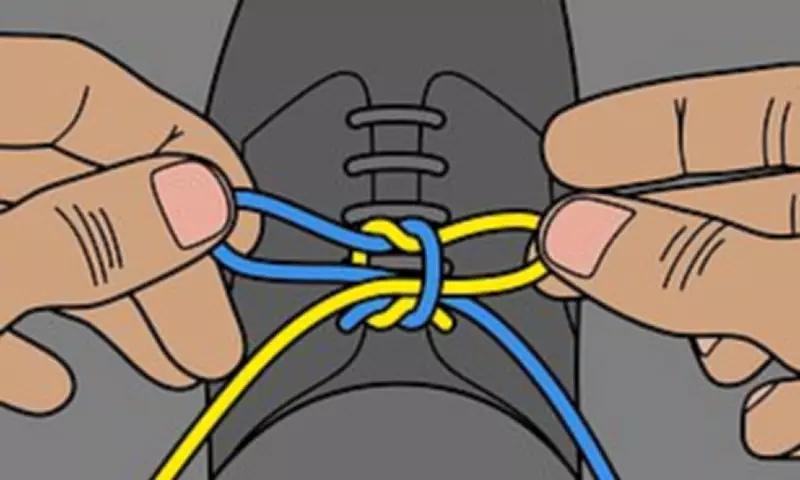
Knot Expert Reveals You've Been Tying Shoelaces Wrong All Along
Whether you learned with the classic 'bunny ears' technique or the 'around the tree' method, tying your shoelaces is a skill most people master in childhood. However, experts now assert that you have likely been doing it incorrectly your entire life. Knot specialist Ian Fieggen, famously known as 'Professor Shoelace', claims there are far more efficient ways to tie a knot than the traditional approaches. From straightforward and sturdy options like the Reef Knot to intricate designs such as the Turquoise Turtle Shoelace Knot, there are actually 25 distinct knots tailored for every conceivable scenario. Remarkably, one method can be tied in less than a second, revolutionizing your daily routine.
The Fastest Knot: The Ian Knot
If speed and efficiency are your primary objectives, Mr Fieggen's personal favourite, the Ian Knot, is the ideal choice. This knot emerged from his quest to create a perfectly symmetrical design that would wear down laces evenly. As a beneficial side effect, with a bit of practice, it results in a knot that is astonishingly quick to tie. Mr Fieggen explained to the Daily Mail: 'The Ian Knot's main selling point is speed – it's almost magically quick. The technique requires fewer movements, and they're done with both hands simultaneously.' To execute this knot, start with a simple left-over-right knot, form loops with each end, twist them anti-clockwise, cross the loops, and pull through to tighten. Its symmetrical structure not only enhances speed but also improves durability.
The Science Behind Secure Knots
Dr Alexander Klotz, a physics expert from California State University, highlights that a common mistake is accidentally tying a granny knot, which looks similar to a standard bow but lacks stability. This false knot reduces friction within the laces, making it prone to unravelling. A 2017 study found that granny knots failed more frequently during simulated walking. The Ian Knot avoids this pitfall due to its symmetrical technique, ensuring secure laces every time. Dr Klotz notes that shoelaces come undone because material in the loops swings with each step, pulling on the knot as inertia loosens the centre. Therefore, the best knots incorporate as much lace as possible into the central knot to minimize this effect.

The Most Secure Knots: Double and Mega Ian Knots
For those prioritizing tightness over speed, Dr Klotz recommends the Double Ian Knot and Mega Ian Knot. These variations use the same technique as the Ian Knot but involve repeating the process or starting with double loops, respectively. This design places more lace in the knot rather than the loops, reducing inertia from movement and enhancing longevity. Dr Klotz explains: 'I think it's important that knots are tied in ways that prevent the loops from swinging too much. Knots in which more of the laces are part of the core and less in the loops would prevent this failure mechanism.' These knots are comparable to traditional options like the Tibetan Trekking Knot but offer symmetrical construction that reduces wear.
A Comprehensive Guide to 25 Shoelace Knots
Mr Fieggen has catalogued 25 different methods for tying shoelaces, ranging from basic to complex. Key examples include:

- Standard Shoelace Knot: Also known as 'loop, swoop, and pull', it is the simplest approach.
- Two Loop Shoelace Knot: The 'bunny ears' method ties two loops together.
- Ian's Secure Shoelace Knot: A symmetrical knot with enhanced security.
- Surgeons Shoelace Knot: Involves an extra loop for added tightness.
- Turquoise Turtle Shoelace Knot: A complex, secure variation of the two-loop knot.
- Reef Knot: A standard square knot made from two mirrored overhand knots.
- One Handed Shoelace Knot: Designed for quick, single-handed tying.
Mr Fieggen reflects: 'I'm like most regular people in that I've never had a hobby or career that requires knotting proficiency. But I do tie my shoelaces, and so does almost everyone. It therefore fascinates me that other regular people, with similar lack of knot literacy, have come up with different solutions to the age-old problem of shoelaces coming undone.' This exploration into knot physics and technique offers practical insights for improving everyday tasks, proving that even the simplest actions can be optimized for better performance.