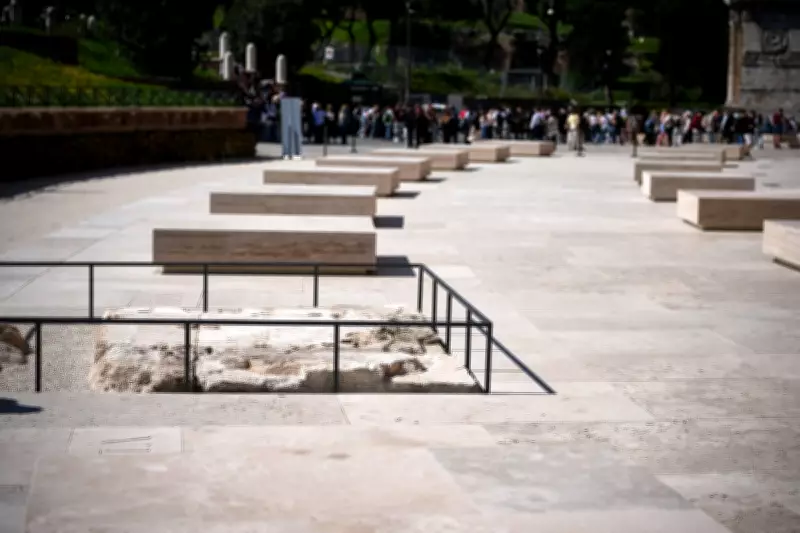
Rome's iconic Colosseum has been transformed with a striking new restoration that meticulously recreates the footprints of long-vanished columns using the same travertine marble employed by ancient Romans over two millennia ago. This ambitious project revitalises a semicircular piazza outside the arena, offering visitors a tangible connection to the structure's storied past while enhancing its status as Italy's premier tourist attraction, which drew nine million visitors in 2025 alone.
Reimagining Ancient Arcades with Authentic Materials
The restoration focused on the area where Roman spectators once gathered under two grand arcades, each featuring marble columns soaring up to fifty metres high. These architectural marvels, which served as waiting areas for crowds entering the Colosseum, collapsed centuries ago due to earthquakes and unstable ground. Now, tourists can sit on large travertine marble slabs precisely positioned where the original pillars stood, accompanied by reproductions of Roman numerals that once indicated seat sections, providing an immersive historical experience.
Architectural Vision and Historical Insights
Italian architect Stefano Boeri, the designer behind the piazza, explained that the goal was to restore public perception of the arcades' proportions and the vaulted arches used for entry. "These blocks of travertine marble are placed exactly where the original pillars were based," Boeri stated. "Our idea was to give back to the public the sense of scale and grandeur that defined this ancient entrance."

During the restoration, workers dug a metre deep to uncover the original travertine paving stones, unearthing a trove of artefacts including coins, statues, animal bones, and a gold ring. Below this layer lies a secret underground passageway, once used by Emperor Commodus to enter the Colosseum discreetly, which opened to the public last year, adding another layer of historical intrigue.
Sourcing Stone from Ancient Quarries
The new travertine slabs were sourced from the very quarries that supplied ancient Rome, now also used for modern constructions like religious buildings, banks, and museums. Fabrizio Mariotti, head of the Mariotti Carlo stonecutting firm in Tivoli, emphasised the project's significance: "For a family like ours, working with travertine for four generations, contributing to the Colosseum—a symbol of both Rome and this material—is profoundly important." His firm has specialised in custom travertine carving for generations, underscoring the continuity of traditional craftsmanship.
Funding and Broader Urban Developments
The restoration was funded through compensatory resources from a multi-billion euro metro project, which recently completed with two new subway stations, one located deep beneath the Colosseum. This integration of archaeological preservation with contemporary infrastructure highlights Rome's commitment to balancing heritage with modern urban needs. The piazza's previous state, overgrown with weeds and littered with ruins, has been transformed into a clean, accessible space that honours the Colosseum's legacy while catering to today's visitors.
By blending historical accuracy with innovative design, this project not only safeguards the Colosseum's architectural heritage but also enriches the tourist experience, ensuring that the echoes of gladiatorial battles and ancient crowds continue to resonate for generations to come.