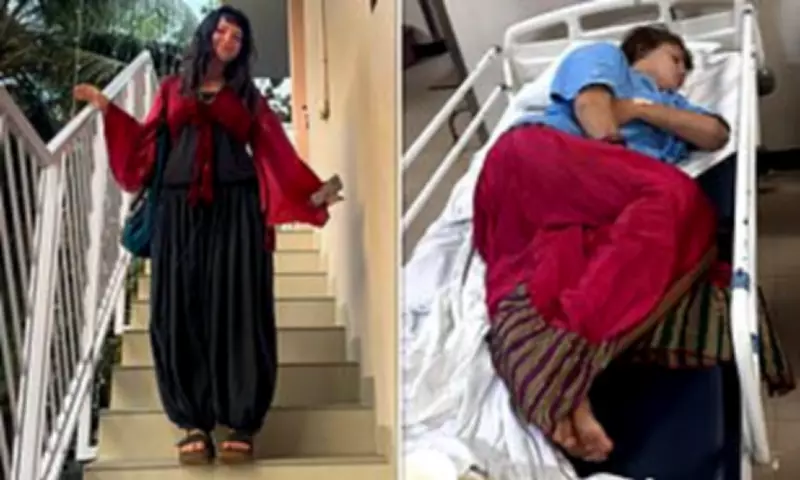
The promise I had made to myself to keep my emotions in check broke the second I stepped into the intensive care unit of the hospital. For almost five long days my daughter Olivia had lain, bloodied and bruised, on a metal bed in that noisy, filthy ward in Goa. Tears flooded down my cheeks as soon as I saw her, so tiny in her blood-soaked hospital-issued powder-blue smock.
For the most part she had been in a coma, following a horrific road accident on May 5, days before she was due to fly home after a gap year adventure in India. When I entered the ward, she was at least awake, if very drowsy. For a long time, amid the agonised yells of other patients and the beeping of medical equipment, we just hugged each other.
The last time I had held my daughter in a hospital was the day she was born, 21 years ago, in Aberystwyth. Now she seemed as vulnerable as she had then, especially as it was obvious that her injuries went beyond what we could see. While she recognised me, it became clear Olivia had almost no short- or long-term memory and was mostly incoherent.

And as grateful as I was that the team at Goa Medical College in Bambolim had, without doubt, saved her life, I was horrified at the lack of resources. Arriving at the hospital with my youngest daughter, Beatrice, 19, we had to step over numerous dogs sleeping in sweltering 40-degree hospital corridors as we made our way to the ICU, or Ward 120 as the makeshift sign pinned to a wall informed us. At one point a huge rat had scuttled across our path and into a cupboard. Outside, piles of filth were left rotting against low walls.
Our arrival came after I had the conversation every parent of a child embarking on a gap year overseas dreads. Four days earlier Beatrice, in her second year of a psychology degree at Manchester University, had called me to ask if I had heard from Olivia in the past 24 hours. 'Not to stress you, Dad, but I haven't heard from Liv since 11am yesterday,' she said. I hadn't heard, no. The lack of contact was unusual because Olivia liked to touch base with one or both of us – and her mother, my almost ex-wife – several times a day.
According to Beatrice, Olivia had planned a last evening out before she flew home: dinner at a tapas restaurant run by a surfer friend, a 15-minute scooter ride from the coastal village where she was staying in northern Goa. Scooter! The word alone sent ice cold shivers through me. We had already had a scare in January when, in the dark, her scooter had collided with a metal bar sticking out of a building. Olivia was not wearing a helmet and was knocked unconscious. She was saved by the kindness of a local man, driving behind her, who gently picked her up from the middle of the road and took her to a nearby medical centre.
She refused to consider flying home early, and sadly it did not stop her scooter habit – it is just how people get around in this part of the world – despite my pleas. So when it emerged no one had heard from her for more than 24 hours, I worried. This turned to panic when calls and messages to her mobile, which were normally answered instantly, were ignored. My imagination went into overdrive: had she had another smash, been attacked or befallen some other, unspeakable event?
I racked my brains for the name of the hostel where she had been staying. Eventually I managed to speak to its owner, Ravi. He had seen her the day before but not since. He would make some calls, he said. 'Don't worry, we'll find your daughter, Sir,' he assured me. And he was true to his word. But it was not good news. Within a couple of hours he had established that my dear Liv had been involved – again – in a very serious road accident and had been taken by ambulance to a hospital in southern Goa. He did not know where.
I spent the next hour frantically ringing almost every hospital in the region until finally a voice on the other end of the line almost 5,000 miles away said: 'Miss Olivia? Yes, we have her here.' Relief and fear swept through me as I was transferred to the ICU, where one of the medics gave me more details, all terrifying. 'Your daughter has been critically injured,' Dr Samira told me. 'She collided with another scooter at 50 to 70kph [30 to 40mph] and was not wearing her helmet. She has a subdural hematoma with intusion, or bruising, and a bleed on her brain measuring 3.6mm.'

A very serious brain injury, in other words, that, I was later to discover, had nearly cost her her life as she slipped into a coma in the hours after the accident. There was no let-up in the torrent of details sweeping down the line. She was being treated with steroids and slipping in and out of consciousness. Another CT was planned in four days to see if the clot had gone down. 'If it hasn't, she will require urgent surgery,' Dr Samira continued. 'The neurosurgeons will drill holes in her skull in order to drain the blood.' I nearly passed out at this point. It was clear I needed to get to her as quickly as possible.
Inevitably, my thoughts drifted to the death just a month earlier of Orla Wates, the 19-year-old gap year British student who had lost her life in a scooter accident in Vietnam. I wondered how her parents were coping. I also remembered having flagged the tragedy up to Olivia in one of our many 'Please ride carefully' conversations. Forty-eight hours later, having secured visas, Beatrice and I were at Heathrow Airport preparing to fly to Goa, via Delhi. Born just 21 months apart, the girls are extremely close and I knew Beatrice would want to come. We decided it would be easier for their mum to stay at home while I made the trip, as I have greater flexibility work-wise. But we promised to keep her updated constantly.
About to touch down in a country I had never visited before in the most awful of circumstances, I had little idea what to expect. All I knew was that I was going to have to present an unshakeable belief to Olivia – and Beatrice – that she was going to pull through, even if I was not sure I believed it myself. What I had read online about her injuries filled me with gloom – these are head injuries that are frequently fatal. The half-hour taxi ride from the airport to the hospital gave me a better understanding of how Olivia ended up there. The potholed roads teemed with scooters, cars, buses and lorries, all manoeuvring around each other with millimetres to spare. It was simply terrifying.
But had not she always been an adventurous kid? I remembered six-year-old Olivia insisting on competing in a cycle race for under-18s in Cardigan, west Wales, where she grew up. She was by far the youngest. The start line was a throng of teenagers, most representing local cycle clubs, all vying for the win. But she got the biggest cheers from the crowd as she pedalled her bright pink bike furiously through the town, beaming with pride as she finished a thoroughly creditable last! It was in the same spirit that Olivia left the UK for India in December.
Unlike most gap-year children she had already done two years at university, but last summer decided to defer her final year at Goldsmiths, University of London, where she is studying for a media and communications degree. Olivia had become disillusioned with university life, and Goldsmiths in particular, due to its increasingly Left-leaning political orientation. During her final term she had been unable to use the library because of a student sit-in, encouraged by lecturers, she said, over Palestine. She felt she needed a break from this intense political bubble. Travelling around India on her own and experiencing another culture would give her more perspective on the world, she hoped, and she had worked in bars and restaurants full-time for six months to save up for the trip.
While I had supported her decision, she had listened with growing impatience to my many warnings about the dangers she might face in India, not least because she was a beautiful young woman travelling solo. Having said goodbye to Olivia at her mother's house the night before she left, like every parent I was both impressed with her courage and fearful for her safety. Even now, I cannot comprehend Olivia's decision not to wear a helmet. Perhaps she thought lightning could not strike twice after the first accident. More likely she did not think at all because, at 21, sometimes you just do not. And I know, having witnessed the scooter riders myself, there are many who do not. Who of us can honestly say we have never done anything unwise in our younger years?
One of the many grave consequences of not wearing a helmet – or having the right driving licence – is that her travel insurance is void, leaving us in a deepening financial hole. So far it has cost around £7,500 on flights, hotels, private healthcare, food and travel, but this will only increase as we do not yet know when she will be well enough to come home. Goa Medical College discharged her within minutes of us arriving due to the number of patients they are battling to deal with. Immediately, I had to find a suitable hotel where her sister and I could nurse her ourselves. This was this despite the fact that Olivia still had a bleed on her brain – that meant it was up to us to monitor her symptoms. Any deterioration could mean she would need the brain surgery.
Then there was her almost total loss of memory. Although she remembered us, she believed her older brother Sam to be her uncle and, more tragically, had no memory of her beloved dog, Raj, or his death just days before Christmas last year. She did not remember where she went to school or even the things she enjoyed so much, such as horse riding and representing her country at cricket as a teenager. But she was – is – miraculously, alive. Olivia understands what has happened to her, but only because of what we have told her. She is not well enough yet to reflect on it. She can walk short distances, feed herself and talk, though often her conversation is gibberish. The other day, she asked me if we are still going to Russia later.
So 18 days on from the accident, we are still living in a hotel – a quiet place close to a private hospital where she is having regular scans and assessments. Olivia is still sleeping around 20 hours a day, something her neurosurgeon has assured us is normal. We have no date yet for travelling home as Olivia needs to be recovered enough to cope with the changes in air pressure on a plane. Her sister, meanwhile, has had to fly back to the UK for university exams, meaning that it is just the two of us now.
The road ahead for Olivia is long and slow. As well as her brain injury, she also has a severe facial gash that nearly resulted in her losing her left eye. Two weeks after she was discharged without, to the best of our knowledge, having had any X-rays or scans of her body, we have now discovered that she has two fractures in her wrist and lower arm, which is belatedly in plaster. Her teeth and jaw give her pain, too, but she has not been able to stay still for long enough to have those scanned yet.
What she needs now, her doctor tells us, is 'rest, rest and rest' plus medication – she is on everything from anti-epileptic drugs and strong painkillers to vitamins – and love. But he is hopeful of a full recovery – eventually – although it could take up to two years, even with lots of therapy. I am trying to tee up her treatment for when we get back but I have discovered that GPs are not allowed to communicate with patients when they are overseas. Even after speaking to some of the friends she made in India, and the police officer who investigated the accident, I still cannot get an accurate picture of what happened that night. Olivia has no memory of the collision, or the days leading up to it. The police officer told me the other scooter rider had suffered an ear injury but said no charges would be pressed. She was inside the speed limit, even at 40mph, and he thinks she simply hit a pothole in the dark and lost control.
I am aware, as A-levels draw to a close, that many parents back home will be having conversations with children wishing to embark on a gap year. It is not for me to thwart any child's hunger for adventure but I do urge them to approach every decision they make on their travels with the question: Is this wise? As for the parents who have to watch them go, on a practical level I wish that I had at least insisted on Olivia learning how to ride a motorbike and passing her test before she left. But as I watch her sleep, still so vulnerable, I think back to that baby girl I held, on that ward in Aberystwyth 21 years ago. I did not know what the future held for her then, and I still do not now. But I do know that, whatever it is, I will be here for her, with every baby step.