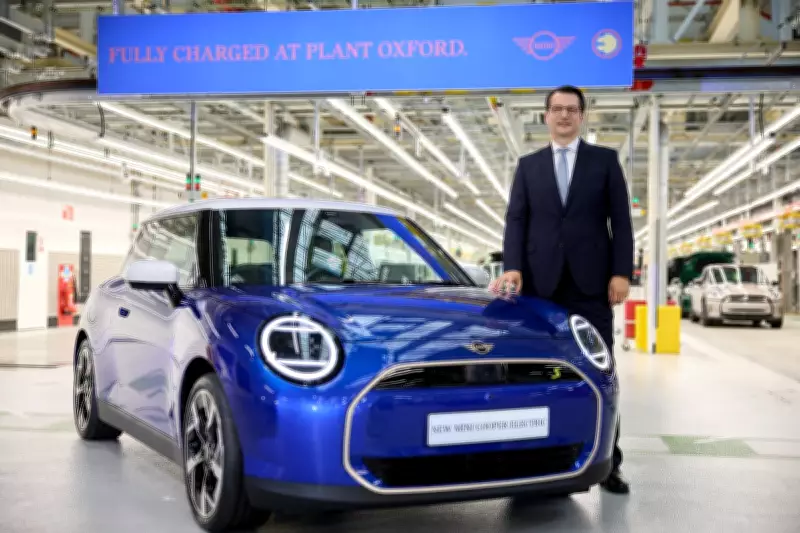
The European Union's proposed 'Made in Europe' policy, part of its broader Industrial Accelerator Act, has drawn sharp criticism from Milan Nedeljković, the newly-appointed chairman of BMW. Nedeljković, who currently oversees BMW Group's production operations including its UK factories, has labelled the plans as "dangerous" and "not helpful," echoing concerns previously voiced by his predecessor.
What the EU's Industrial Accelerator Act Entails
The Industrial Accelerator Act is designed to revitalise Europe's manufacturing base and accelerate the transition to low-carbon industries. A key component is the 'Made in Europe' initiative, which aims to promote locally-produced goods to strengthen European industry. Specifically, the act proposes that only electric vehicles manufactured within the EU should benefit from sales incentives and emissions credits. Furthermore, it would restrict EU member state government corporate fleets to purchasing exclusively EU-made vehicles.
Implications for BMW's UK Operations
BMW operates two significant manufacturing facilities in the United Kingdom: Mini Plant Oxford, which produces Mini Cooper models, and BMW Group Plant Hams Hall in Warwickshire, manufacturing engines for Mini, BMW, and Rolls-Royce vehicles. The proposed EU rules could severely complicate the export of these vehicles and components from the UK to European markets, posing a substantial threat to BMW's integrated supply chain.

Nedeljković articulated his concerns during a speech at the recently renovated BMW Group Plant in Munich, a facility that has undergone a €650 million (£562 million) upgrade to produce the new all-electric BMW i3. He emphasised, "Our business model is based on global free trade. Currently, this fundamental economic concept is coming under pressure. We in Europe must be careful not to fall behind."
A Continuation of Previous Criticisms
The incoming chairman's remarks follow similar criticisms from outgoing BMW chairman Oliver Zipse, who previously described the Industrial Accelerator Act as "protectionism." Nedeljković elaborated on this stance, stating, "In our view, the current proposal for the Industrial Accelerator Act is not helpful in this regard. It focuses on 'Made in Europe' while neglecting the supply chains of European corporations operating globally. This will lead to less innovation, lower growth – and finally to reduced prosperity in Europe – a development which is dangerous."
He further argued for a more forward-looking approach: "Europe needs to act more future-oriented by strengthening free trade – and creating a positive business environment. We are convinced: Europe needs a strong industrial footprint. Since industry is the basis for applied science and innovation. And we are part of it."
Potential Impact on the UK Automotive Sector
The repercussions for the British car industry could be significant. Mike Hawes, Chief Executive of the Society of Motor Manufacturers and Traders (SMMT), expressed grave concerns: "The UK automotive sector is gravely concerned by the 'Made in Europe' proposals set out in the European Commission's Industrial Accelerator Act. As drafted, it would discriminate against UK-made vehicles and components, damaging a trading relationship worth almost £70 billion annually."
Hawes highlighted the specific regulatory challenges: "The strict EU assembly rules and EU27 eligibility criteria currently proposed would effectively put UK manufacturers at a systemic competitive disadvantage in the EU market." This underscores the broader economic tensions and the potential for trade barriers to disrupt longstanding industrial partnerships post-Brexit.