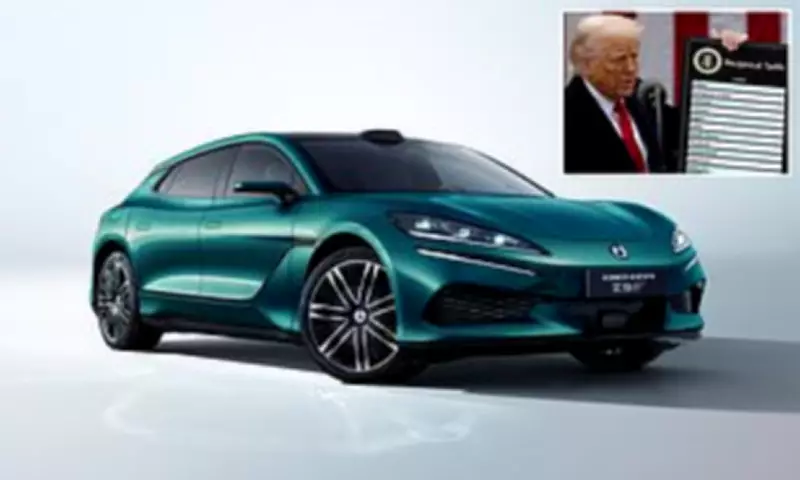
Canada is poised to welcome a wave of inexpensive Chinese electric vehicles onto its roads, a strategic move that threatens to undermine American car manufacturers and intensify an ongoing trade dispute with President Donald Trump. The Canadian government is actively working to expedite an agreement between domestic automotive dealers and major Chinese auto giants, including BYD, Chery, and Geely. Industry analysts predict that the first affordable Chinese EVs could arrive in Canada as early as this year, marking a significant shift in the North American automotive landscape.
Trade Policy Shift and Market Implications
Under a newly negotiated trade arrangement, Canada has dramatically reduced its tariff on Chinese-made vehicles. The previous prohibitive 100 percent duty has been replaced with a modest 6.1 percent tariff and an annual import cap of 49,000 vehicles. This policy reversal effectively removes the barrier that previously made it nearly impossible for Chinese automotive brands to compete in the Canadian market.
Jason Zhao, Director of Asian Market Development at automotive analysis firm DSMA, confirmed to Automotive News Canada that low-cost Chinese electric vehicles are expected to enter the country by the end of this year. This development comes at a particularly sensitive time in international trade relations.

Escalating US-Canada Trade Tensions
The Canadian initiative unfolds against a backdrop of escalating trade investigations launched by the Trump administration. Following the Supreme Court's rejection of President Trump's latest attempt to impose comprehensive global tariffs, the administration has ramped up trade investigations against dozens of countries, including Canada.
While Canada wasn't initially on Trump's investigation list under Section 301 of the Trade Act of 1974, the administration swiftly expanded its scrutiny to include sixty additional countries, with Canada among them. US Trade Representative Jamieson Greer emphasized the urgency of these investigations, telling CNBC, "We are trying to move very quickly. We are trying to move in a matter of months."
Broader North American Implications
The implications of Canada's policy shift extend far beyond its own borders. Because Canada and the United States share closely aligned vehicle safety and emissions standards, automobiles approved for the Canadian market can typically enter the US market with minimal regulatory friction. This effectively places low-cost Chinese electric vehicles just across the border from American consumers, creating what US automakers view as a significant competitive threat.
Ford CEO Jim Farley has already warned that such competition could pose an "existential threat" to American automakers. General Motors Chief Executive Mary Barra expressed similar concerns in January, stating that Canada's decision to allow tens of thousands of inexpensive Chinese EVs into the country represents a genuine risk to North American auto manufacturing.
"I can't explain why the decision was made in Canada," Barra remarked. "It becomes a very slippery slope."
Market Share and Regulatory Requirements
Under the new system, Chinese vehicles would account for approximately 3 percent of annual car sales in Canada. By the end of the decade, at least half of the imported Chinese EVs would need to be priced at about $26,000 or less, while all vehicles must still meet Canada's stringent safety standards.
Canada represents a substantial market for Detroit's Big Three automakers. In 2025 alone, Ford, General Motors, and Stellantis collectively sold more than 700,000 vehicles in Canada, making the potential influx of Chinese competition particularly concerning for these established manufacturers.
Political Context and International Relations
Canadian Prime Minister Mark Carney has framed the China deal as a strategic response to diminishing American influence in global affairs. Speaking at the World Economic Forum in Davos, Carney noted, "American hegemony, in particular, helped provide public goods, open sea lanes, a stable financial system, collective security and support for frameworks for resolving disputes. This bargain no longer works."

Despite this positioning, Carney later clarified that Canada has "no plans" to pursue a comprehensive free-trade agreement with China. This clarification came after President Trump warned he would impose a 100 percent tariff on Canadian exports if Ottawa struck a broader deal with Beijing.
USMCA Renegotiation and Broader Trade Dynamics
President Trump is simultaneously seeking to renegotiate the US-Mexico-Canada Agreement (USMCA), which governs $1.6 trillion in annual trade in goods among the three nations. Trump's top trade advisor indicated in December that the administration would be willing to withdraw from the pact entirely if satisfactory terms cannot be achieved, potentially opting for separate bilateral deals with each country instead.
This move leaves the United States as the only major automotive market that doesn't allow Chinese cars to be easily sold, creating a distinct trade isolation that contrasts sharply with Canada's new openness to Chinese electric vehicle imports.