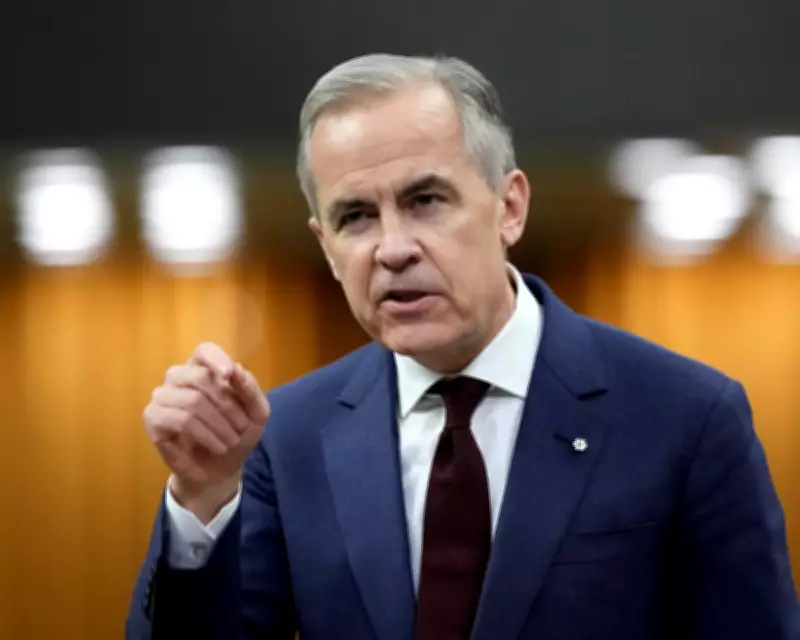
Carney Declares Canada's US Economic Ties a 'Weakness' Requiring Correction
In a stark warning, Canadian Prime Minister Mark Carney has asserted that the nation's historically strong economic ties to the United States have transformed from a strength into a significant weakness that must be urgently addressed. Delivering a 10-minute video address, Carney detailed his government's proactive efforts to diversify the Canadian economy by attracting new international investments and securing trade agreements with countries beyond the United States.
A Shift in Global Dynamics and US Trade Policy
Carney emphasized that the global landscape has become more perilous and divided, citing a fundamental change in the United States' approach to trade. He highlighted that US tariffs have escalated to levels not witnessed since the Great Depression, creating substantial challenges for Canadian industries. "Many of our former strengths, based on our close ties to America, have become weaknesses. Weaknesses that we must correct," Carney stated, underscoring the necessity for strategic adaptation.
The Prime Minister specifically pointed to tariffs imposed under former President Donald Trump, which have adversely impacted workers in Canada's auto and steel sectors. He noted that businesses are currently withholding investments, constrained by a pervasive atmosphere of uncertainty. Additionally, Carney referenced Trump's provocative remarks suggesting Canada become the 51st state, which have fueled discontent among many Canadians.

Strategic Diversification and Economic Resilience
Carney outlined a comprehensive plan to reduce Canada's economic dependency on the United States, promising regular updates to the public on these diversification initiatives. "Security can't be achieved by ignoring the obvious or downplaying the very real threats that we Canadians face," he affirmed. "I promise you I will never sugarcoat our challenges."
His strategy includes attracting new investments into Canada, doubling the nation's clean energy capacity, and reducing internal trade barriers. Carney also highlighted increased defense spending, tax reductions, and measures to enhance housing affordability as integral components of building a more resilient economy.
Key Government Initiatives Announced:- Attracting new international investments to stimulate economic growth.
- Doubling clean energy capacity to promote sustainability.
- Reducing trade barriers within Canada to boost internal commerce.
- Increasing defense spending and lowering taxes to strengthen fiscal health.
- Implementing policies to make housing more affordable for Canadians.
Historical Context and Political Backdrop
This is not the first instance Carney, a former central bank governor for both the Bank of Canada and the Bank of England, has addressed shifts in global power dynamics. In January, at the World Economic Forum in Davos, Switzerland, he garnered widespread acclaim for condemning economic coercion by larger nations against smaller countries, a stance that drew a sharp rebuke from Trump.
Carney's recent comments follow his securing of a majority government after special election victories, amidst pressure from the opposition Conservatives to deliver on a US trade deal promised during last year's election campaign. A review of the North American Free Trade Agreement (NAFTA) between Canada, the US, and Mexico is scheduled for July, adding urgency to the discussions.
A Call for Sovereignty and Self-Reliance
Carney stressed that Canada must assert greater control over its own destiny, rather than relying on the hope that the United States will revert to previous norms. "We have to take care of ourselves because we can't rely on one foreign partner," he asserted. "We can't control the disruption coming from our neighbors. We can't control our future on the hope it will suddenly stop."

He reiterated that simply hoping for a return to normalcy in US relations is not a viable strategy, famously remarking, "Hope isn't a plan and nostalgia is not a strategy." Carney acknowledged Canada's longstanding alliance with the US, referencing support in conflicts such as Afghanistan and both World Wars, but concluded, "The US has changed and we must respond. It's about taking back control of our security, our borders, and our future."
As of Sunday, there was no immediate reaction from the White House regarding Carney's address, leaving the international community to watch how this pivotal shift in Canadian economic policy will unfold.