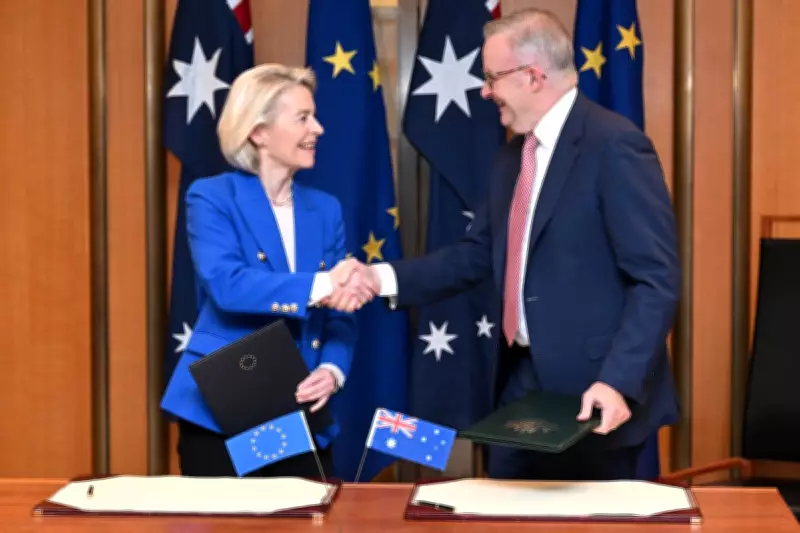
The European Union and Australia have officially signed a landmark free trade agreement, concluding eight years of protracted negotiations that had previously stalled over contentious agricultural market access demands. The deal, valued at approximately A$10 billion ($7 billion), was inked by European Commission President Ursula von der Leyen and Australian Prime Minister Anthony Albanese at the Australian parliament house, marking a significant milestone in bilateral relations.
Key Provisions of the Trade Agreement
Under the terms of the agreement, Australian producers will gain increased access to the European market for red meat, with the EU opening two tariff rate quotas totalling 30,600 metric tonnes, of which 55 per cent will be duty-free. Conversely, Australian tariffs on European goods such as wine, sparkling wine, fruit, vegetables, and chocolate will be eliminated immediately, while cheese tariffs will be phased out over three years.
Agricultural and Geographical Indications
However, the deal has faced criticism from Australian farmers, who argue it delivers "subpar" market access, particularly for beef and sheep meat, which remain subject to export quotas. Additionally, Australian producers of prosecco, a sparkling wine traditionally associated with northern Italy, will be prohibited from using the name on exports a decade after the pact takes effect.

Some European geographical indications, including Pecorino Romano and Ouzo, will receive full protection after a short phasing-out period, while others like feta may continue to be used with clear origin labelling.
Strategic and Economic Implications
The agreement is expected to remove over 99 per cent of tariffs on EU exports to Australia, saving companies an estimated $1.2 billion annually in duties and potentially boosting EU exports to Australia by up to 33 per cent over the next decade. It also aims to secure the EU's supply of critical raw materials, reducing economic reliance on China and exposure to uncertain US tariffs.
Defence and Innovation Partnerships
Beyond trade, the leaders announced a new defence partnership to enhance military cooperation and initiated negotiations for Australia to become an associate of the Horizon Europe research and innovation funding program. This move aligns with Europe's growing engagement in the Indo-Pacific region, following recent trade accords with Indonesia and India.
Prime Minister Albanese hailed the deal as a "defining moment" in Australia-EU relations, emphasising shared global perspectives despite geographical distance. President von der Leyen underscored the strategic importance of diversifying trade networks, stating that reducing dependency on single suppliers like China is crucial for both parties.
Additional Measures and Criticisms
The agreement includes provisions to lift the luxury car tax threshold for EU electric vehicles to A$120,000 ($83,600), exempting about 75 per cent of EVs from the region from the tax. Despite these benefits, Australian agricultural representatives, such as National Farmers Federation President Hamish McIntyre, have expressed disappointment, claiming the negotiations concluded without commercially meaningful gains compared to previous walk-away points.
This comprehensive pact not only facilitates trade but also strengthens diplomatic ties, positioning both the EU and Australia for enhanced economic resilience and cooperation in an increasingly uncertain global landscape.