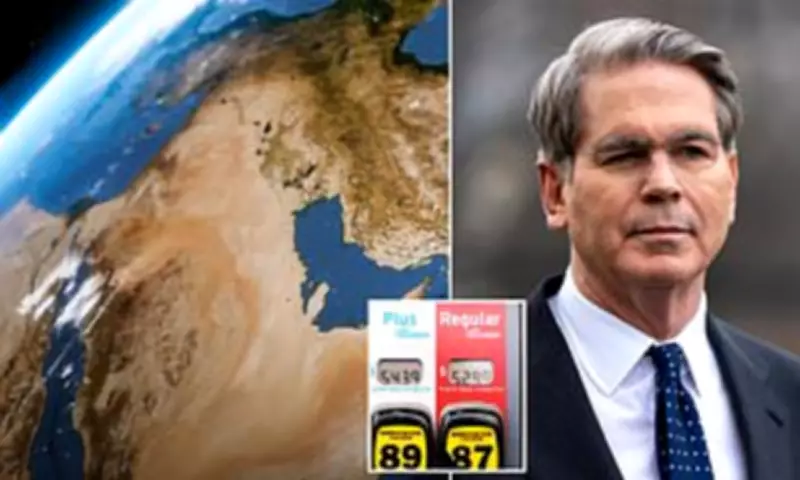
US Temporarily Lifts Sanctions on Iranian Oil to Ease Global Supply Crunch
The Trump administration has announced a one-month license to lift sanctions on Iranian oil currently stranded at sea, a move designed to alleviate soaring global oil prices as the war with Iran enters its fourth week. This temporary waiver, effective from Friday and set to expire on April 19, applies exclusively to oil already loaded onto ships, with an estimated 140 million barrels expected to reach global markets quickly.
Strategic Move to Boost Supply and Counter China
Treasury Secretary Scott Bessent highlighted that this initiative prevents China from being the sole beneficiary of discounted Iranian oil, accusing Beijing of hoarding supplies. "By temporarily unlocking this existing supply for the world, the United States will quickly bring approximately 140 million barrels of oil to global markets," Bessent stated on social media. He emphasized that the authorization is limited to oil in transit, estimated at around 440 million barrels, while bans on new purchases or production remain firmly in place.
This marks the third such waiver in about two weeks, following similar temporary easements on certain Russian oil shipments. Bessent defended the policy, noting that President Trump's pro-energy agenda has driven U.S. oil and gas production to record levels, which he claims strengthens energy security and lowers fuel costs in the long term.

War Context and Nuclear Ambitions
Meanwhile, President Trump is also pursuing efforts to seize Iranian nuclear materials as part of the broader war strategy. Reports indicate that Joint Special Operations Command forces may be deployed to extract these resources, with the Pentagon preparing for such operations. Trump has suggested he is considering winding down strikes on Iran, aiming to end the Middle East conflict as U.S. military actions degrade Tehran's capabilities.
U.S. Central Command has released videos showcasing assaults on Iranian soil, with Admiral Brad Cooper stating, "Iran's capabilities are declining." However, the war has intensified, with Iran using unmanned boats and drones to attack ships, and the U.S. deploying heavy bombs on underground missile sites near the Strait of Hormuz.
Impact on Global Oil Markets and Shipping
The Strait of Hormuz, a critical waterway through which one-fifth of the world's oil passes, has been under intense pressure due to Iran's control, disrupting global fuel supplies. This has led to a sharp rise in U.S. gas prices, with the average gallon of regular gas reaching $3.91, a 25% increase from a year ago and a 33% spike from just before the war began.
Despite the conflict, Iran has managed to export over 16 million barrels of oil since March, primarily to China, with about 90 ships, including oil tankers, crossing the strait. Data shows that more than one-fifth of these vessels are Iran-affiliated, while others hail from China, Greece, Pakistan, and India. For instance, the Pakistan-flagged tanker Karachi and Indian LPG carriers Shivalik and Nanda Devi have navigated the strait recently, highlighting the ongoing, albeit reduced, flow of oil.
International Response and Coalition Challenges
Oil prices have surged over 40% to above $100 per barrel since the war started, with Iran threatening to block oil shipments to the U.S., Israel, and their allies. The U.S. has called for a coalition to secure the Strait of Hormuz, but many allies, including Italy, Germany, and France, have expressed reluctance to join military efforts until a ceasefire is in place. Instead, six major powers—Britain, France, Germany, Italy, Japan, and the Netherlands—have voiced readiness to contribute to safe passage initiatives post-ceasefire.
Some nations, such as Saudi Arabia, Argentina, and Denmark, have committed to helping keep the strait open. The UK has allowed the U.S. to use bombers based at RAF Fairford and Diego Garcia for strikes aimed at reopening the waterway, citing collective self-defense agreements.

Humanitarian and Economic Toll
The war has taken a severe human toll, with over 3,000 Iranians reported killed in the first three weeks, including at least 210 children, according to human rights group HRANA. Lebanese authorities state that around 1,021 people have died in Israeli strikes since March 2, with over 100 children among the casualties. Additionally, approximately 100 individuals from other nations in the region have perished, and 13 American soldiers have lost their lives as of Saturday.
Economically, the strait's closure is crippling countries like Kuwait, Iraq, Bahrain, Qatar, and the UAE, while depriving the global market of vital oil and gas. Overland transport alternatives are deemed impractical due to lack of infrastructure and vulnerability to Iranian attacks. In a recent escalation, Iran struck a pipeline terminus in Saudi Arabia, prompting Riyadh to threaten entry into the conflict.
European leaders have called for the strait's reopening and a moratorium on strikes targeting water and energy infrastructure, urging de-escalation to address rising energy prices. As the situation evolves, the temporary sanctions relief offers a brief respite, but long-term stability hinges on resolving the broader conflict and securing key shipping routes.