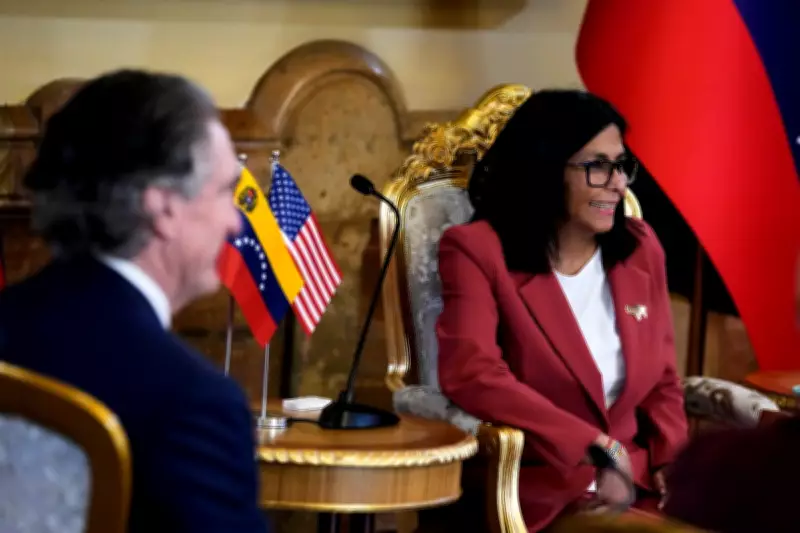
Venezuela's acting President Delcy Rodríguez has made a direct appeal to international investors, promoting her country's recently reformed oil sector at a high-profile summit in Miami. The event, backed by Saudi interests, served as a platform for Rodríguez to outline lucrative opportunities in Venezuela, emphasizing a transformed industry open to private capital and international arbitration.
Reforms and Reassurances
Addressing the summit remotely from Venezuela, Rodríguez focused on reassuring potential investors about the safety and stability of investments in the nation. She highlighted that Venezuela has implemented significant reforms in less than three months since the capture of her predecessor, Nicolás Maduro, by U.S. military forces. Maduro and his wife were taken to New York to face drug trafficking charges, with both pleading not guilty and a court appearance scheduled.
Rodríguez projected that Venezuela will experience double-digit economic growth this year and over the next two years. She stated, "We are in a process of stabilization, implementing the reforms needed for a productive environment and to attract investments that will diversify the engines of the Venezuelan economy." Her presentation, delivered entirely in Spanish, underscored efforts to create conditions where investors feel secure regardless of political changes.

Historical Context and Current Production
Venezuela possesses the world's largest oil reserves, which once fueled Latin America's strongest economy. However, decades of corruption, mismanagement, and U.S. economic sanctions led to a dramatic decline in production. Output fell from 3.5 million barrels per day in 1999, when Hugo Chávez took power, to less than 400,000 barrels per day in 2020.
In 2019, the U.S. Treasury Department under the Trump administration sanctioned state-owned Petróleos de Venezuela S.A. (PDVSA), effectively locking Venezuela out of global oil markets. This forced the government to sell oil at steep discounts, often to buyers like China, and accept payments in alternative forms such as Russian rubles or cryptocurrency. Currently, Venezuela produces about one million barrels per day.
Investment Incentives and Regulatory Changes
Rodríguez touted Venezuela's low production costs and willingness to negotiate favorable terms for investors. She explained, "When we consider a barrel of oil, its production cost, 64% of that barrel has room for negotiation with the investor regarding royalty reductions, income tax reductions, and most importantly, the dividends the investor receives." She emphasized that larger investments would yield higher returns on this negotiable portion.
Following Maduro's capture, Rodríguez swiftly overhauled oil industry regulations under pressure from the Trump administration. A new law now grants private companies control over oil production and sales, ending PDVSA's monopoly. It also allows for independent arbitration of disputes, moving away from a system where disagreements were settled only in Venezuelan courts controlled by the ruling party.
Eased Sanctions and Future Prospects
In response to these reforms, the U.S. Treasury Department has eased sanctions. Recently, it issued a broad authorization permitting PDVSA to directly sell Venezuelan oil to U.S. companies and on global markets. This marks a significant shift after years of restricted dealings with Venezuela's government and oil sector.
Rodríguez's pitch at the Miami summit reflects a broader strategy to attract foreign investment and revitalize Venezuela's economy through its oil resources. By highlighting regulatory changes, eased sanctions, and projected growth, she aims to position Venezuela as a safe and profitable destination for international capital.