

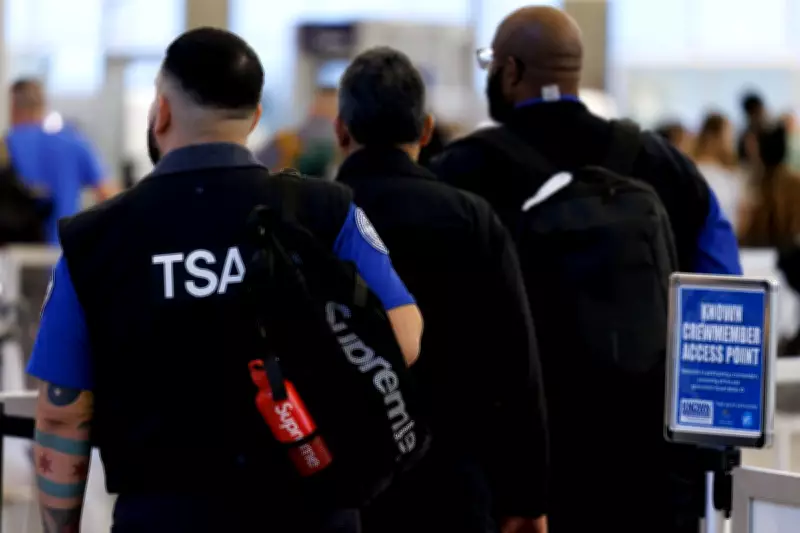
Government Shutdown Triggers Major Airport Security Delays Across US
The ongoing partial government shutdown has created significant disruptions at security checkpoints in numerous American airports, resulting in hours-long queues for travelers. This situation has highlighted a critical vulnerability in the nation's air travel infrastructure during political funding impasses.
Private Screening Model Provides Stability Amid Chaos
While most airports face mounting delays, approximately two dozen facilities operating under a lesser-known federal program have experienced far fewer disruptions. San Francisco International Airport (SFO) serves as a prominent example, utilizing private security contractors who continue operations despite the government closure.
"The money's already been allocated, the payments have already been made, and that continues without interruption," explained Doug Yakel, an SFO spokesperson, in comments to The Associated Press. "That is a very nice place to be."

This arrangement functions through TSA's Screening Partnership Program, which allows airports to employ private security companies selected by federal authorities while maintaining TSA oversight of procedures and standards. Contractors' salaries derive from pre-allocated federal contracts that typically remain active during government shutdowns.
Contrasting Approaches Highlight Industry Debate
The current situation has reignited longstanding discussions within aviation circles regarding the potential benefits and drawbacks of privatized security screening. Approximately 400 commercial airports across the United States rely primarily on federal screening officers employed directly by TSA. During shutdowns, these essential workers must continue reporting for duty despite not receiving paychecks, historically leading to increased absenteeism and slower checkpoint operations as financial pressures mount.
Aviation security expert Sheldon Jacobson, whose research contributed to TSA PreCheck's design, views SFO's successful implementation as evidence that privatization merits broader consideration. "It's operated just as well as any other airport," Jacobson noted, emphasizing that SFO's status as a major international hub demonstrates that large-scale operations can function effectively under this model.
"If SFO is the litmus test for delivering this privatized product, then many other airports can do it, too," Jacobson added, calling for expanded dialogue about how such approaches might enhance service delivery and benefit travelers.
Union Opposition and Alternative Solutions
The American Federation of Government Employees, representing TSA officers, maintains strong opposition to privatization efforts. Johnny Jones, secretary-treasurer of the TSA union's bargaining unit, stated unequivocally: "We will never advocate for any privatization of any federal employees. We don't believe that'll work."
The union argues that privatization could undermine accountability in aviation security—a primary reason Congress federalized airport screening following the September 11 attacks. Additional concerns include potential cost-cutting measures affecting training, staffing levels, and employee benefits, alongside possible inconsistencies between airports if different companies operate checkpoints nationwide.
Industry groups including the U.S. Travel Association, Airlines for America, and the American Association of Airport Executives advocate for legislative solutions rather than privatization. They urge Congress to pass measures ensuring aviation workers receive pay regardless of government funding status.
"Every time Washington fails to fund the government, these essential workers pay the price. So do travelers. So does the economy," declared Geoff Freeman, U.S. Travel Association's president. "That is why America's travel industry has come together, because this workforce is too important, and the stakes are too high, for this to keep happening."

Political Dimensions and Future Considerations
Republican lawmakers have periodically proposed dismantling TSA entirely, replacing its screening functions with private contractors under federal oversight. Last year, two GOP senators introduced the "Abolish TSA Act," which would gradually phase out the agency while transferring aviation security responsibilities to a new federal office.
TSA leadership has demonstrated willingness to engage in discussions about potential privatization models. Ha Nguyen McNeill, a senior official performing TSA administrator duties, testified before a House Appropriations subcommittee last year that "nothing is off the table" regarding privatization possibilities.
"If a new privatization scheme makes sense, then we're happy to have that discussion to see what we can come up with," McNeill stated. "It's not an all-or-nothing game."
At SFO, officials adopted their screening model over two decades ago for reasons unrelated to government shutdowns. However, with shutdowns becoming increasingly frequent and prolonged in recent years, the airport has discovered an unexpected advantage: significantly reduced staffing disruptions at security checkpoints during political funding crises.
Airline industry analyst Henry Harteveldt, president of Atmosphere Research Group, emphasized the importance of maintaining rigorous standards regardless of operational model. "The benefits, I think, are compelling," Harteveldt remarked. "The real issue is making sure that any vendor, any partner to the TSA, upholds the strict standards that TSA has established and works with TSA to ensure that screening remains efficient and finds ways to make it even better."
The current shutdown specifically affects the Department of Homeland Security, which includes TSA. This marks the third shutdown in less than a year temporarily leaving TSA workers without pay, creating particular strain during what airlines and airports anticipate will be one of the busiest spring break travel seasons on record.





