

Alaska Airlines and FedEx Jets in Near Miss at Newark Airport
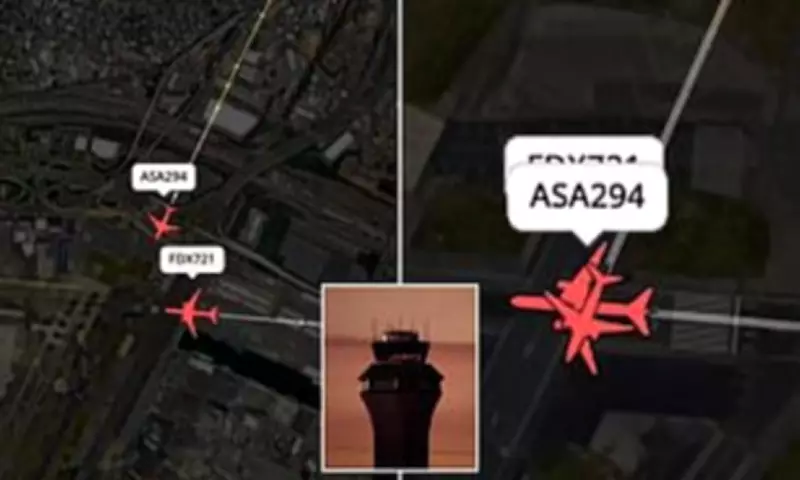
On Tuesday evening, a potentially catastrophic incident unfolded at Newark Liberty International Airport when an Alaska Airlines passenger jet and a FedEx cargo plane narrowly avoided a collision during their final descent. The close call has sparked an urgent investigation by aviation authorities and raised concerns about air traffic control operations during a partial government shutdown.
Details of the Near Collision
Flight radar data reveals that the Alaska Airlines flight, originating from Portland, Oregon, was approximately 150 feet in the air and preparing to land on a runway at around 8:17 PM. Simultaneously, a FedEx Boeing 777 cargo plane from Memphis, Tennessee was making its final approach to an adjacent runway. At the last moment, an air traffic controller instructed the Alaska Airlines pilot to execute a go-around, maintaining an altitude of 2,000 feet. Preliminary information from Flightradar24 indicates that the Alaska flight cleared the FedEx aircraft by a mere 300 to 325 feet, a dangerously close margin in aviation terms.
Following the safe touchdown of the FedEx plane, the pilot was heard over air traffic control radio commending the controller with the words, 'Nice job.' This acknowledgment underscores the critical split-second decision that averted disaster. In response to the incident, Alaska Airlines confirmed that their flight had initially been cleared to land before the go-around order was issued, emphasizing that their pilots are highly trained for such scenarios. The airline reported 171 passengers and six crew members on board, with no injuries sustained. FedEx also stated that its crew adhered to air traffic control instructions and landed without incident.

Investigation and Expert Analysis
The National Transportation Safety Board (NTSB) and the Federal Aviation Administration (FAA) have launched investigations into the causes of this near miss. Michael McCormick, former vice president of the FAA, provided insight into the challenges faced by air traffic controllers. He noted, 'It is a challenge for a tower controller to try to get that timing perfect. It doesn't always happen and that's what happened in this case.' McCormick suggested that the controller may have waited too long before issuing the go-around command, highlighting the precision required in managing simultaneous landings at busy airports like Newark.
Context of Government Shutdown
This incident occurs against a backdrop of a partial government shutdown, which has left air traffic controllers working without pay. The shutdown stems from a political impasse between Democrats and Republicans over funding for the Department of Homeland Security, following two fatal shootings during immigration raids in Minnesota. Airlines for America, an industry trade group, has called on Congress to resolve the shutdown, warning of potential travel disruptions. The group estimates that 171 million people will fly between March 1 and April 30, a four percent increase from last year, and expressed frustration in a recent letter, stating, 'Americans are tired of long lines at airports, travel delays and flight cancellations caused by shutdown after shutdown.'
In response to safety concerns, the FAA has implemented temporary measures, including barring helicopter traffic near major airports operating on visual separation and mandating that air traffic controllers use radar to maintain aircraft spacing. These steps aim to mitigate risks during the ongoing shutdown, which has previously led to disruptions, such as during a 43-day shutdown last fall that resulted in flight cuts and delays at major airports.
As investigations proceed, this near miss serves as a stark reminder of the vulnerabilities in aviation safety under political and operational pressures, urging swift action to ensure passenger security in the skies.






