

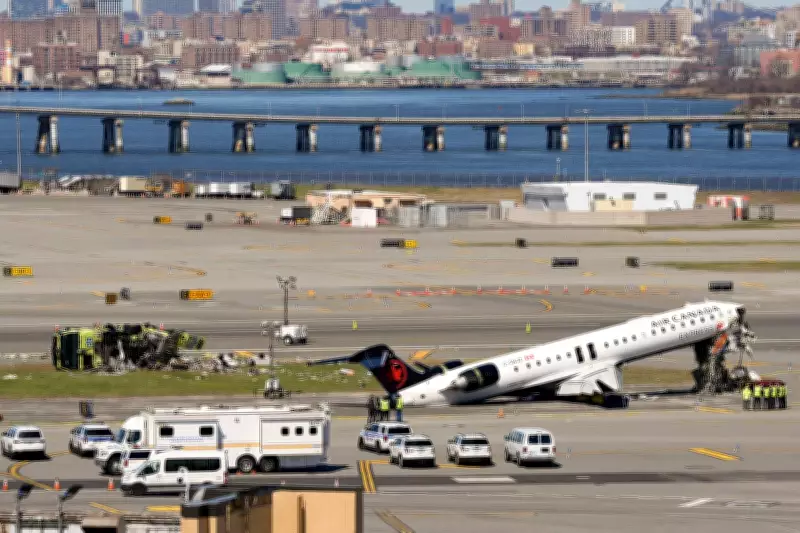
LaGuardia Airport's Safety System Failed to Prevent Deadly Runway Collision
The safety systems designed to prevent ground collisions at New York's LaGuardia Airport catastrophically failed last Sunday, allowing an Air Canada jet to smash into a fire truck on the runway during landing. The tragic incident resulted in the deaths of both pilots and injuries to dozens of passengers, raising serious questions about aviation safety protocols at one of America's busiest airports.
Multiple Safety Layers Breached in Fatal Incident
According to preliminary investigations, multiple layers of the aviation safety system failed simultaneously. One of the two air traffic controllers on duty cleared the fire truck to cross the runway just twelve seconds before the Air Canada flight carrying seventy-six people touched down. Despite frantic calls from the controller moments later shouting "Stop, stop, stop, Truck 1," the collision could not be prevented.
The National Transportation Safety Board has launched a comprehensive investigation to determine exactly what went wrong. Investigators are interviewing all personnel involved, examining the wreckage, and testing every component that might have played a role in the disaster. The mangled aircraft was moved to a secure hangar on Wednesday for detailed forensic examination.

Airport Surface Detection System Failed to Sound Alarm
LaGuardia Airport is one of thirty-five major airports nationwide equipped with the Airport Surface Detection System, known as ASDE-X. This sophisticated system combines radar data with information from transponders inside planes and ground vehicles to create a real-time display for air traffic controllers, showing the precise location of every aircraft and vehicle on the ground. Crucially, the system is designed to sound an alarm when it anticipates a potential collision.
NTSB Chairwoman Jennifer Homendy confirmed that the ASDE system failed to sound any alarm before Sunday's crash because it had difficulty predicting the collision. "The system is better at predicting potential collisions when vehicles or planes are moving," explained Rick Castaldo, a former FAA official who helped design and install ASDE systems. "Its computer cannot predict what a stopped vehicle is going to do."
Emergency Vehicle Lacked Critical Transponder Technology
One significant concern raised by investigators is that the fire truck involved in the collision, along with other emergency vehicles at LaGuardia, lacked transponders that would provide more precise location data to the ASDE system. While some airports have equipped their emergency vehicles with these transmitters, LaGuardia's fire trucks operated without this critical technology.
The Federal Aviation Administration has encouraged airports to install these transmitters and offered financial assistance, but the agency admits it lacks comprehensive data about how widely they have been adopted. Even without transponders, the ASDE system should still track vehicles using radar, but the precision is significantly reduced.
Runway Warning Lights May Have Been Ignored
Even though the controller cleared the fire truck to cross the runway, lights embedded in the taxiway pavement should have illuminated red to warn the driver that the Air Canada plane was approaching. Aviation safety expert Jeff Guzzetti emphasized that "the driver should have known not to cross, even if the controller told them to cross, because the runway status lights were red—flashing red."
Investigators will need to verify whether these lights were functioning properly at the time of the incident. The runway status lights rely on data from the ASDE system to indicate when planes are landing or taking off and are currently installed at twenty airports across the United States.
Distractions Complicated an Already Dangerous Situation
Compounding the tragedy, both the fire truck driver and the air traffic controller were likely distracted by an emergency call from another aircraft. A United Airlines plane had reported a strange odor that was making flight attendants feel ill, prompting multiple emergency vehicles to respond. The radios in the fire truck would have been blaring with communications from the New York Fire Department as first responders tried to reach the United plane quickly.

Mike O'Donnell, a former FAA official who oversaw airport safety programs, noted that "none of these systems are designed to be absolute. Each one of these systems, along with other safety precautions, are designed to reduce the risk of a crash—but no single thing will prevent every disaster."
Historical Context of Runway Safety Systems
The ASDE system has a proven track record of preventing numerous potential disasters. Just last fall, the NTSB credited the warning system with preventing a private jet from colliding with a Southwest Airlines plane on a runway in San Diego. The alarm alerted controllers in time to prevent the aircraft from hitting each other, even though they came within one hundred feet.
The system also prevented a JetBlue plane from hitting another aircraft crossing a runway in Boston in 2023 and has been praised in numerous NTSB reports since its creation in the late 1990s. Its predecessor system dates back to the 1980s, reflecting decades of aviation safety evolution.
Broader Implications for Aviation Safety
Only the busiest U.S. airports have received the costly ASDE system, but the FAA is currently installing a lower-cost version at two hundred additional airports over the next few years. This system is already operational at fifty-four airports and represents one of several measures the FAA has implemented as part of its goal to eliminate runway incursions and collisions entirely.
O'Donnell emphasized that aviation safety relies on a broader framework: "It's just one of several layers that are designed to reduce the risk of incursions. There's procedures. There's communication. There's decision-making. All those other layers are there as well." The LaGuardia tragedy serves as a sobering reminder that even the most advanced technological systems cannot replace human judgment and comprehensive safety protocols.





