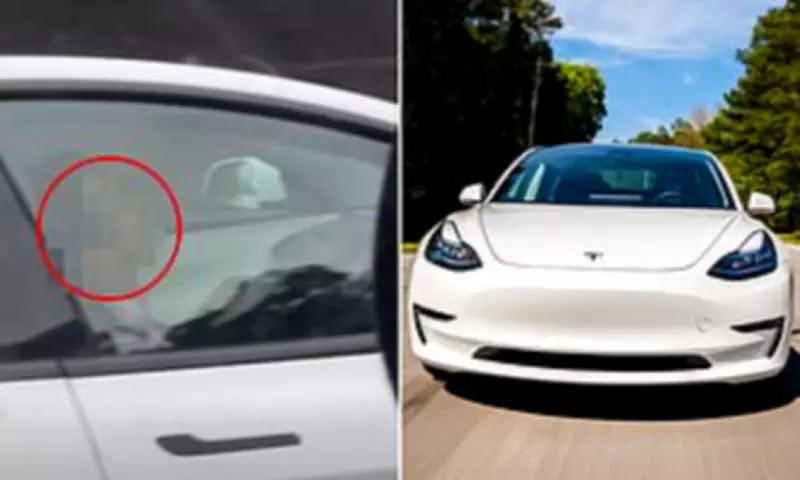
A motorist has shouted at a fellow driver to 'wake up' after capturing him fast asleep behind the wheel of a self-driving car on a busy highway. Video footage shows a car pulling alongside a white Tesla traveling at speed on Sydney's M2 motorway, where the driver had his head tilted back on the headrest, seemingly unconscious.
Incident on the M2 Motorway
The driver recording the incident honked his horn and yelled, 'Hey. F***ing wake up.' The Tesla driver quickly awoke and waved apologetically to the other motorist. The incident raises concerns about the misuse of Tesla's Full Self-Driving (Supervised) software, which became available in Australia last September for authorized Model 3 and Model Y vehicles equipped with the Hardware 4 (HW4) camera suite.
What is Tesla's Full Self-Driving?
The driver-assistance system can navigate, brake, indicate, and change lanes autonomously, but it requires constant driver supervision. It is classified as a Level 2 system, meaning it is not fully autonomous. Swinburne University Professor of Transport Technology Hussein Dia said last year that the new Tesla technology is exciting but has limitations. 'I think the name "Full Self-Driving" is quite misleading. This is what we call an advanced driver assist or partial automation,' he told the ABC. 'It has some very advanced features… but we think of it more as maybe an advanced learner driver rather than a professional chauffeur.'

Legal Implications in Australia
In Australia, road laws apply to vehicles with driver assistance systems 'with a human driver remaining in control,' according to the National Transport Commission. Under Level 2 automation, the driver must oversee the system, observe the road, and be ready to take over instantly. While the car can handle much of the driving, legally the person in the driver's seat is still the driver. Tesla's website warns that drivers must remain fully attentive while using Autopilot mode, and the system can lock out drivers who are not paying sufficient attention.
Past Incidents and Criticism
In the United States, Tesla has faced legal action after its driver assistance technology was involved in several fatal crashes. In 2016, a Tesla Model S crashed into a truck in Florida while Autopilot was engaged, killing the driver. Two years later, a Tesla Model X slammed into a highway barrier and burst into flames in California. Overseas safety experts have expressed concern that self-driving Teslas can make drivers feel so comfortable that they relax too much behind the wheel. European safety bodies like Euro NCAP have criticized Tesla for using terms like 'Autopilot' and 'Full Self-Driving,' claiming they are misleading.
Public Reaction
Aussies online have generally given positive reviews to self-driving Teslas. One EV owner wrote on Reddit, 'I've had it for three months, my best way to describe it is that it's incredible just how well it works, especially how it deals with weird edge cases such as construction, people doing dumb things, and around pedestrians. It also makes a road trip a breeze. Would I be comfortable sitting in the back seat while it drove for me? It's absolutely not there yet. That's the easiest way I can describe it.' The Daily Mail has contacted Tesla for comment.