Hurvin Anderson's Tate Retrospective: A Masterful Survey of Black Vision and British Suburbia
Hurvin Anderson, born in Birmingham in 1965 as the first British-born child of Jamaican parents, has solidified his reputation as one of Britain's most skilful and genuinely experimental painters. His major retrospective at Tate Britain, following his Turner Prize nomination in 2017, fills the galleries with absorbing depictions of barbershops, Black heroes, and English suburbia. Anderson's mission, as defined in the exhibition's opening text, is "to see the Black vision" and "broaden out" the view of life in Britain, a place where he notes "your vision shrinks somehow."
Despite this subversive intent, Anderson embraces artistic virtues often considered typically British, such as emotional reticence and a doggedly patient focus on his subjects. He has created some of the most resonant images of English suburban life, blending free-form expression with precise execution.
Exploring Suburban Landscapes and Artistic Methods
In the painting "Sliding" (2015), which dominates the first room, a large-scale blizzard of dark green smears overlain with dripping yellow might initially suggest a slightly ominous Caribbean forest-scape. However, a closer look reveals the neatly maintained paths and fences of an English suburban park. This work typifies Anderson's style, appearing both spontaneous and meticulously planned, with even the loosest dabs of paint seeming painstakingly thought out.

Anderson's decision to leave in grid lines from the original photograph used to transpose the image onto canvas serves as both a stylistic flourish and an honest revelation of his methods. This approach evokes the dour English realism of the interwar Euston Road School, known for its quasi-mathematical 'measured drawing,' creating an unlikely association that enriches his work.
Atmosphere, Memory, and Human Presence
Anderson generally works from photographs rather than directly from reality, which may explain his ability to imbue images with the quality of memory. "The Banqueting Palace," completed this year, aims to "recapture the walk home from school" and masterfully captures the mood of a rainy English dusk. Blurry figures reflect in shining pavements, with a dark venue looming in the background, showcasing his seductive use of wash layers and drips with free overpainting.
In "Audition" (1999), a view of a vast municipal swimming pool with sketchily drawn swimmers evokes a slightly repressed, old-school English experience, almost allowing viewers to hear echoing voices and taste chlorine. People are often few and far between in his paintings, seen from a distance, behind objects, or deliberately blurred, adding to the sense of detachment.
Barbershops and Abstract Tensions
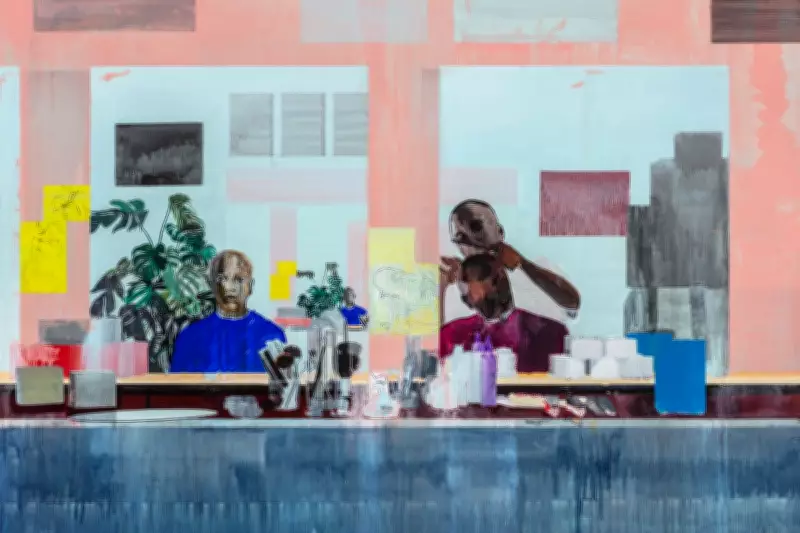
Even in depictions of barbershops, classic venues for Black male bonding, customers tend to be glimpsed in mirrors or not at all. In "Is It OK To Be Black?" (2005-6), Anderson focuses on images of Black heroes like Martin Luther King and Malcolm X pinned to the wall. By "Jersey" (2008), these images are reduced to blocks of single colours with a Mondrian-like balance, while clumps of hair litter the floor around empty chairs.
"Essentials" (2017) features only abstract patterns from posters, highlighting a constant tension between figurative images and their abstract potential. This unsettling sense that human presence is mostly hidden is particularly apparent in paintings of Jamaica, where lush foliage is overlaid with security grill patterns from affluent homes.
Colonial Memories and In-Between Spaces
Touches of vibrant colour, such as the splash of red in "Ashanti Blood" (2021), evoke disquieting colonial memories, alluding to the massacre of African slaves during an uprising in 1761. Anderson notes in wall text that he is "intrigued by the idea of a no man's land, a kind of in-between space and what that might look like, what it might mean." This exhibition suggests that everywhere is a kind of no-man's land for Anderson, with detachment and alienation giving his painting its unique quality.

Critique and Legacy
The exhibition's "meandering" chronology, as termed by curators, makes it difficult to follow the development of Anderson's art or see how he evolved his signature approach. Yet, this remains an absorbing survey of an undoubtedly significant figure. Anderson stands as a potential standard-bearer for the great British tradition of figurative painting, represented by 20th-century greats like Bacon, Freud, and Auerbach, not through conservatism but through a humbling commitment to developing his craft.
'Hurvin Anderson' is at Tate Britain from 26 March until 23 August, offering a profound exploration of identity, memory, and place in contemporary British art.