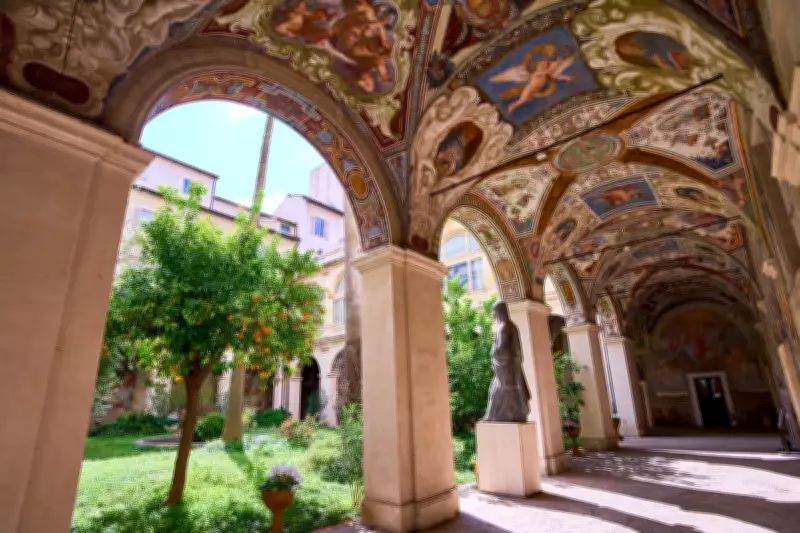
The Hidden Cloister of Rome: Where Serenity Meets a Tumultuous Past
Just a few steps from the bustling crowds at Rome's iconic Pantheon lies a secret sanctuary, largely unknown to the millions of tourists who pass by each year. Behind a large, unassuming wooden door, a hidden cloister offers a peaceful haven for silent meditation and reflection. This tranquil space, however, conceals a dramatic and turbulent history vividly etched onto its frescoed walls, which remain closed to the general public.
A Sanctuary of Calm with a Rich Historical Tapestry
At the heart of the cloister is a serene pond teeming with goldfish and turtles, encircled by olive trees, two towering palm trees, and an orange tree whose bright fruit the resident friars use to make marmalade. Well-fed cats bask in sunny spots on the lush grass, adding to the idyllic atmosphere. Today, twenty friars continue to live in the convent surrounding the cloister, carrying out their religious duties in this designed place of prayer and meditation.
"It is designed to be a place of prayer, of meditation and therefore in some way to encourage prayer and the meditation of the friars," explained Friar Aucone, highlighting the cloister's enduring spiritual purpose.

Centuries of History: From Pagan Temples to Papal Conclaves
The basilica adjoining the cloister, Santa Maria Sopra Minerva, hints at its layered past. Its name translates to "Saint Mary over Minerva," signifying a Catholic basilica dedicated to the Virgin Mary built atop a former pagan temple dedicated to Minerva, the Roman goddess of wisdom. Over the centuries, this space has attracted illustrious figures, including St. Catherine of Siena and the Renaissance painter Fra Angelico, both of whom are buried in the adjacent basilica.
"This cloister of Santa Maria Sopra Minerva is one of the largest and perhaps the most beautiful in all of Rome and it was a great cultural center in ancient times and it is even now," remarked Claudio Strinati, a noted art historian.
The site's history stretches back to ancient Rome, where people gathered to cast ballots during Julius Caesar's reign. In the late 1200s, Dominican Friars constructed a church on the location. The original cloister was later replaced around 1570 by one designed by architect Guidetto Giudetti, a student of the legendary Michelangelo.
Frescoes Revealing Faith, Conflict, and Famous Figures
The walls and vaulted ceilings of the cloister are adorned with intricate frescoes. Some depict the mysteries of the rosary, intended to foster the contemplative life of the Dominican friars. Others, nestled in niches and corners, unveil the fraught history of the location and its inhabitants.
In the 16th century, the convent served as the offices for the Roman Inquisition. Several chilling portraits in medallions high on the cloister walls show decapitated Dominican Friars who worked as inquisitors, depicted with stumps for necks and their heads held in their own hands.
"Among other things there was the tribunal of the Inquisition where famously Galileo Galilei was interrogated," explained Strinati. In a room adjacent to the cloister in 1633, Galileo was forced to renounce his "heretical" heliocentric theory that the Earth and planets revolve around the Sun, standing before the judges of the Inquisition.
Artistic Legacy and Papal Elections
The cloister also celebrates artistic heritage. A medallion portrays Fra Angelico, the Dominican Renaissance painter who resided at the convent while creating frescoes for the Niccoline Chapel in the Vatican. The image shows a wrinkled, elderly man hunched over a painting, though he was only in his fifties at the time.
Another medallion honors St. Catherine of Siena, who spent time at the convent and is entombed in the neighboring basilica. Friar Aucone noted wryly that while her body remains there, her skull was given to the Dominican Friars in Siena.
The building surrounding the cloister was the site of two significant papal conclaves, electing Pope Eugene IV in 1431 and Pope Nicholas V in 1447. Five popes are buried within the Basilica, underscoring its historical importance.

The Enduring Allure of Rome's Hidden Treasures
For Claudio Strinati, hidden gems like the Santa Maria Sopra Minerva cloister are central to Rome's enchanting character. "There is all the history hidden and therefore sometimes something is found and all generations, including mine, have discovered things," he reflected. "The generations that will come later will continue to discover why it is so great and so profound that much is secret and hidden. And that is an element of its charm."
This cloister stands as a profound testament to Rome's layered narrative—a peaceful oasis where the whispers of papal power, inquisitorial trials, and artistic genius linger silently on ancient walls, waiting to be discovered by those who seek beyond the well-trodden paths.