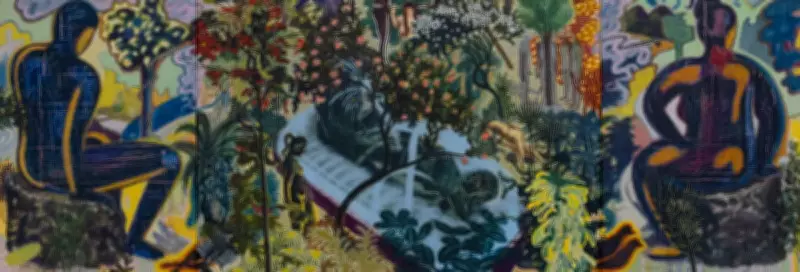
Indian painter T Venkanna's works hit you like a punch. His first institutional solo show features an overwhelming altarpiece shaped like a juvenile drawing of a penis, flanked by Adam and Eve. They gaze upon an orgasmic thicket of desire: a woman pleasured by a nose, a figure copulating with an animal's hindquarters, and a kaleidoscopic blur of fondling figures that make Hieronymus Bosch seem restrained.
Art as a Mirror to Religion
For Venkanna, carnal enjoyment is just a starting point. 'It is a way to consider many things, including the myth of religions,' he says. His landscapes are scattered with stony figures reminiscent of India's pantheon of gods. Women worship a lingam, the aniconic form of Shiva, while a man caresses a statue's breast and drinks from her vagina. 'That is what you see in ancient temples,' Venkanna explains. 'People touch the breasts of sculptures so they become smooth and shiny.'
Childhood Influences
Growing up in Gajwel, a small town in south-central India, Venkanna lived in a one-room home that doubled as his father's rectory. As a Hindu priest's son, he saw the gap between puritanical doctrine and reality. 'Village people came to ask about rituals and good days,' he recalls. He discovered hidden European porn books, which became early source material. His family was ambivalent but supported his talent.

Artistic Journey
Venkanna trained as a drawing teacher but discovered fine art college in Hyderabad. With teachers' support, he learned printmaking, miniature painting, and tempera, which he still uses. He earned a gold medal but struggled during his master's at Maharaja Sayajirao University of Baroda. 'I didn't know what to paint, only how to do it,' he says. He found inspiration in Frida Kahlo and Henri Rousseau, creating pastiches of Western art.
Controversy and Recognition
Charles Saatchi bought an early work, but Indian audiences were not keen. At his 2006 graduate show, he sold only an etching. Now, in his mid-40s, he notes that those who once rejected his work now seek it. However, he has faced blasphemy accusations and death threats. A print showing a woman hoisting herself onto two erect penises was hidden behind a black curtain at a Delhi institution. 'It's absurd,' he says. 'Read the newspaper; you'll see much more violence.'
Gender and Power
Venkanna foregrounds women's experiences and sexual appetite, sometimes as vengeful acts. In Golden Quartet (2025), two women ride skeletal men amid sprays of gold-leaf urine, drawing them toward death. These pre-cataclysmic scenes explore intimacy, isolation, consent, and obscenity. 'I don't want to shock,' Venkanna insists. 'What I'm showing are things around us.'